
You’re staring at 847 resumes for a single Software Engineer position. At 5 minutes per resume, that’s 70 hours of manual screening, nearly two full workweeks.
Your hiring manager needs candidates by next Friday. You need a shortlist by tomorrow morning. This is the reality for HR managers and recruiters in 2025.
The resume parsing software market grew from $20.19 billion in 2024 to $23.54 billion in 2025, reflecting how critical automated screening has become for modern recruitment. Manual resume review isn’t just slow, it’s mathematically impossible at scale.
This guide reveals the 6 best resume parsing software solutions actually worth using in 2025, tested specifically for high-volume hiring scenarios.
You’ll see real accuracy rates, processing speeds, pricing breakdowns, and exactly which tool works best for your hiring volume.
CVShelf is the best resume parsing software for high-volume hiring in 2025, delivering 98% accuracy while screening 1,000+ CVs in under 5 minutes with background processing.
Other strong options include RChilli (40+ language support), Affinda (100+ field extraction for enterprises), HireAbility (multi-platform sourcing), Textkernel (semantic search capabilities), and Zoho Recruit (budget-friendly ATS integration).
Choose based on your volume, language needs, and whether you need standalone parsing or full ATS functionality.
Quick Comparison: Best Resume Parsing Software at a Glance
| Software | Best For | Accuracy | Processing Speed | Starting Price | Free Plan |
|---|---|---|---|---|---|
|
CVShelf
#1 CHOICE
|
High-volume hiring | 98% | <5 min for 1,000+ CVs | Free | 20 credits/month |
|
RChilli
|
Multilingual parsing | 95% | Fast (bulk capable) | Contact sales | 5K docs ($150) |
|
Affinda
|
Enterprise teams | 100+ fields extracted | Fast | $80/month | Trial available |
|
HireAbility (ALEX)
|
Multi-platform sourcing | High | Very fast | Custom pricing | No |
|
Textkernel
|
Semantic search | Semantic parsing | Fast | Enterprise pricing | No |
|
Zoho Recruit
|
Budget-conscious SMBs | Good | Standard | $25/user/month | 15-day trial |
These six tools represent the best options for recruiters handling high application volumes in 2025. Each excels in different areas like accuracy, speed, language support, or cost-effectiveness.
CVShelf leads for overall value and performance, particularly when processing hundreds or thousands of resumes quickly. The others fill specific niches: global hiring, enterprise compliance, budget constraints, or semantic intelligence.
What Is Resume Parsing Software? (And Why You Can’t Scale Without It)
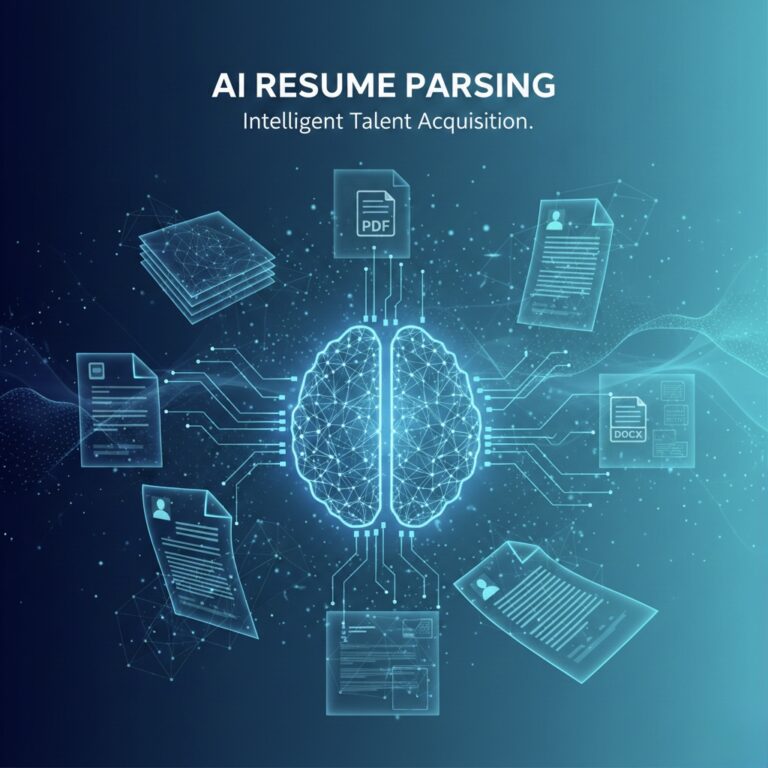
Resume parsing software uses AI and OCR (Optical Character Recognition) to automatically extract structured data from unstructured resumes.
It identifies and categorizes information like names, contact details, work experience, education, skills, certifications, and then organises this into searchable, filterable databases.
The math that makes parsing essential:
- Manual resume review: 3-5 minutes per resume
- 500 applicants × 4 minutes average = 33 hours of screening
- CVShelf processes 1000+ CVs in under 5 minutes
That’s the difference between spending a full workweek on data entry versus spending 5 minutes and moving straight to candidate evaluation.
What modern parsers extract:
- Contact information: Name, email, phone, physical address, LinkedIn profiles
- Work history: Company names, job titles, employment dates, responsibilities, achievements
- Education: Degrees, institutions, graduation dates, GPA, academic honours
- Skills: Technical competencies, soft skills, certifications, tools, software proficiency
- Languages: Spoken languages with proficiency levels
- Additional data: Publications, patents, volunteer work, professional affiliations, and awards
The technology behind it:
- Natural Language Processing (NLP): Understands context and meaning, not just keyword matches
- Machine Learning: Improves accuracy over time by learning from patterns
- OCR Technology: Extracts text from images, scanned PDFs, and even smartphone photos of resumes
- Deep Learning: Recognises complex resume structures and unconventional formats
AI screening tools show 89 to 94% accuracy in skill matching and resume parsing, dramatically outperforming manual screening for consistency. Humans get tired, distracted, or biased by the 200th resume. AI maintains the same accuracy for resume #1 and resume #1,000.
Why 2025 is different:
This isn’t emerging technology anymore; it’s standard infrastructure for competitive hiring. Modern parsers now handle complex creative layouts, multilingual documents, handwritten sections, and even video resume transcripts.
They’re no longer just extracting text; they’re understanding candidate quality and fit.
How Resume Parsing Softwares Work (The 5-Step Process)
Understanding how parsing works helps you evaluate tools and optimise your resume intake process.
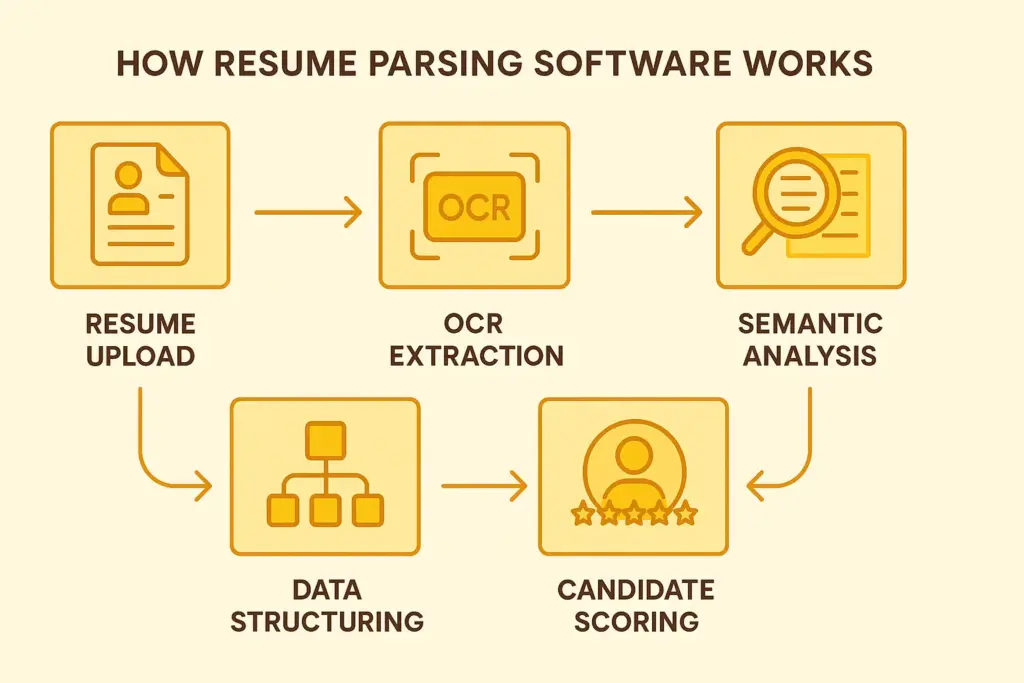
Step 1: Document Upload & Format Recognition
Candidates submit resumes in various formats like PDF, DOC, DOCX, TXT, RTF, HTML, JPEG, and PNG. The parser identifies the file type and prepares for extraction.
Format compatibility matters. Older parsers struggled with creative PDFs or scanned documents. Modern tools handle everything. CVShelf accepts all standard formats and processes them with 98% accuracy regardless of layout complexity.
Step 2: OCR Text Extraction
For image-based documents, scanned resumes, smartphone photos, or PDFs created from design software. OCR converts visual text into machine-readable characters.
Advanced OCR capabilities:
- Processes handwritten text (increasingly common with form fills)
- Handles resumes photographed with smartphones
- Recognises text in 50+ languages
- Manages poor-quality scans, unusual fonts, or low-resolution images
This step is critical because approximately 60-65% of large enterprises use cloud-based solutions, often receiving applications via mobile devices, where candidates photograph documents instead of uploading digital files.
Step 3: Semantic Analysis & Data Categorisation
This is where AI demonstrates its value. The parser doesn’t just look for keywords; it understands context and meaning.
Example of semantic understanding:
- Input: “Led a team of 12 engineers”
- Parser extracts: Leadership experience (categorised), Team size: 12 (quantified metric), Role level: Management (inferred)
- Input: “Bachelor’s degree in Computer Science, Stanford University, 2019”
- Parser extracts: Degree type: Bachelor’s, Field: Computer Science, Institution: Stanford University, Graduation: 2019, Institution tier: Top-ranked (inferred)
NLP algorithms identify resume sections even with non-standard headers. If someone writes “Where I’ve Worked” instead of “Work Experience,” semantic parsers still categorise correctly.
Step 4: Data Structuring & Database Population
Extracted information gets organised into structured fields within your ATS or recruitment database.
Each data point receives tags and metadata:
- Skills tagged by category (technical, soft, domain-specific, tools/software)
- Experience tagged by industry, seniority level, and management scope
- Education tagged by degree type, field of study, and institution prestige tier
This structure enables powerful filtering: “Show me candidates with Python skills, 5+ years experience, and CS degrees from top-50 universities.” Instant results instead of manual searches through hundreds of resumes.
Step 5: Quality Validation & Scoring
Top parsers include confidence scores for extracted data. When the AI isn’t certain about a data point (unusual formatting, ambiguous phrasing), it flags for human verification.
CVShelf takes this further with candidate ranking and scoring. Beyond just extracting data, it evaluates how well each candidate matches your job requirements, providing scored rankings with detailed explanations. You get a shortlist, not just a database.
Processing time comparison:
- Manual data entry: 5-10 minutes per resume
- CVShelf AI parsing: Seconds per resume, bulk processing under 5 minutes for 1,000+
6 Best Resume Parsing Software (Detailed Reviews)
1. CVShelf – Best Overall Resume Parsing Software
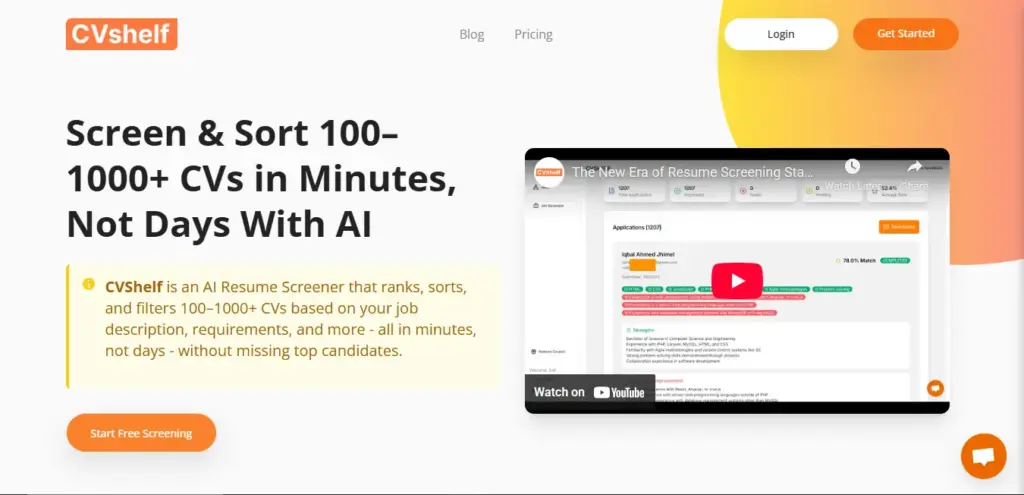
CVShelf dominates the resume parsing space in 2025 by solving the specific problems that crush recruiters in high-volume scenarios: speed, accuracy, and actionable candidate insights.
Why CVShelf ranks #1:
Most resume parsers stop at data extraction. CVShelf goes further; it parses, screens, scores, and ranks candidates automatically, delivering a shortlist instead of just structured data.
Key Features:
- 98% Parsing Accuracy: Industry-leading accuracy ensures minimal manual corrections. In testing with diverse resume formats, CVShelf consistently extracted data correctly even from creative layouts, scanned documents, and unconventional structures.
- Background Processing: This is CVShelf’s killer feature. Upload your resumes and keep working. Processing happens in the background without blocking your workflow. Check back in 5 minutes for complete results. No other major parser offers true background processing.
- Bulk Screening at Scale: Screen hundreds to thousands of CVs in minutes. CVShelf handles high-volume hiring scenarios that would overwhelm most tools. Process 5,000 applications for a job fair or seasonal hiring rush without slowing down.
- Intelligent Ranking with Scoring Explanations: Beyond parsing, CVShelf’s AI analyses each resume against your job requirements and provides scored rankings (0-100%) with detailed explanations. You understand why Candidate A scored 92%, and Candidate B scored 67%.
- Detailed Reports: Every candidate gets a comprehensive report highlighting strengths, skill matches, experience relevance, and areas of concern. These reports help you make faster, more confident hiring decisions and provide documentation for your choices.
- Proven Track Record: 578,000+ CVs processed with 98% accuracy across 300+ companies.
- Automated Email System: Select candidates in bulk and let CVShelf handle communications automatically. Schedule interview invitations, rejection notices, or follow-ups without manual email management.
- Job Description Generator: AI-powered JD creation from website URLs or basic requirements, ensuring your job postings attract the right candidates whose resumes will parse well.
Ideal For:
- Recruitment agencies processing 100-500 applications per role
- Corporate HR teams with seasonal hiring surges
- Startups scaling rapidly from 10 to 100+ employees
- Any recruiter managing multiple open positions simultaneously
- Companies doing university recruitment (hundreds of similar applications)
Pricing:
CVShelf’s pricing structure makes it accessible for any team size:
- Free Plan: $0/month – 20 credits (20 CV screenings), perfect for testing or low-volume needs, no credit card required
- Basic: $10/month – 1,000 credits (1,000 CV screenings)
- Standard: $25/month – 3,000 credits (Most Popular, best value)
- Professional: $99/month – 15,000 credits for enterprise-scale hiring
Lifetime plans are also available ($59-$249 one-time payment with recurring monthly credits).
1 credit = 1 CV screening. Job description generation and automated emails are currently free features.
Processing Speed:
Average processing time: Under 5 minutes for 1,000+ CVs, often faster depending on file formats and complexity. Because processing happens in the background, recruiters never wait; they submit resumes and move to other tasks, returning later to completed results.
Unique Advantages:
Background processing eliminates downtime. Other parsers make you wait while they process. CVShelf lets you work continuously.
Candidate-friendly scoring transparency means you’re not just seeing match percentages—you understand the reasoning. This helps justify hiring decisions to sceptical hiring managers and provides audit trails for compliance.
Built by recruiters, for recruiters. The interface reflects actual recruitment workflows, not generic software design. Common tasks take fewer clicks. Reports include information recruiters actually need.
87% time savings, what used to take days now takes minutes. Real customers report screening 500 resumes in the time it previously took to manually review 25.
Best Feature:
The combination of parsing + screening, + ranking in one platform. Most competitors make you export parsed data into another system for evaluation. CVShelf delivers shortlists immediately. You go from “500 applicants” to “Here are your top 20 candidates with detailed reports” in minutes.
Limitations:
CVShelf focuses specifically on resume parsing and screening rather than being a full-featured ATS with onboarding, offer management, and HRIS integration.
For teams needing comprehensive applicant tracking, CVShelf works excellently alongside existing ATS platforms via integrations. This focused approach means it excels at what it does rather than being mediocre at everything.
Bottom line: For high-volume resume screening, CVShelf delivers unmatched speed and actionable insights. The free plan lets you test with zero risk, and paid plans scale affordably from small teams to enterprise recruitment operations.
Check out Cvshelf’s Resume Screener – Free plan, no credit card required.
2. RChilli – Best for Multilingual Resume Parsing
RChilli provides Resume Parsing, Matching, and Data enrichment for global recruiting platforms, making it the go-to choice for companies hiring across multiple countries or processing resumes in various languages.
Key Features:
- 40+ Language Support: Parse resumes in virtually any major language with high accuracy. RChilli handles not just different languages but culturally different resume formats (European CVs vs. North American resumes vs. Asian formats).
- Deep Learning Technology: Continuously improves accuracy through machine learning, adapting to new resume trends and formats automatically.
- Rich Taxonomy Tagging: An extensive skills database categorises competencies precisely, recognising industry-specific terminology and emerging skills.
- Search and Match Engine: Built-in candidate-to-job matching beyond just parsing, helping identify best fits algorithmically.
- Resume Enrichment: Augments parsed data with additional information from public sources, providing more complete candidate profiles.
- Bulk Upload Capability: Process thousands of resumes simultaneously without performance degradation.
Ideal For:
- Global companies hiring across multiple countries
- Staffing agencies with international clients
- Companies in multilingual regions (Canada with English/French, Switzerland with multiple languages, India with diverse regional languages)
- Organisations needing cultural format recognition
Pricing:
- Standard Plans: Volume-based with monthly, quarterly, or yearly payment options
- Incubator Program: 5,000 documents for $150, excellent for testing capabilities before committing to larger contracts
- Enterprise Plans: Customised for high-volume needs with dedicated support
Pricing isn’t published, and requires contacting sales for quotes, which can slow evaluation.
Processing Accuracy:
RChilli has garnered several awards, including Best Product of the Year from Software Technology Parks of India, reflecting strong industry recognition for parsing accuracy and innovation.
Best Feature:
Multilingual capability combined with deep learning creates exceptional international recruitment support. The system doesn’t just translate, it understands context across languages, recognising that “project management” in English, “gestion de projet” in French, and “projektmanagement” in German represent the same competency.
Limitations:
Lack of pricing transparency frustrates buyers. Setup complexity is higher than plug-and-play solutions like CVShelf. Best suited for teams with IT support or those willing to invest time in configuration for long-term global hiring needs.
3. Affinda – Best for Enterprise-Grade Accuracy
Affinda’s Resume Parser is accurate, fast, and easy to set up, offering enterprise-level features including fraud detection, data anonymisation, and compliance tools.
Key Features:
- 100+ Custom Fields Extracted: Extract 100+ custom fields in seconds, so none of the finer details are missed. This depth of extraction surpasses most competitors, capturing nuanced information valuable for specialised roles.
- AI Recruitment Suite: Comprehensive tools including Resume Parser, Job Description Parser, Search and Match algorithms, Resume Redaction for compliance, and AI-generated Resume Summaries.
- Enterprise Accuracy: Affinda’s Resume Parser delivers unmatched precision in controlled testing, particularly for complex resumes with non-linear career paths or specialised industries.
- Flexible Integration: Connect your ATS and HR systems with Affinda API. JSON output format simplifies integration with custom recruitment platforms.
- 56+ Language Support: Global hiring capabilities with cultural format recognition.
- Redaction and Anonymisation: Remove personally identifiable information for blind hiring initiatives or GDPR compliance.
Ideal For:
- Large enterprises needing compliance features (GDPR, CCPA, blind hiring)
- ATS providers and job boards are looking to white-label parsing capabilities
- Companies requiring extreme detail (100+ field extraction for specialised roles)
- Organisations in regulated industries (finance, healthcare, government)
Pricing:
- Starting at $80/month for basic plans
- Free trial available for testing
- Enterprise pricing scales with volume and features
More transparent pricing than RChilli or HireAbility, making budget planning easier.
Best Feature:
Flexibility and customisation, the parser is highly adaptable, capable of recognising industry-specific jargon. For specialised fields like biotech, aerospace, or finance, Affinda’s customisation extracts terminology that other parsers miss.
Limitations:
Advanced features might necessitate a steep learning curve for novice users. Teams without technical expertise may struggle with full implementation. The breadth of features also means more complexity and overkill for straightforward hiring needs.
4. HireAbility (ALEX) – Best for Multi-Platform Sourcing
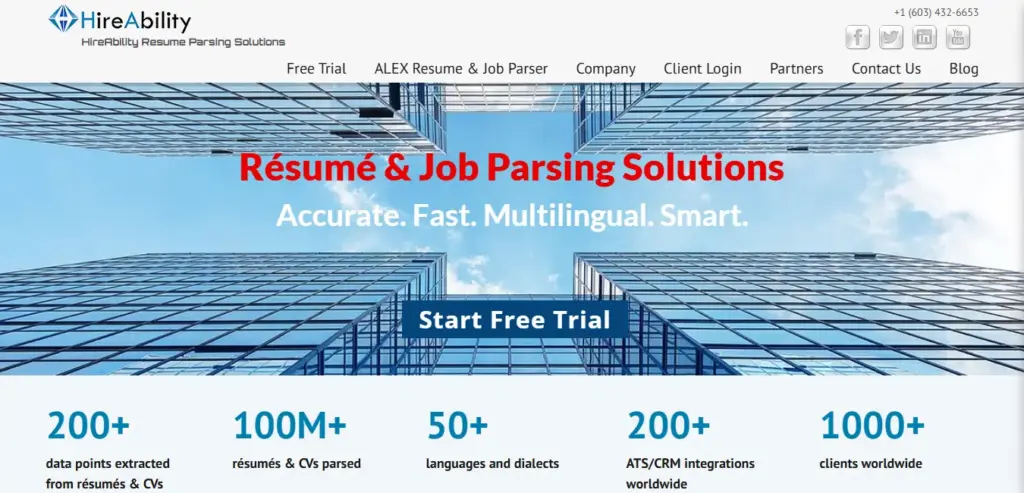
HireAbility’s parser, called ALEX, uses language processing, pattern recognition, and artificial intelligence technologies to analyse resumes, excelling at sourcing candidates from diverse platforms.
Key Features:
- Proprietary Grid Technology: Ensures fast transactions with accurate results, maintaining efficiency even with high volumes. This architecture prevents performance degradation during hiring surges.
- 50+ Language Support: Parse resumes from global talent pools with consistent accuracy across languages.
- Multi-Platform Integration: Seamless connections with job boards, social media platforms, and career sites. Pull candidates from LinkedIn, Indeed, Monster, and niche platforms into one unified system.
- Fast Processing Speed: Designed specifically for speed without sacrificing accuracy, ideal for time-sensitive hiring.
- Pay-Per-Use Pricing: Flexible cost structure, pay only for resumes parsed, no fixed monthly fees.
Ideal For:
- Staffing agencies sourcing from multiple platforms simultaneously
- Companies with highly variable hiring needs (seasonal spikes, project-based hiring)
- Recruiters who want flexible, usage-based pricing without monthly commitments
- Organisations that source heavily from social media and professional networks
Pricing:
No pricing plans published, HireAbility believes you should only pay for what you need and pay less per parse the more you use. Volume discounts reduce per-resume costs as usage scales.
Contact sales for custom quotes. This flexibility benefits companies with unpredictable hiring volumes but frustrates those needing upfront cost clarity.
Best Feature:
Grid technology maintains reliable performance under heavy load. During sudden hiring surges (opening a new location, seasonal demands), ALEX doesn’t slow down. Other parsers can bottleneck; HireAbility’s architecture scales seamlessly.
Limitations:
Zero pricing transparency is the biggest drawback. You must engage with sales before knowing if it fits your budget. For teams wanting to self-serve and compare options independently, this creates friction.
5. Textkernel – Best for Semantic Search & Enterprise Needs
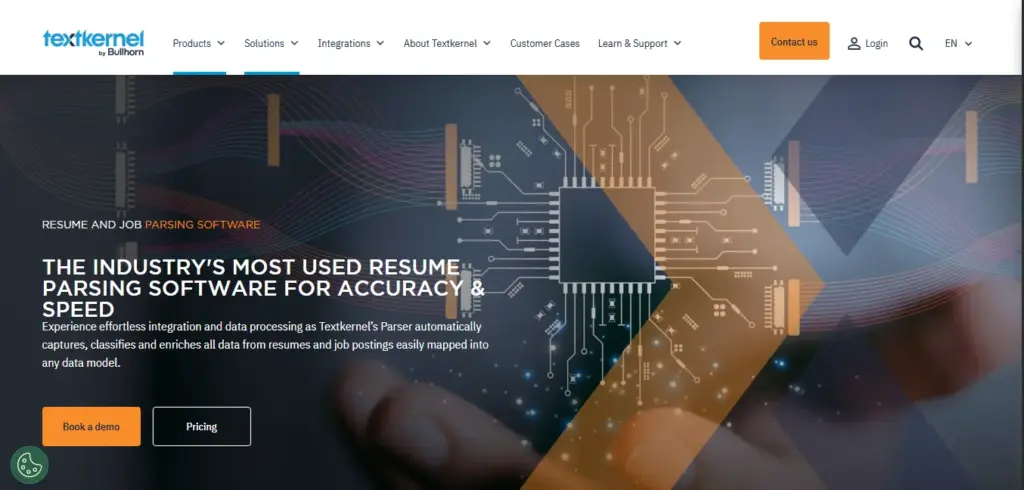
Textkernel is enterprise-centred CV parsing software for high-volume hiring with advanced semantic capabilities that go beyond keyword matching.
Key Features:
- 29 Language Support: Semantic parsing across 29 languages with OCR and enrichment. Languages include major European, Asian, and Middle Eastern options.
- Semantic Search Technology: Understands meaning and context, not just keywords. If a candidate writes “spearheaded initiatives” instead of “project management,” Textkernel recognises the equivalence. This dramatically reduces false negatives from terminology mismatches.
- Data Enrichment APIs: Augments candidate profiles with additional intelligence from public sources, creating more complete pictures of candidates.
- Labour Market Insights: Provides market data alongside parsing, salary benchmarks, skills demand trends, and competitive intelligence. This helps inform hiring strategies beyond just processing applications.
- OCR Technology: Handles scanned documents, image-based PDFs, and smartphone photos effectively.
Ideal For:
- Large enterprises with complex, sophisticated hiring needs
- International corporations hiring across Europe and Asia
- Companies want labour market analytics alongside parsing
- Organisations needing semantic intelligence (consulting, research, specialised fields where terminology varies widely)
Pricing:
Enterprise-focused pricing requires a sales contact. Generally positioned at the premium end, expect higher costs than CVShelf or Affinda, but with more comprehensive features.
Best Feature:
Semantic search capability is compelling. Candidates using “led cross-functional teams” versus “project management” versus “program coordination” are matched appropriately because Textkernel understands conceptual relationships, not just phrase matching. This reduces qualified candidates slipping through due to terminology differences.
Limitations:
The cost can be a concern, especially for smaller businesses. Premium features command premium pricing. Small-to-medium businesses may find the investment hard to justify unless hiring at a substantial scale or in highly specialised fields where semantic understanding provides a clear ROI.
6. Zoho Recruit – Best Budget-Friendly ATS with Built-in Parsing
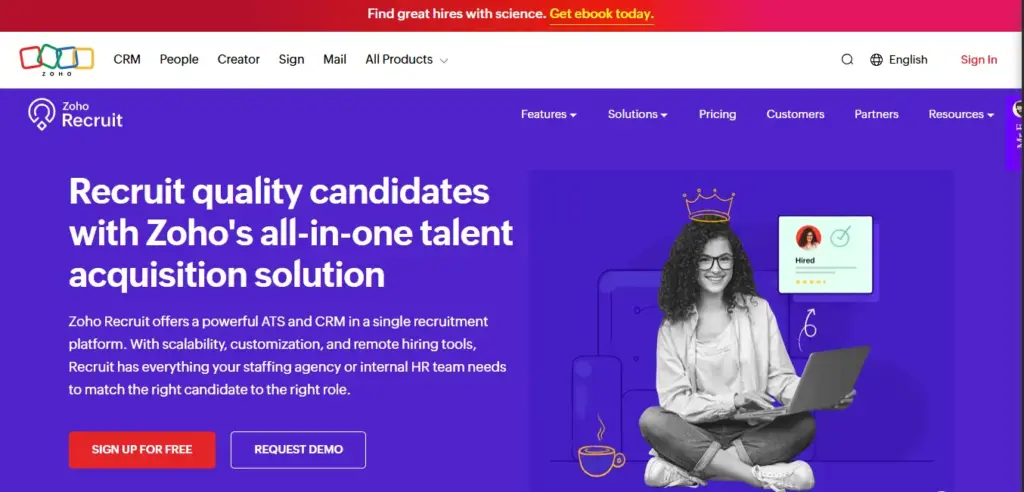
Zoho Recruit is a budget-friendly ATS with a built-in CV parsing tool, ideal for small-to-medium businesses wanting an all-in-one solution without separate systems.
Key Features:
- Full ATS Integration: Parsing is built directly into a complete applicant tracking system. Manage job postings, candidate pipelines, interview scheduling, offer letters, and onboarding in one platform.
- Candidate Portal: Self-service features for applicants to update information, check application status, and communicate.
- Customizable Workflows: Adapt the system to your specific hiring process stages, approval chains, and communication templates.
- Email Integration: Parse resumes from email applications automatically, and candidates can apply by sending resumes to a dedicated email address.
- Basic Parsing Capabilities: Handles standard formats reliably for straightforward resumes.
Ideal For:
- Small businesses (10-50 employees) with limited IT resources
- Companies want ATS + parsing in one tool to avoid multiple subscriptions
- Budget-conscious teams needing “good enough” parsing rather than “best in class”
- Organisations with straightforward hiring (standard roles, conventional resumes)
Pricing:
$25/user/month makes this extremely affordable for small teams. A 5-person HR department pays $125/month for full ATS functionality plus parsing.
15-day free trial lets you test before committing.
Best Feature:
The value proposition is unbeatable for small businesses. You get a complete ATS with integrated parsing at a price point that’s a fraction of enterprise systems. No need to integrate separate parsing tools; everything works together out of the box.
Limitations:
Parsing accuracy lags behind specialised tools. Zoho Recruit handles straightforward, well-formatted resumes fine. Creative layouts, unusual formats, or complex career histories challenge the parser more than CVShelf or RChilli would.
For high-volume hiring or roles attracting diverse resume formats, the parsing limitations become noticeable. You’ll spend more time manually correcting parsing errors than with more accurate, specialised tools.
How to Choose the Best Resume Parsing Software for Your Team
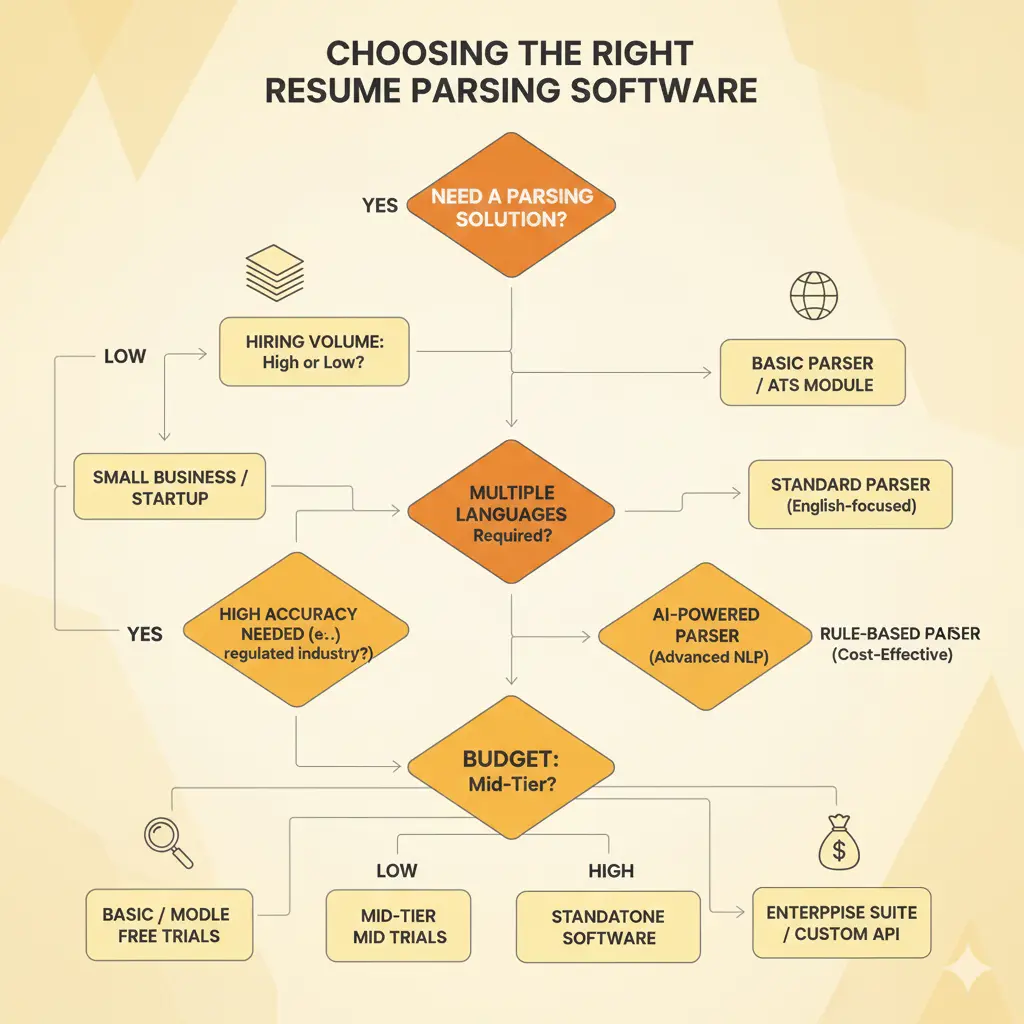
Selecting the right parser depends on your specific needs. Use this decision framework:
Evaluate Your Hiring Volume
Low volume (< 50 resumes/month): CVShelf’s free plan (20 credits/month) or Zoho Recruit ($25/user/month) both work well. At this volume, even basic parsing saves significant time.
Medium volume (50-500 resumes/month): CVShelf paid plans ($10-$25/month) or Affinda ($80/month) provide the accuracy and speed needed without enterprise costs.
High volume (500-2,000 resumes/month): CVShelf Standard/Professional plans ($25-$99/month) or RChilli excel here. Background processing and bulk capabilities become critical.
Enterprise volume (2,000+ resumes/month): CVShelf Professional, RChilli, Affinda, or Textkernel handle enterprise scale. Consider factors beyond just parsing, integration complexity, support quality, and compliance features.
Consider Language Requirements
English-only hiring: Any tool works well. CVShelf, Affinda, and Zoho Recruit all handle English resumes excellently.
Multilingual needs (2-5 languages): CVShelf or Affinda supports major languages with good accuracy.
Global hiring (10+ languages): RChilli (40+ languages) or HireAbility (50+ languages) becomes necessary.
Semantic understanding across languages: Textkernel’s semantic capabilities across 29 languages help when candidates use varied terminology.
Assess Integration Needs
Using existing ATS: Choose tools with strong APIs, CVShelf, RChilli, and Affinda all integrate smoothly with major ATS platforms.
Need an all-in-one solution: Zoho Recruit combines ATS + parsing, eliminating integration complexity.
Building custom systems: API-focused tools like RChilli or Affinda provide flexibility for developers.
Accuracy Requirements
Resume parsing software should perform at 90% accuracy or above to prevent the need for extensive human supervision.
Mission-critical accuracy (98%+): CVShelf or Affinda when every data point must be correct (regulated industries, executive hiring, specialised roles).
Standard accuracy needs (90-95%): RChilli, HireAbility, and Textkernel all meet this threshold reliably.
Basic parsing is sufficient (85-90%): Zoho Recruit works for straightforward hiring where occasional manual corrections are acceptable.
Budget Considerations
Free/minimal budget: CVShelf’s free plan (20 credits/month) provides genuine parsing capability without spending anything.
Small business budget ($100-300/month): Zoho Recruit ($25/user) or CVShelf Basic/Standard ($10-$25/month for 1,000-3,000 credits).
Mid-market budget ($300-1,000/month): CVShelf Professional ($99/month for 15,000 credits) or Affinda ($80+/month).
Enterprise budget ($1,000+/month): RChilli, Textkernel, or HireAbility with custom pricing based on volume and features.
Processing Speed Priority
Fastest processing: CVShelf (<5 min for 1,000+ CVs) and HireAbility’s grid technology lead in raw speed.
Background processing needed: CVShelf uniquely offers true background processing, upload and continue working without waiting.
Bulk capability is important: CVShelf, RChilli, and Textkernel all handle bulk uploads without performance degradation.
Special Features
Need candidate ranking: CVShelf provides automatic scoring and ranking with explanations, not just data extraction.
Want matching algorithms: RChilli and Textkernel include candidate-to-job matching beyond parsing.
Require resume redaction: Affinda offers anonymisation for blind hiring or compliance.
Need labour market insights: Textkernel provides market data, salary benchmarks, and skills demand trends.
Decision shortcut: If you’re primarily focused on high-volume screening with maximum accuracy and minimal wait time, CVShelf solves the core problem most directly.
If you have specialised needs, global hiring across 20+ languages, enterprise compliance requirements, or semantic search across varied terminology, then the specialised tools become worth their added complexity and cost.
Why CVShelf Is the Clear Choice for High-Volume Hiring
After reviewing the top 6 resume parsing tools, CVShelf emerges as the best overall solution for most recruiting teams, especially those handling high application volumes.
The core advantages
Speed + Accuracy combination: 98% accuracy with processing under 5 minutes for 1,000+ resumes is unmatched. You don’t sacrifice accuracy for speed or vice versa.
Background processing eliminates waiting: Other tools make you watch progress bars. CVShelf lets you work continuously, checking back for completed results at your convenience.
Parsing + Screening integration: Most competitors stop at data extraction. CVShelf delivers scored, ranked shortlists ready for interview scheduling.
Transparent pricing that scales: From free (20 credits/month) to enterprise (15,000 credits/month for $99), pricing grows with your needs. No surprise costs or sales-only pricing.
Built specifically for recruiters: The interface, features, and workflow reflect actual recruitment processes, not generic software that happens to parse resumes.
The free plan removes all risk. Test CVShelf with 20 real resumes from an actual role. Experience the speed, review the accuracy, and evaluate the shortlist quality. If it saves you even 2 hours on one hire, it’s worth switching to a paid plan.
For teams processing hundreds or thousands of resumes monthly, CVShelf transforms hiring from overwhelming to manageable. The 87% time savings means recruiters focus on relationship-building and strategic decisions instead of data entry drudgery.
Get Started with CVshelf today – Free plan, no credit card required, 20 credits to test with real hiring scenarios.
Final Word
The resume parsing market offers solutions for every need: global hiring, enterprise compliance, semantic search, and budget constraints. But for the core problem most recruiters face, too many resumes, too little time, need for accuracy at scale. CVShelf solves it most directly and effectively.
Start with the free plan. Process 20 resumes. See the ranked results. Compare to your manual screening.
Frequently Asked Questions (FAQs)
Yes, CVShelf ranks #1 for high-volume hiring with 98% accuracy and unique background processing. While competitors like RChilli excel at multilingual parsing (40+ languages) and Textkernel offers semantic search, CVShelf combines parsing + screening + ranking in one platform with transparent pricing starting free.
Yes, for high-volume hiring. Traditional parsers make you wait while processing (3-5 minutes of idle time per batch). CVShelf’s background processing lets you upload 1,000 resumes and continue working immediately, checking back later for completed results. This eliminates workflow interruptions.
No. If you exclusively hire English-speaking candidates in English-speaking markets, multilingual capabilities add no value. CVShelf, Affinda, and Zoho Recruit handle English resumes excellently. Save money on multilingual features (RChilli, Textkernel) unless you’re hiring internationally or in multilingual regions like Canada or Switzerland.
Yes. CVShelf’s free plan (20 credits/month) or Zoho Recruit ($25/user/month) delivers immediate ROI. Even screening 50 resumes manually takes 3-4 hours at $30/hr ($90-120 labour cost). Organisations report up to 30% reduction in recruitment costs per hire using AI-driven platforms.