

Your resume keeps getting rejected, and you are not sure why. You have the experience. You have done the work. But something is not connecting with employers. The problem might be simpler than you think: you are not showing the right core competencies for your resume.
Most job seekers list random skills without understanding what hiring managers actually look for. They miss the specific professional abilities that get resumes past applicant tracking systems and onto interview lists.
When you know which core competencies to include and how to present them, you immediately separate yourself from other candidates competing for the same position.
This guide shows you exactly which core competencies for your resume matter most, how to identify your strongest professional abilities, and where to place them for maximum impact.
You will learn the difference between skills and competencies, see real examples for different career levels, and discover how to customize your resume for each job application. By the end, you will have a clear strategy to showcase your expertise areas in a way that gets you hired faster.
What Are Core Competencies on a Resume?
Core competencies are the main professional abilities and expertise areas that make you good at your job. Think of them as your strongest professional strengths that apply across different roles and companies. These are the capabilities that let you perform well and deliver results consistently.
When you list core competencies on your resume, you create a quick snapshot of what you can do. A hiring manager can look at your competencies list and immediately understand your professional abilities without reading your entire work history.
How to Identify Your Core Competencies
Finding your real core competencies takes some honest self-assessment. You want to identify strengths that are genuine and that you can back up with actual examples from your work history.
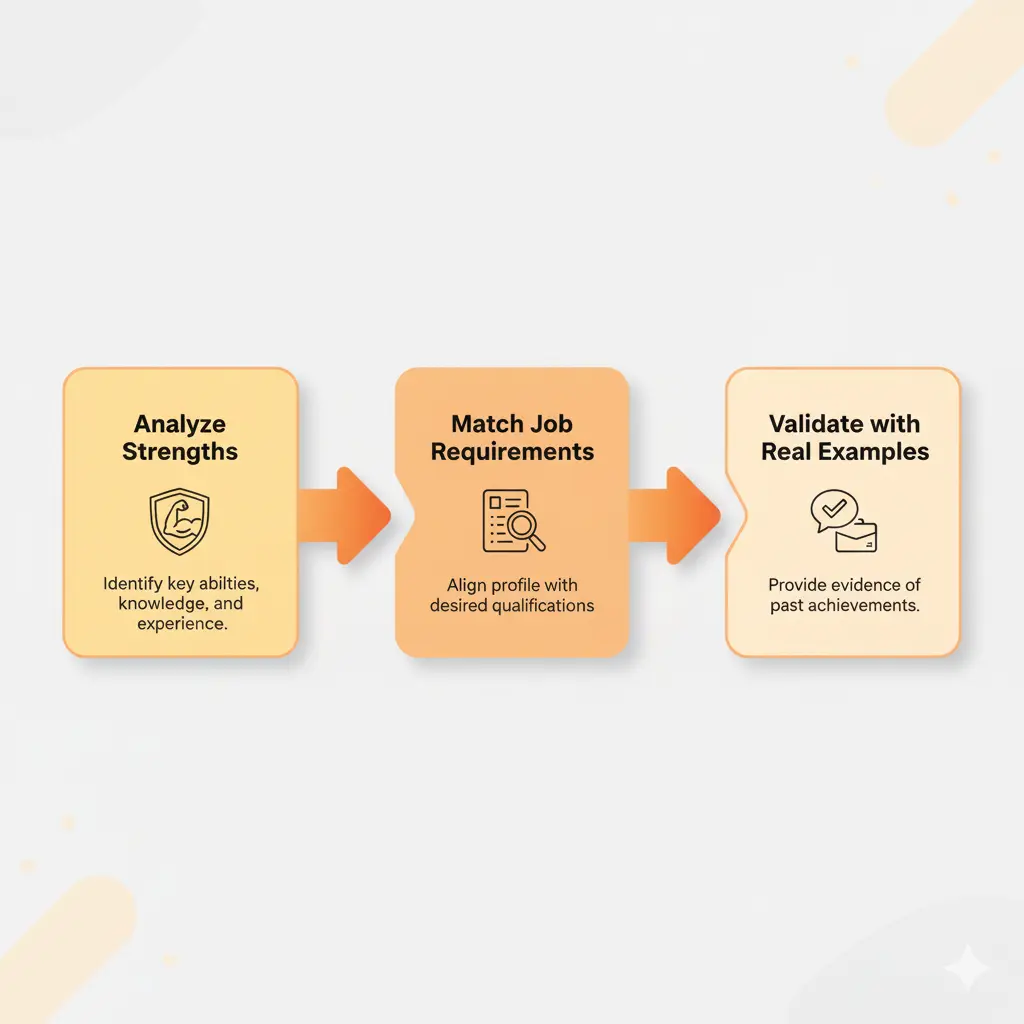
Analyze Your Professional Strengths
Start by looking at your past successes. What abilities did you use when you completed projects ahead of schedule or solved tough problems? What do managers and coworkers regularly ask you to help with? These patterns reveal your natural competencies.
Make a list of times you received praise, promotions, or recognition. What were you doing in those moments? The common threads often point to your strongest professional abilities.
Also consider feedback from performance reviews and skill assessments. These formal evaluations often highlight competencies you might overlook in yourself.
Match Skills to Job Requirements
Read job postings in your field carefully. Companies tell you exactly what competencies they want when they list requirements and qualifications. Look for repeated phrases across multiple job descriptions in your industry.
Create a match between what employers want and what you genuinely have. Don’t list competencies you lack, but do recognize where your experience aligns with common job requirements. This helps you tailor your resume content to each application.
Use the same language employers use when possible. If a job posting mentions “cross-functional collaboration” instead of “teamwork,” use their terminology. This optimization helps both ATS systems and human readers.
Validate with Real Examples
Every competency you list should connect to a real situation where you used that ability. If you cannot think of a specific example, leave that competency off your list.
Good validation comes from measurable results. “Project management” becomes stronger when you can point to projects you completed on time and under budget. “Customer service” gains credibility when you mention customer satisfaction scores you improved.
Write down 1-2 brief examples for each competency before you add it to your resume. This preparation also helps during interviews when employers ask you to demonstrate the competencies you listed.
Core Competencies vs Skills: Key Differences
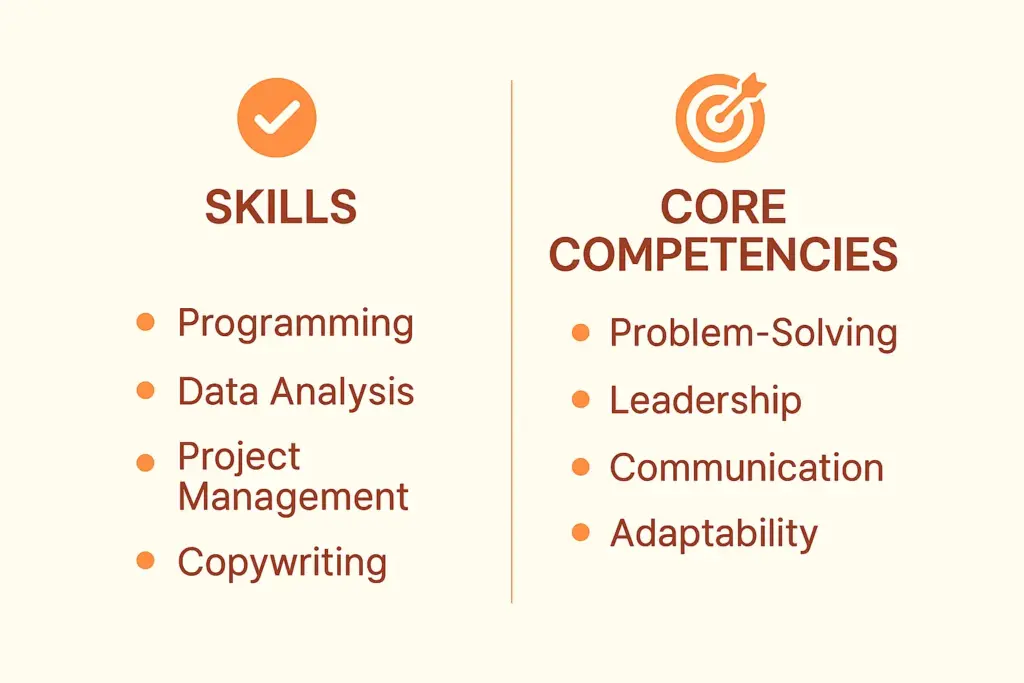
Skills and competencies sound similar, but they work differently on your resume. Skills are specific things you learned, like using Excel or speaking Spanish. Core competencies are broader professional abilities that show how you apply those skills to get results.
For example, “Microsoft Excel” is a skill. “Data analysis and reporting” is a core competency that shows you use Excel and other tools to solve real business problems. A competency-based resume focuses on these broader capabilities rather than just listing every skill you have.
The best core competencies for resume writing combine both technical abilities and behavioral competencies. This shows you have both the hard skills to do the work and the soft skills to work well with others.
Why Employers Value Core Competencies
Employers look at core competencies because they need to fill positions quickly with people who can actually do the job. Your competencies tell them whether you match what they need without making them guess.
Applicant tracking systems scan resumes for keywords that match the job description. When you include relevant professional competencies, your resume has a better chance of making it past these systems to a real person.
Hiring managers also value competencies because they predict job performance better than just education or job titles. Someone who demonstrates competencies through specific examples shows they can deliver results, not just hold a position.
Pro Tip: Improve Your Resume With AI Screening Insights
If you want to understand exactly how your resume performs before applying, consider using our AI Resume Screener. It scans your resume the same way modern ATS and hiring teams do, highlights missing core competencies, and shows you what to improve instantly.You can also check out our guide on how AI can improve candidate experience to see how these tools help job seekers and employers communicate more effectively.
25+ Core Competencies Employers Want Most
These professional competencies appear frequently in job postings across industries. Pick the ones that honestly match your abilities and the positions you want.
Leadership and Management Skills
- Team leadership and development
- Strategic planning and execution
- Performance management
- Change management
- Stakeholder engagement
- Decision-making under pressure
Leadership competencies matter even if you are not applying for management roles. They show you can take initiative and guide projects forward.
Communication and Interpersonal Abilities
- Written and verbal communication
- Presentation skills
- Active listening
- Conflict resolution
- Cross-functional collaboration
- Client relationship management
Communication competencies are transferable skills that work in almost any role. Employers consistently rank these among the most important employability skills.
Problem-Solving and Critical Thinking
- Analytical thinking
- Creative problem solving
- Root cause analysis
- Process improvement
- Risk assessment
- Strategic thinking
These competencies show you can handle challenges that do not have obvious solutions. They signal that you will add value beyond just following instructions.
Technical and Digital Skills
- Data analysis and interpretation
- Software proficiency
- Digital literacy
- Technical documentation
- System optimization
- Technology adoption
Technical competencies vary widely by field. Focus on the specific technologies and methods used in your industry rather than listing every program you have ever touched.
Project Management and Organization
- Project planning and coordination
- Time management
- Resource allocation
- Budget management
- Quality assurance
- Deadline management
Organization competencies prove you can handle complex work without constant supervision. They are especially valuable in remote work environments where self-direction matters more.
Core Competencies by Industry
Different industries value different competencies. Customize your resume to highlight the professional abilities that matter most in your field.
Technology and IT
Tech employers look for technical competencies mixed with business understanding. Strong core competencies include software development, system architecture, cybersecurity, database management, and API integration. They also value agile methodology, DevOps practices, and technical troubleshooting.
Include specific programming languages and frameworks as skills, but frame broader competencies around what you accomplish with those tools. “Full-stack development” works better than just listing “HTML, CSS, JavaScript.”
Healthcare and Medical
Healthcare competencies center on patient care and clinical knowledge. Key areas include patient assessment, treatment planning, medical documentation, regulatory compliance, and infection control. Emergency response and clinical decision making also rank high.
Healthcare workers should also highlight interpersonal competencies since patient interaction is central to these roles. Compassionate care and family communication bridge technical medical skills with human connection.
Marketing and Sales
Marketing professionals need competencies in campaign management, market research, content creation, SEO/SEM, and brand development. Sales roles require relationship building, negotiation, pipeline management, and revenue generation.
Both fields value data-driven decision-making. Modern marketing and sales rely heavily on analytics, so demonstrate competencies that show you use data to optimize results.
Finance and Accounting
Financial competencies include financial analysis, budget forecasting, financial reporting, regulatory compliance, and risk management. Audit experience and tax preparation also appear frequently for accounting roles.
The finance industry values attention to detail and accuracy as core behavioral competencies. These traits matter as much as technical knowledge since small errors can have large consequences.
Customer Service
Customer service competencies focus on customer satisfaction, complaint resolution, service recovery, product knowledge, and communication skills. Call center environments also value multitasking and CRM software proficiency.
Companies increasingly want customer service professionals who can identify upselling opportunities and contribute to revenue, not just solve problems. Sales aptitude has become a valuable competency even in traditional service roles.
How to Add Core Competencies to Your Resume
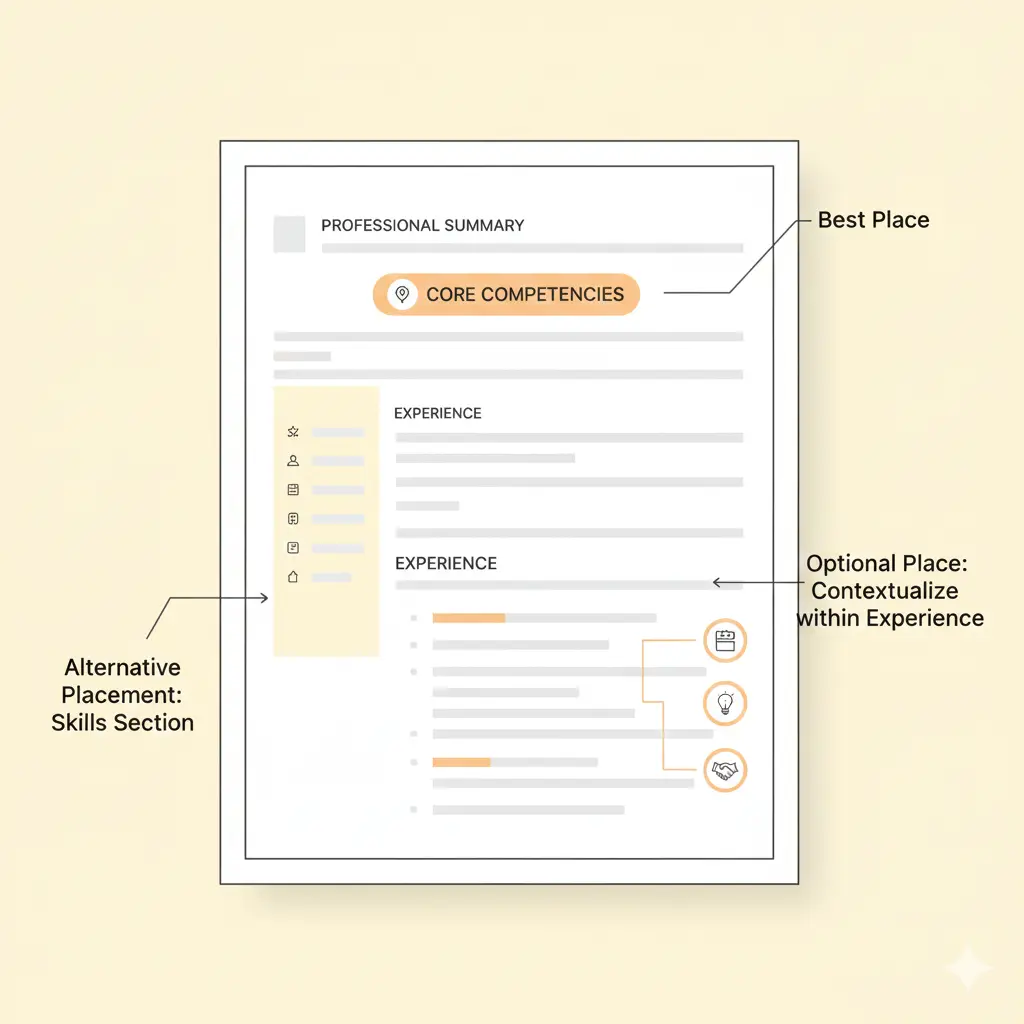
Place your core competencies in a dedicated resume skills section near the top of your resume, usually right after your professional summary or objective. This prime location helps both ATS systems and hiring managers find your key qualifications quickly.
Use a simple format that is easy to scan. A bulleted list or a clean table with 2-3 columns works well. Avoid graphics or charts that ATS systems cannot read properly.
Include 8-12 core competencies maximum. More than that becomes overwhelming and dilutes your strongest abilities. Choose the competencies most relevant to each specific job application.
Write competencies using the same keywords from the job posting when they honestly apply to you. If the job description mentions “vendor management” and you have that experience, use that exact phrase rather than “supplier coordination.”
Skip the ratings scales or proficiency bars. These add no real information and waste space. Either you have a competency worth listing or you do not.
Weave your competencies throughout your work experience section, too. Do not just list them at the top and never mention them again. Show where you used each competency to achieve specific results.
For example, if you list “process improvement” as a competency, your work history should include an example like “streamlined inventory system, reducing processing time by 30%.”
Beyond optimizing keywords, understand when to opt out of AI screening versus staying in the system.
Core Competencies Resume Examples
These examples show how different job seekers can showcase skills effectively for their career level and goals.
Entry-Level Professional
Core Competencies:
- Research and data analysis
- Microsoft Office Suite
- Written and verbal communication
- Time management and organization
- Team collaboration
- Social media management
- Customer service
- Basic project coordination
Entry-level candidates should include academic projects and internships when demonstrating these competencies.
Even without years of professional experience, you can highlight abilities developed through coursework, volunteer work, or part-time jobs.
Experienced Professional
Core Competencies:
- Strategic planning and execution
- Cross-functional team leadership
- Budget management ($2M+)
- Stakeholder relationship management
- Performance optimization
- Change management
- Vendor negotiation
- Risk mitigation
Experienced professionals can be more specific with their competencies. Notice the budget size included with “budget management.” These details add credibility and help you stand out to employers.
Career Change Candidate
Core Competencies:
- Project management (PMP certified)
- Client relationship management
- Process improvement and optimization
- Training and development
- Analytical problem solving
- Adaptability and quick learning
- Cross-industry communication
- Technology adoption
Career changers should emphasize transferable skills that apply across industries. Focus on universal professional abilities rather than industry-specific jargon from your old field. This helps hiring managers see how your background applies to their needs.
Common Core Competencies Mistakes to Avoid
Do not use vague or generic competencies like “hard worker” or “team player.” These phrases mean nothing specific and waste valuable resume space. Every candidate claims to be a hard worker, so it does not differentiate you.
Avoid listing competencies you cannot actually demonstrate. If you include “public speaking” but have never given a presentation, that competency will backfire during interviews. Only include abilities you can discuss with concrete examples.
Do not copy the same competencies list to every job application. Different positions need different capabilities. Customize your competencies section for each role based on what that specific employer needs.
Skip outdated or irrelevant competencies. Your expertise with Windows 95 or your typing speed does not belong on a modern professional resume. Focus on current, relevant professional abilities that matter in today’s workforce.
Do not forget to optimize your resume for applicant tracking systems. Use simple formatting, standard fonts, and clear section headers. Fancy designs might look nice, but they often get rejected by ATS software before any human sees them.
Avoid mixing up competencies with personal traits. “Reliable” or “honest” are character qualities, not professional competencies. Focus on capabilities you developed through training and experience.
The Bottom Line
The right core competencies for your resume make you visible to employers who need exactly what you offer. Focus on 8-12 strong core competencies that match each job description, place them prominently near the top of your resume, and back them up with real examples in your work history.
Avoid generic phrases and outdated skills. Instead, use the same professional language employers use in their job postings to optimize your resume for both applicant tracking systems and human readers.
When you demonstrate competencies that align with what hiring managers want, you move from the rejection pile to the interview list.
Your core competencies list is not just a section on your resume; it is your first chance to prove you can deliver the results employers need for career advancement and business success.