
AI CV Screening For Marketing Agencies
AI CV screening for marketing agencies solves a specific problem.
The account manager role went live on LinkedIn Monday morning. By Thursday there are 170 applications. The person handling screening has a client presentation due Friday and two briefs to review before end of week.
That's the real context. Not a recruiter with dedicated screening hours and a trained eye. Someone with a full calendar and 170 CVs sitting in a folder they haven't opened.
AI CV screening was built to handle exactly that gap. The question is whether the tool you're using is actually doing AI screening or just doing keyword matching dressed up as AI.
The Real Problem for Marketing Agencies
The screening problem at a marketing agency isn't volume for its own sake. It's volume arriving in the hands of someone without a process, without written criteria, and with competing priorities for the same hours.
Manual screening at volume produces inconsistent results by design. The reviewer reads carefully at the start, skims in the middle, and stops or rushes at the end. The shortlist reflects fatigue and reading order as much as candidate quality. The strong candidate who applied on day three and sits at position 140 in the pile doesn't get the same attention as position 12.
This happens four to ten times a year at most marketing agencies. And because it's infrequent, nobody builds a process between cycles. Each hire starts from scratch.
The software problem compounds this. Most ATS platforms include some form of "AI screening" that is in practice keyword matching: it scans resumes for words from the job description and scores candidates based on frequency. A candidate who writes "led a 12-person account team" might score lower than one who wrote "account management, client management, account leadership" because the first has fewer keyword hits. The model doesn't understand what the words mean.
Genuine AI screening reads resumes for meaning, whether the experience maps to the role requirements, at what level, in what context. The output is a ranking based on relevance, with an explanation per candidate that shows the reasoning. A reviewer can agree with it, question it, or override it. That's a different tool from a keyword filter.
What Good Actually Looks Like
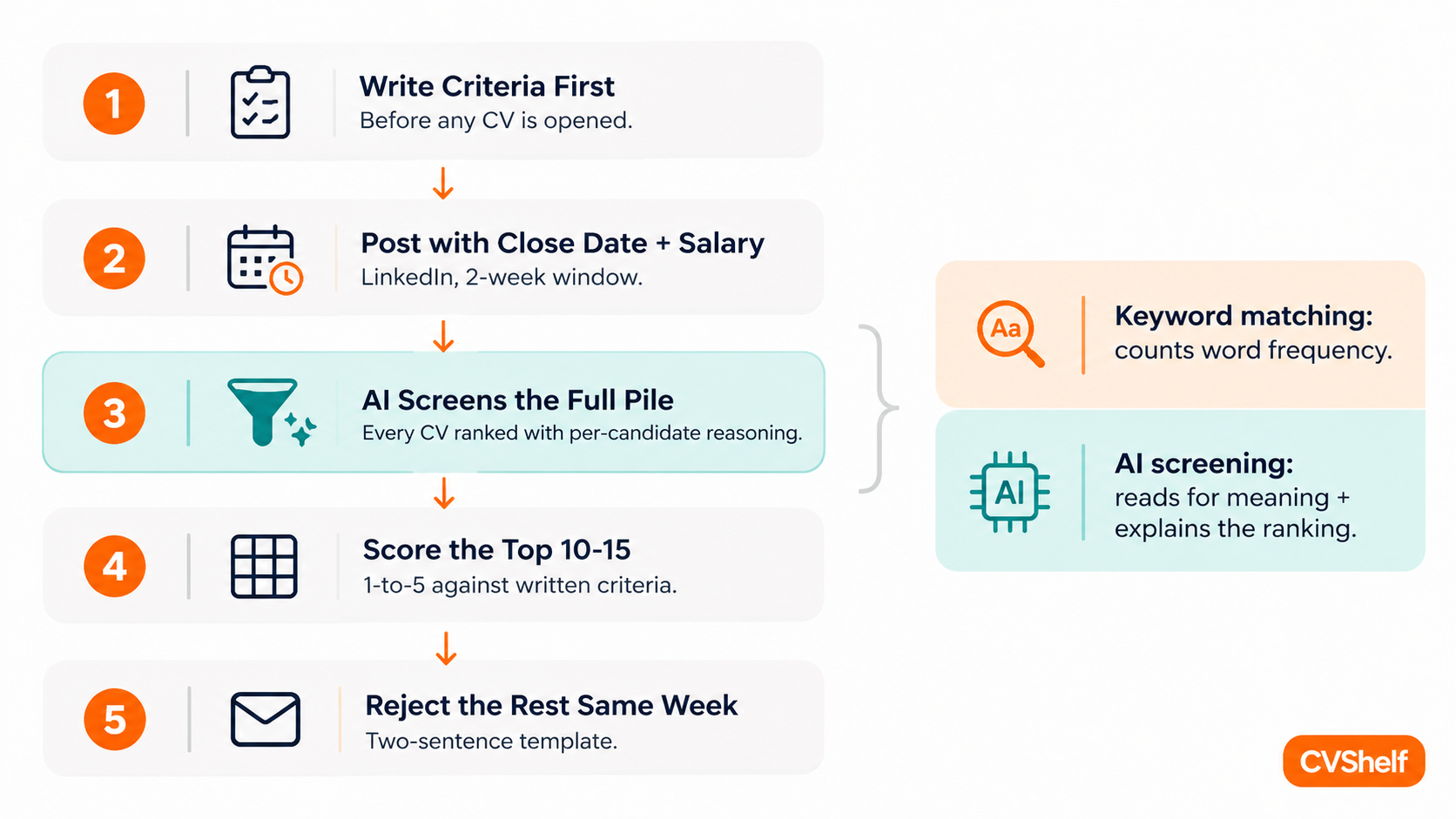
Five steps. Each one reduces variance in the shortlist and time spent producing it.
1. Write the criteria before the role posts. Three to five non-negotiables, written down before a single CV is read. Agency-side experience, required or not. Specific channel knowledge if it's a genuine dealbreaker. Minimum relevant experience. These criteria become the job description and the AI screening input. Vague criteria produce vague rankings. Specific criteria produce a shortlist you can act on.
2. Post with a close date and visible salary. Two weeks out. LinkedIn for most agency roles in the US and UK. Include the salary, candidates who can't see a range either skip the listing or waste everyone's time discovering late that it doesn't work. A close date means you process one batch rather than a drip that stretches indefinitely.
3. Run the full pile through AI screening. When the close date hits, upload every CV, paste in the job description, and get a ranked output with per-candidate reasoning. CVShelf does this: it reads every application against the criteria, ranks by relevance, and attaches a short explanation per candidate covering what it found and what it flagged. The reviewer reads the top ten to fifteen with full attention. Every other candidate was processed against the same criteria, in the same way, with no fatigue. A non-recruiter works through the output in under an hour.
4. Score the top candidates before presenting. 1-to-5 against each written criterion. Takes 30 minutes. Produces a shortlist with a rationale you can hand to an MD or hiring manager and explain without saying "I thought they seemed strong."
5. Reject the rest the same week. Templated email, two sentences. Every candidate outside the shortlist gets one. The marketing industry is not large. Candidates who applied to your agency are in your professional network regardless of outcome.
The Most Common Mistake
Using "AI" in an ATS that's actually doing keyword matching.
Most ATS platforms market their screening feature as AI. Some of them are running genuine language models. Most are pattern-matching on keywords. The practical difference shows up in the shortlist quality: keyword-based screening rewards candidates who list every skill in the job description over candidates who demonstrate relevant experience without using the exact terms.
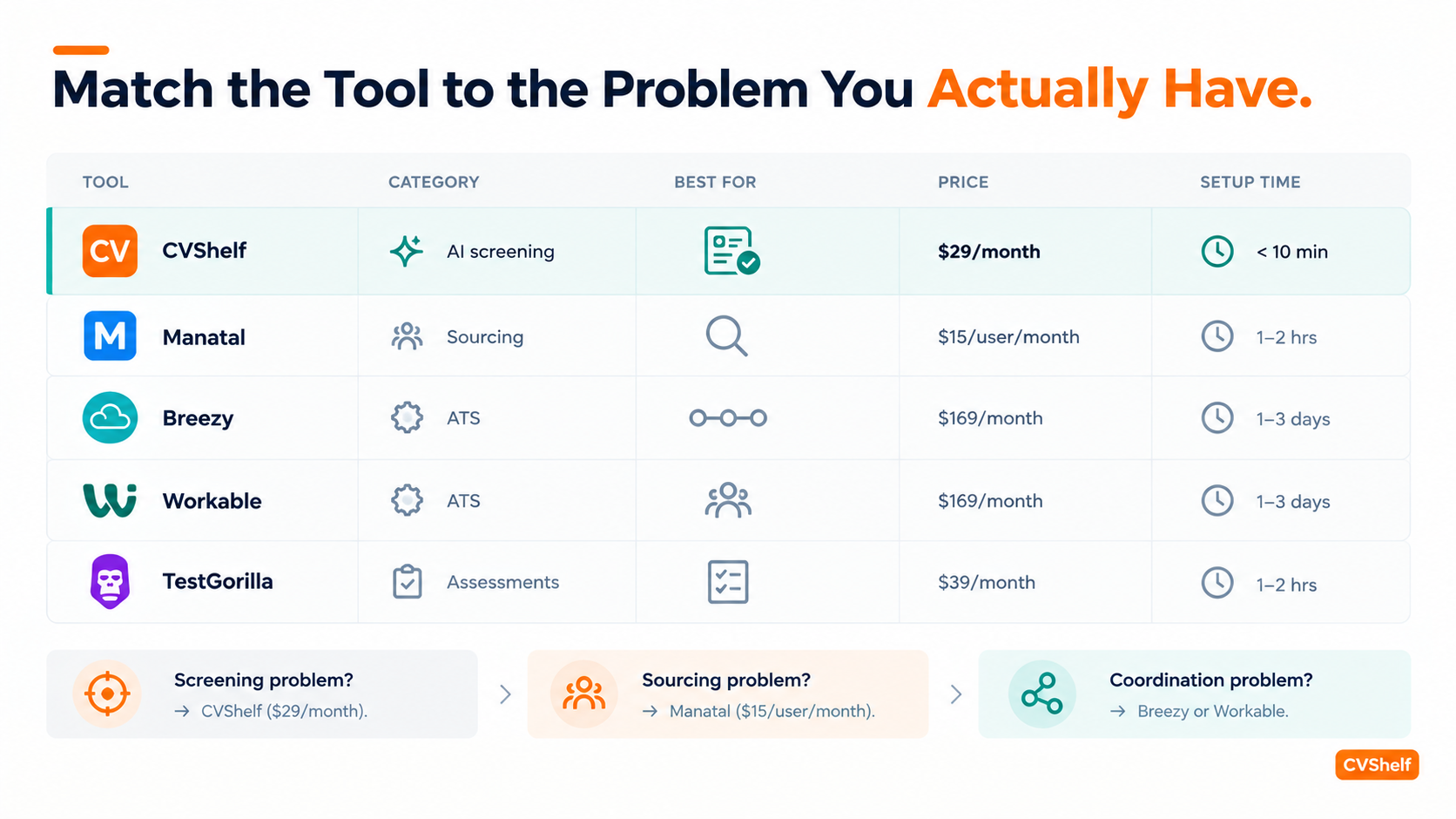
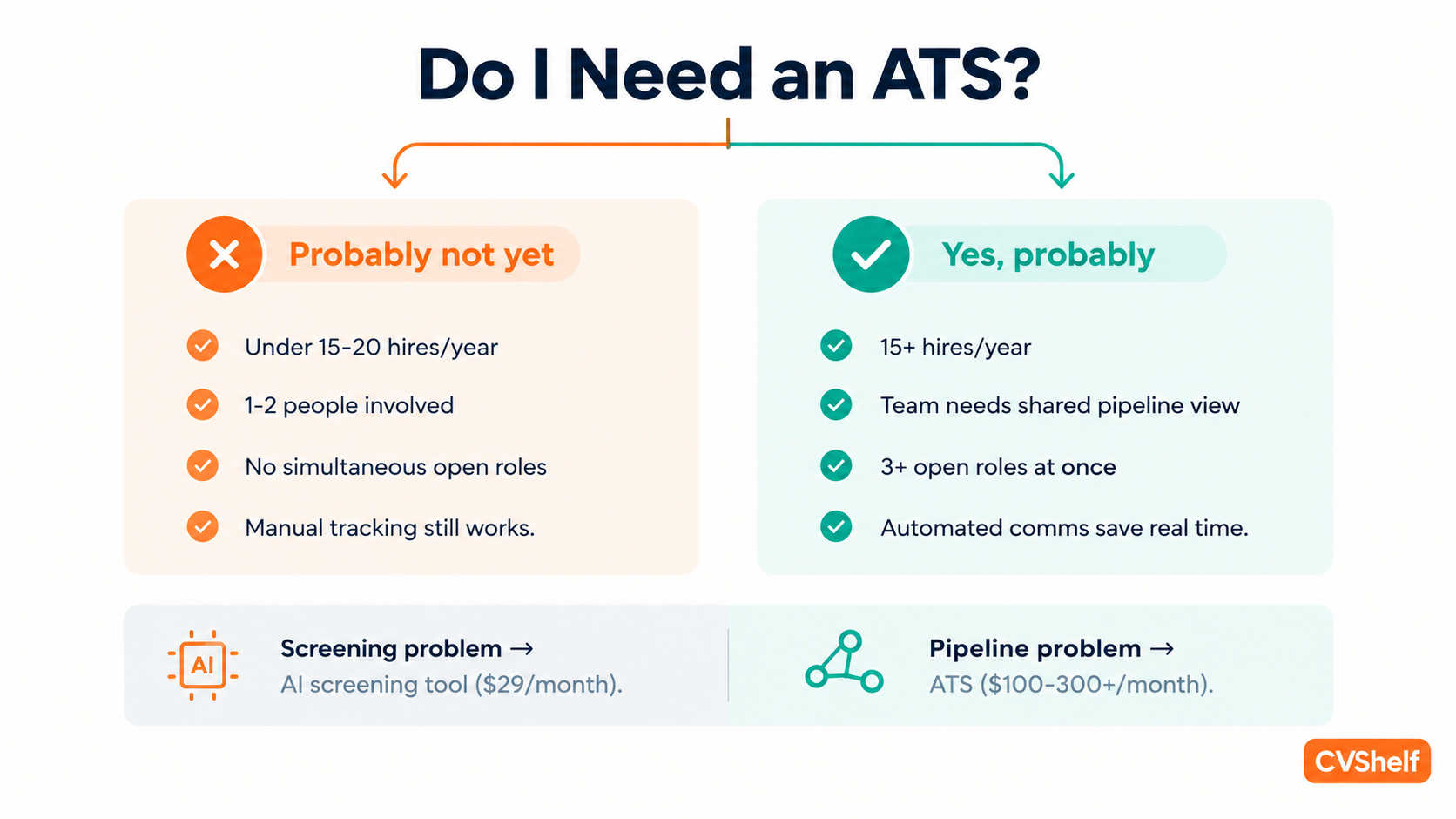
The second mistake is buying a full ATS to solve a screening problem. An ATS manages a hiring pipeline, multiple stages, team visibility, automated communications, compliance reporting. A screening tool evaluates incoming CVs and returns a ranked shortlist. For a marketing agency doing eight hires a year with one person running the process, the pipeline infrastructure is overhead. The screening problem is the actual problem.
Conflating the two categories is what leads to buying a $150/month platform to solve a $29/month problem, then abandoning it after two hires because the setup and maintenance are more than the team can sustain.
FAQ
Q1. Does AI CV screening actually work for marketing roles like account managers and strategists?
Yes, when the job description is specific. The quality of the ranking is directly tied to the specificity of the criteria you give the AI. "Marketing experience required" produces a broad ranking because it matches a broad population. "Agency-side AM, minimum 3 years managing performance marketing campaigns for B2B clients, client-facing" produces a tight ranking. The tool is only as sharp as the brief.
Q2. What's the difference between AI screening and keyword matching?
Keyword matching counts how often words from the job description appear in a resume. AI screening reads the resume for meaning, whether the described experience actually maps to the role, at what level, in what context. A candidate who writes "managed a team of eight account executives through a product launch" may not hit every keyword but demonstrates relevant seniority. AI screening surfaces that candidate. Keyword matching often doesn't.
Q3. How do I know if my ATS is doing real AI screening or just keyword matching?
Ask for a sample output on a role you know well. If every highly-ranked candidate has high keyword frequency and every low-ranked candidate is missing key terms regardless of actual experience, it's keyword matching. If the ranking reflects experience depth and relevance rather than keyword density, and if you can see per-candidate reasoning rather than just a score, it's closer to genuine AI screening.
AI CV screening for marketing agencies works when the tool understands context, not just keywords, and when the person running it has written criteria to work from.
Try CVShelf complimentary at cvshelf.com.
Keep Reading
More from AI Resume Screening.
AI Hiring Tool USA Small Business
This post is for COOs and ops managers at 10 to 100-person US businesses.
Do I Need An ATS As A Small Agency
Most small agencies under 100 people don't need a full ATS.
How To Hire Without A Recruiter
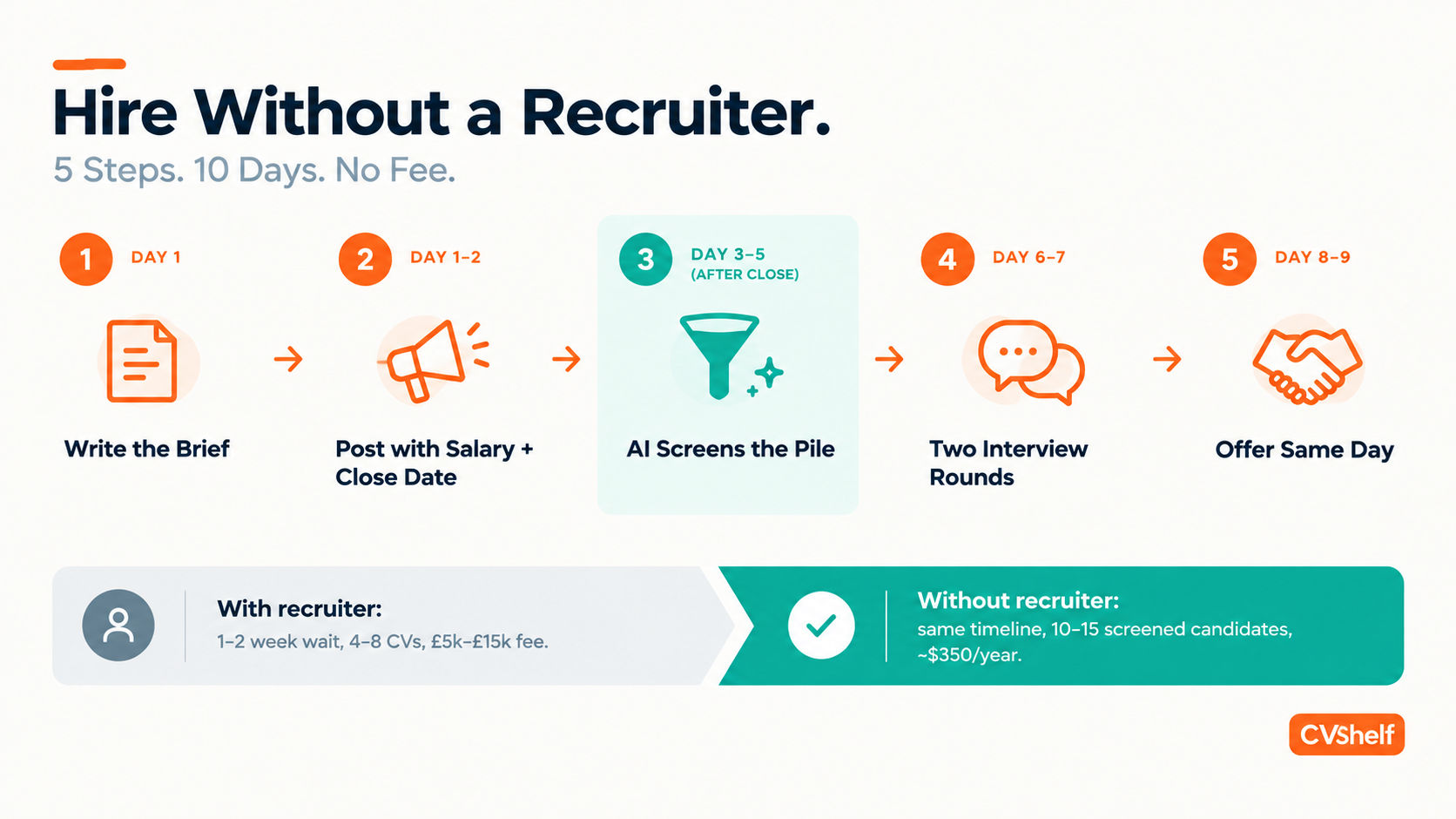
Most agency founders have hired without a recruiter at least once.