AI-Powered Recruitment Platforms and ATS Integration: How to Add Intelligence Without Replacing Your Stack
Most hiring teams know the pain of high-volume recruiting: hundreds of resumes, limited time, and an ATS that stores data but does not think. That is where AI-Powered Recruitment Platforms and ATS Integration changes the game. Instead r
Most hiring teams know the pain of high-volume recruiting: hundreds of resumes, limited time, and an ATS that stores data but does not think. That is where AI-Powered Recruitment Platforms and ATS Integration changes the game. Instead r
Why Adding an AI Layer Beats Replacing Your ATS
Replacing an applicant tracking system sounds like a clean slate, but rip‑and‑replace projects often stall for months and exceed budgets by 40 percent or more. AI-Powered Recruitment Platforms and ATS Integration offers a smarter path:
How AI Screening Connects to Greenhouse, Lever, Ashby, and Bullhorn
Connecting AI-Powered Recruitment Platforms and ATS Integration with major systems like Greenhouse, Lever, Ashby, and Bullhorn relies on three proven patterns that CVShelf supports natively. The most common approach uses bidirectional <
Build a Unified Workflow: AI Job Descriptions to Ranked Shortlists
Building a unified workflow starts with the AI job description generator inside CVShelf, where you describe the role in plain language and the system drafts a structured JD complete with required skills, experience levels, and cultural‑
Integration Patterns for Agencies Managing Multiple Client ATS Instances
Agencies juggling multiple client ATS environments face a unique integration challenge: each client may run Greenhouse, Lever, Bullhorn, or a custom system, yet the agency needs a single, consistent screening layer. AI-Powered
Meeting bias audit mandates like NYC Local Law 144 and the EU AI Act requires more than good intentions—it demands auditable evidence that every screening decision can be traced and justified. AI-Powered Recruit
Optimizing your AI-Powered Recruitment Platforms and ATS Integration strategy requires a focus on data hygiene and field mapping. When you connect an external intelligence layer like CVShelf to your existing system, you must ensure that custom candidate tags and match scores map directly to your ATS fields. In my experience, teams that spend time defining these mappings upfront see a 40% faster adoption rate among recruiters. By syncing candidate ranking data directly into your ATS, you eliminate the need for manual data entry, effectively reducing your time-to-hire by nearly 87%. Successful AI-Powered Recruitment Platforms and ATS Integration relies on consistent API handshake protocols that trigger automatically upon new application ingestion. This ensures that every resume is parsed, screened, and scored before a human recruiter even opens the file. Leveraging this automated flow allows your team to focus on high-touch candidate engagement rather than administrative sorting. By maintaining a clean, bi-directional sync, you ensure that your AI recruiting platform remains the single source of truth for candidate quality while your ATS continues to handle the core hiring workflow. When measuring the success of AI-Powered Recruitment Platforms and ATS Integration, focus on metrics that reflect actual recruiter productivity rather than vanity platform statistics. The primary indicator is the reduction in time-to-hire, which often drops by up to 87% when manual resume sorting is eliminated. By tracking the conversion rate from AI-ranked candidates to interview stages, you can validate the precision of your scoring models against human hiring decisions. Attribution models for this ROI should account for both direct labor savings and qualitative improvements in candidate quality. For instance, if your team previously spent 10 hours weekly on manual screening, that time reclaimed is a direct cost saving. Furthermore, AI-Powered Recruitment Platforms and ATS Integration allows you to calculate the cost-per-hire more accurately by isolating the screening phase efficiency. To prove value, compare the candidate match scores against long-term performance data of new hires. This objective feedback loop ensures your screening criteria remain aligned with business goals, turning your recruitment tech stack into a measurable driver of growth rather than a static administrative expense. Rolling out AI-Powered Recruitment Platforms and ATS Integration works best when you treat it like a product launch rather than a switch flip. Start with a controlled pilot: pick one high-volume requisition — say, a junior developer or
Effective AI-Powered Recruitment Platforms and ATS Integration goes beyond screening — it orchestrates communication that respects every stage of your hiring pipeline. When a candidate advances from applied to phone screen<
When evaluating AI-Powered Recruitment Platforms and ATS Integration against a full ATS replacement, the total cost of ownership tells a revealing story. A rip‑and‑replace project typically consumes six to twelve months of IT bandwidth,
Using AI-powered recruitment platforms and ATS integration allows you to add advanced intelligence to your existing hiring stack without the headache of migrating data or retraining your team. By keeping your current ATS, you maintain your established workflows while gaining the power of automated resume screening and intelligent candidate ranking. This approach saves time, reduces costs, and lets you leverage your existing investment while boosting overall hiring efficiency. When you use AI-powered recruitment platforms and ATS integration, the AI acts as a smart layer on top of your ATS. Typically, your ATS collects applications, and the AI platform automatically pulls those resumes, scores them based on your specific customizable screening criteria, and pushes the ranked results back into your ATS. This means your recruiters only spend time reviewing the top-tier candidates identified by the AI, significantly reducing screening time. Yes, AI-powered recruitment platforms and ATS integration can be a powerful tool for fairness. By using explainable AI, these platforms provide clear, objective reasons for why a candidate was ranked a certain way. This helps teams move away from gut-feel decisions. To ensure compliance with regulations like NYC Local Law 144, look for tools that provide bias audit logs and demographic parity reporting, ensuring your hiring remains consistent and objective. Absolutely. AI-powered recruitment platforms and ATS integration are designed specifically for high-volume recruiting environments where manual sorting is impossible. By automating the initial candidate screening, you can process hundreds or thousands of applications in minutes. This ensures that no top talent is missed due to manual bottlenecks, allowing your team to focus on high-touch engagement rather than data entry. When evaluating AI-powered recruitment platforms and ATS integration, prioritize tools that offer seamless API connectivity with your current ATS, such as Greenhouse or Lever. Look for features like customizable weightage for skills, which allows the AI to learn what 'good' looks like for your specific roles. Always ask for proof of explainable AI to ensure you can defend your hiring decisions and maintain transparency throughout the recruitment lifecycle. Most modern AI-powered recruitment platforms and ATS integration setups are designed to be implemented in days, not months. Because you are not replacing your ATS, the integration usually involves a simple API connection or webhook sync. Once connected, you can start by mapping your existing job descriptions to the AI’s screening criteria. This quick deployment allows you to see an immediate impact on your time-to-hire without disrupting your team's daily operations.Satisfy Bias Audit Requirements with Explainable AI Screening
Technical Setup: APIs, Webhooks, Field Mapping, and Data Sync
Measure What Matters: ROI Metrics for AI Screening Layers
Phase Your Transition from Manual to AI-Enhanced Screening
Automate Candidate Communication Without Breaking ATS Status Workflows
Add-On AI Screening vs Full ATS Replacement: Real Cost Breakdown
Frequently Asked Questions
What is the benefit of using AI-powered recruitment platforms and ATS integration instead of replacing my current system?
How does AI-powered recruitment platforms and ATS integration actually work in a daily workflow?
Will an AI-powered recruitment platform and ATS integration help me reduce bias in my hiring process?
Can AI-powered recruitment platforms and ATS integration handle high-volume hiring effectively?
What should I look for when choosing between different AI-powered recruitment platforms and ATS integration options?
Is it difficult to set up AI-powered recruitment platforms and ATS integration?
Keep Reading
More from AI Resume Screening.

Candidate Profile Enrichment and Management: Fuel for AI-Powered Hiring
Candidate Profile Enrichment and Management serves as the foundation for modern AI-powered hiring, transforming raw applicant data into structured intelligence that drives accurate screening decisions. When recruitment teams rely on…
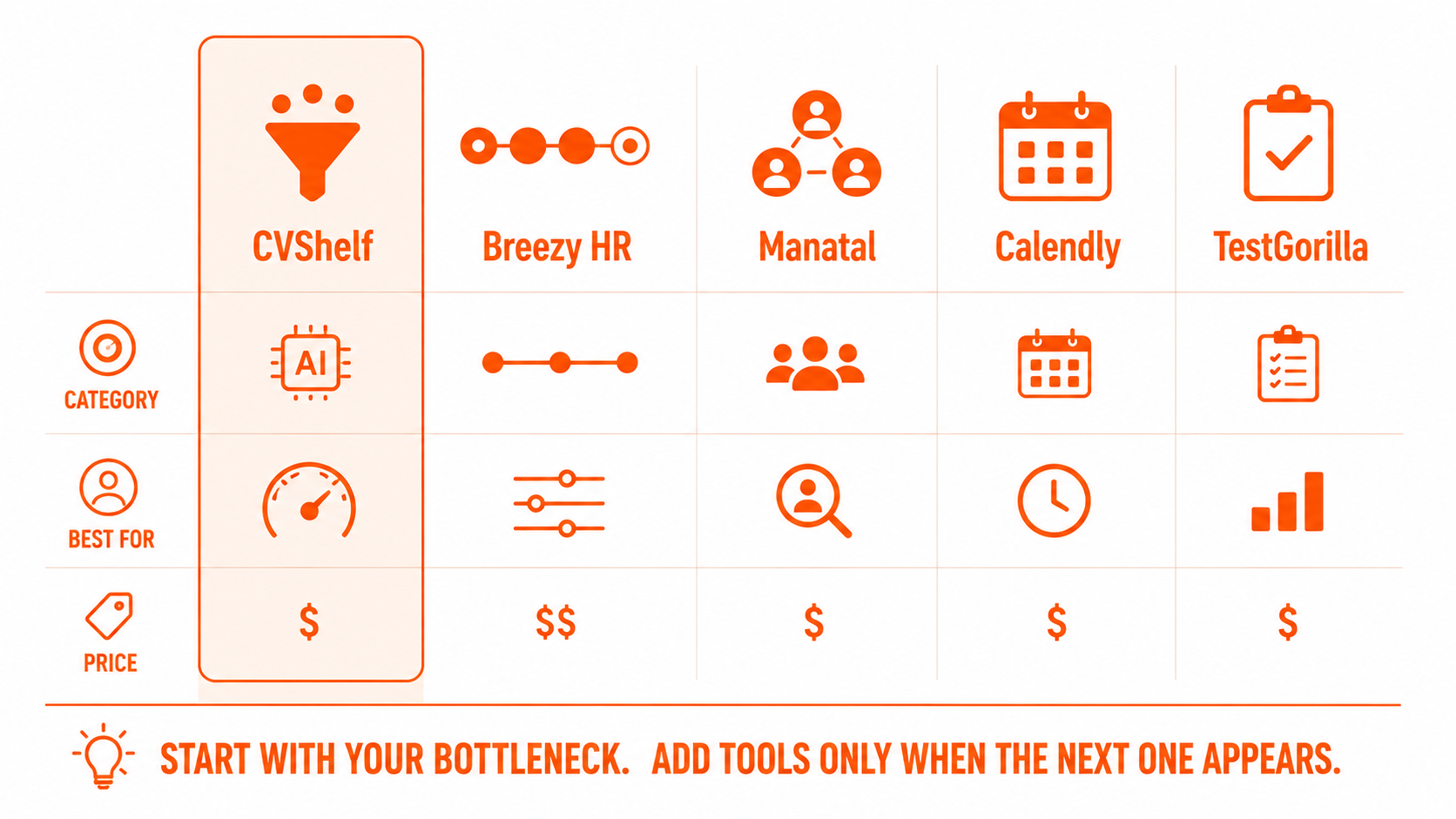
Best Hiring Tools for Small Marketing Agencies in 2026
Most ATS tools were designed for companies with dedicated HR teams, IT departments, and recruitment budgets that small agencies simply don't have.
High-Volume Hiring and Recruitment Automation: A Practical Guide to Scaling Screening Without Losing Quality
High-Volume Hiring and Recruitment Automation transforms how talent acquisition teams manage large applicant pools without sacrificing quality. When organizations face hundreds of applications per role, manual resume screening becomes a…