High-Volume Hiring and Recruitment Automation: A Practical Guide to Scaling Screening Without Losing Quality
High-Volume Hiring and Recruitment Automation transforms how talent acquisition teams manage large applicant pools without sacrificing quality. When organizations face hundreds of applications per role, manual resume screening becomes a…
High-Volume Hiring and Recruitment Automation transforms how talent acquisition teams manage large applicant pools without sacrificing quality. When organizations face hundreds of applications per role, manual resume screening becomes a bottleneck that延
Why High-Volume Hiring Demands a Different Approach
Application volumes have surged dramatically, with many roles now attracting three times more candidates than they did just a few years ago due to one-click apply features and the rise of remote work.
When recruiters face hundreds of resumes per <
Core Challenges That Slow Down High-Volume Recruiting
When application volumes surge, High-Volume Hiring and Recruitment Automation becomes essential to prevent inconsistent evaluation. Without standardized criteria, recruiters often apply different weights to skills, experience, and文化 fit
What to Automate and What Humans Should Still Own
Implementing High-Volume Hiring and Recruitment Automation requires a strategic split between machine efficiency and human judgment. By leveraging AI recruiting tools like CVShelf, teams can automate the heavy lifting of resume screening, bulk parsing, and initial candidate outreach. This allows your team to focus on high-touch activities where human empathy and nuance are irreplaceable.
The following table outlines the clear division of labor necessary to optimize your recruitment workflows and reduce time-to-hire:
| Process Stage | Automation Responsibility | Human Responsibility |
|---|---|---|
| Screening | Bulk CV parsing and AI ranking | Final verification of top-tier matches |
| Scheduling | Automated interview scheduling | Conducting interviews and cultural assessment |
| Communication | Status updates and nurture sequences | Personalized outreach and offer negotiation |
| Decision Making | Data-driven insights and bias-free reports | Final hiring judgment and team consensus |
By delegating repetitive data tasks to High-Volume Hiring and Recruitment Automation, recruiters can reclaim up to 87% of their manual screening time. This balance ensures that while the technology handles the scale, your team maintains the critical human connection that secures top talent.
Building an AI-Powered Screening Workflow That Explains Itself
Building an AI-powered screening workflow that explains itself starts with bulk parsing that can ingest thousands of resumes from sources like LinkedIn and BDJobs in minutes. CVShelf’s parser normalizes every file intoa
Connecting Your Data Sources: LinkedIn, Job Boards, and ATS Integration
Effective High-Volume Hiring and Recruitment Automation begins long before a resume reaches your screening queue. It starts with clean, centralized data ingestion from every channel where candidates apply. Modern talent acquisitionteams
Measuring What Matters: Metrics Beyond Time-to-Hire
Beyond simple speed, High-Volume Hiring and Recruitment Automation allows teams to track the true health of their talent pipeline through advanced metrics. While many recruiters fixate on time-to-hire, the most successful organizations prioritize quality-of-hire by correlating automated screening scores with long-term performance data. By analyzing retention by source, you can identify which channels consistently deliver top-tier talent, allowing you to reallocate your budget toward high-performing platforms.
Furthermore, High-Volume Hiring and Recruitment Automation provides objective hiring manager satisfaction scores by gathering feedback immediately after the interview stage. This data-driven approach highlights screening accuracy, ensuring that the candidates ranked highest by your AI tools are the same individuals who impress your stakeholders. When you measure success through these deeper benchmarks rather than just speed, you transform your recruitment strategy from a reactive administrative function into a strategic asset. Leveraging tools like CVShelf to track these KPIs ensures that every hire is not just fast, but fundamentally aligned with your company's long-term growth objectives and cultural standards.
Keeping Automated Screening Fair, Compliant, and Auditable
Maintaining fairness in High-Volume Hiring and Recruitment Automation requires more than just speed; it demands a foundation of explainable AI. When using automated tools to process thousands of applications, you must ensure every ranking decision is transparent and defensible. By utilizing systems that provide clear, bias-free ranking explanations, HR teams can pinpoint exactly why a candidate was shortlisted, fostering trust with hiring managers and candidates alike.
Compliance is equally critical. Implementing High-Volume Hiring and Recruitment Automation means you must maintain rigorous EEOC and GDPR documentation to stay audit-ready. Modern platforms like CVShelf automatically generate detailed decision audit trails, ensuring every step of your screening process is documented for regulatory reviews. By replacing subjective manual sorting with objective, explainable data, companies reduce legal risks while improving the quality of their talent pipeline. These practices ensure that your recruitment workflows remain both efficient and equitable, allowing you to scale your hiring efforts without compromising on your commitment to fair, data-driven talent acquisition practices across your entire organization.
Helping Recruiters Trust and Adopt Automation
Successful High-Volume Hiring and Recruitment Automation depends on recruiter buy-in, not just technology. Change management starts by involving your team in configuring the screening criteria and weightage that drive the AI ranking. CV
Tailoring Automation for Hourly Roles vs Knowledge Workers
Effective High-Volume Hiring and Recruitment Automation recognizes that hourly and knowledge-worker pipelines demand fundamentally different screening logic. Hourly roles such as warehouse associates or retail staff prioritize speed, EL
Choosing a Screening Intelligence Layer That Fits Your Stack
When selecting a High-Volume Hiring and Recruitment Automation layer, your choice should hinge on how well the tool integrates into your existing stack without forcing a total system overhaul. The best solutions act as an intelligence bridge, pulling data from your current ATS to provide deeper insights. Prioritize platforms that offer explainable AI, as transparency is vital for maintaining trust with your hiring managers and ensuring compliance.
Pricing transparency is another critical factor for mid-market teams. Avoid vendors with hidden enterprise-only fees; instead, look for flexible, usage-based models that scale with your actual hiring needs. A tool that fits your stack should also offer seamless resume screening capabilities that adapt to your specific criteria, rather than a rigid 'black box' approach. By focusing on these core evaluation criteria, you can effectively implement High-Volume Hiring and Recruitment Automation that delivers immediate ROI. The following table highlights key features to look for when comparing potential vendors to ensure your new software supports long-term growth and operational efficiency.
| Feature | Why It Matters |
|---|---|
| Explainability | Ensures bias-free, defensible hiring decisions. |
| Integration Ease | Reduces downtime and manual data entry. |
| Pricing Transparency | Allows predictable scaling for SMBs. |
| Custom Weightage | Aligns AI ranking with unique role needs. |
Frequently Asked Questions
What is High-Volume Hiring and Recruitment Automation and how does it differ from traditional recruiting?
High-Volume Hiring and Recruitment Automation refers to using AI-powered tools to streamline the screening, scoring, and ranking of large candidate pools without sacrificing quality. Unlike traditional recruiting where recruiters manually review each resume, automation handles bulk cv screening, resume parsing, and initial candidate ranking at scale. CVShelf's platform acts as a screening intelligence layer that sits atop your existing ATS, processing hundreds of applications in minutes while providing explainable AI ranking so you understand why candidates score the way they do. This approach reduces screening time by up to 87% while maintaining consistent evaluation standards across all applicants.
Actionable tip: Start by mapping your current screening workflow to identify the biggest time sinks, then test automation on one high-volume role before scaling.
How can I implement High-Volume Hiring and Recruitment Automation without losing candidate quality?
Quality preservation in High-Volume Hiring and Recruitment Automation comes from three pillars: customizable screening criteria, explainable AI ranking, and human-in-the-loop validation. First, define role-specific weightage for skills, experience, and qualifications in CVShelf so the AI evaluates candidates against your exact requirements. Second, use the platform's transparent ranking explanations to verify the AI's logic matches your hiring philosophy. Third, set up a quick human review checkpoint for top-ranked candidates before advancing them. This hybrid approach ensures bias-free hiring at scale while catching edge cases the AI might miss.
Actionable tip: Run a parallel test — screen 50 recent applications manually and through CVShelf simultaneously, then compare results to calibrate your criteria weightage.
What are the biggest challenges in resume screening at scale and how does automation solve them?
The top challenges in resume screening at scale include inconsistent evaluation across recruiters, unconscious bias in manual review, data entry bottlenecks from multiple sources, and candidate experience delays. CVShelf addresses these through automated candidate outreach, LinkedIn applicant import, BDJobs integration, and bulk CV parsing that standardizes data ingestion. The platform's AI resume screening applies identical criteria to every candidate, eliminating recruiter fatigue and bias. Automated scheduling and communication keep candidates engaged throughout the process, reducing drop-off rates common in high-volume funnels.
Actionable tip: Audit your current time-to-hire by funnel stage to pinpoint where automation delivers the highest ROI — usually initial screening and interview scheduling.
How does CVShelf's High-Volume Hiring and Recruitment Automation integrate with my existing ATS and workflow?
CVShelf functions as a screening intelligence layer that enhances — not replaces — your current ATS. The platform offers ATS integration via API and supports seamless data flow: import applicants from LinkedIn and BDJobs with one click, parse and rank resumes in CVShelf, then push shortlisted candidates back to your ATS with scores and explanations attached. This recruitment workflow preserves your existing processes for offer management, onboarding, and compliance while upgrading the screening phase. No data migration or ATS switching required.
Actionable tip: Request a sandbox demo with your actual ATS to test the integration flow using a sample of 20-30 real resumes before committing.
What metrics should I track to measure success with High-Volume Hiring and Recruitment Automation?
Track these five core metrics to validate your High-Volume Hiring and Recruitment Automation investment: 1) Screening time per role (target: 80%+ reduction), 2) Time-to-hire (target: 30-50% faster), 3) Quality of hire measured by 90-day retention and performance ratings, 4) Candidate experience scores via post-process surveys, and 5) Diversity pipeline metrics to confirm bias-free screening outcomes. CVShelf's dashboard surfaces these automatically, letting you correlate screening scores with downstream hiring success. Compare pre- and post-automation baselines after 3-6 months for statistical significance.
Actionable tip: Set up a monthly review cadence with hiring managers to calibrate screening criteria based on quality-of-hire feedback.
Is High-Volume Hiring and Recruitment Automation suitable for companies hiring 50-500 roles per year?
Absolutely. The SMB and mid-market segment (50-500 employees, 50-500 hires/year) is CVShelf's sweet spot — companies that need enterprise-grade screening without enterprise complexity or cost. Unlike point solutions that only handle scheduling or chatbots, CVShelf delivers end-to-end screening automation: bulk CV parsing, AI job description generator, customizable criteria, explainable ranking, and automated outreach in one platform. Credit-based pricing aligns costs with actual volume, so you pay for what you use. This makes recruitment automation accessible for tech startups, boutique agencies, and growing businesses that previously couldn't justify full-suite ATS add-ons.
Actionable tip: Calculate your current cost-per-hire including recruiter hours spent screening — most teams find automation pays for itself within the first 2-3 high-volume roles.
How do I ensure candidate experience stays positive when using AI-driven High-Volume Hiring and Recruitment Automation?
Positive candidate experience in High-Volume Hiring and Recruitment Automation hinges on transparency, speed, and communication. CVShelf enables this by: 1) Instant acknowledgment via automated outreach when applications are received, 2) Clear status updates at each stage (screening complete, shortlisted, interview scheduled), 3) Fast feedback loops — candidates rejected at screening get timely, constructive notes, and 4) Mobile-friendly application flows from LinkedIn and job board imports. The explainable AI ranking also means if candidates ask why they weren't selected, you can share objective, criteria-based reasons rather than vague rejections.
Actionable tip: Add a one-question NPS survey after the screening stage to monitor candidate sentiment and iterate your communication templates quarterly.
Keep Reading
More from AI Resume Screening.
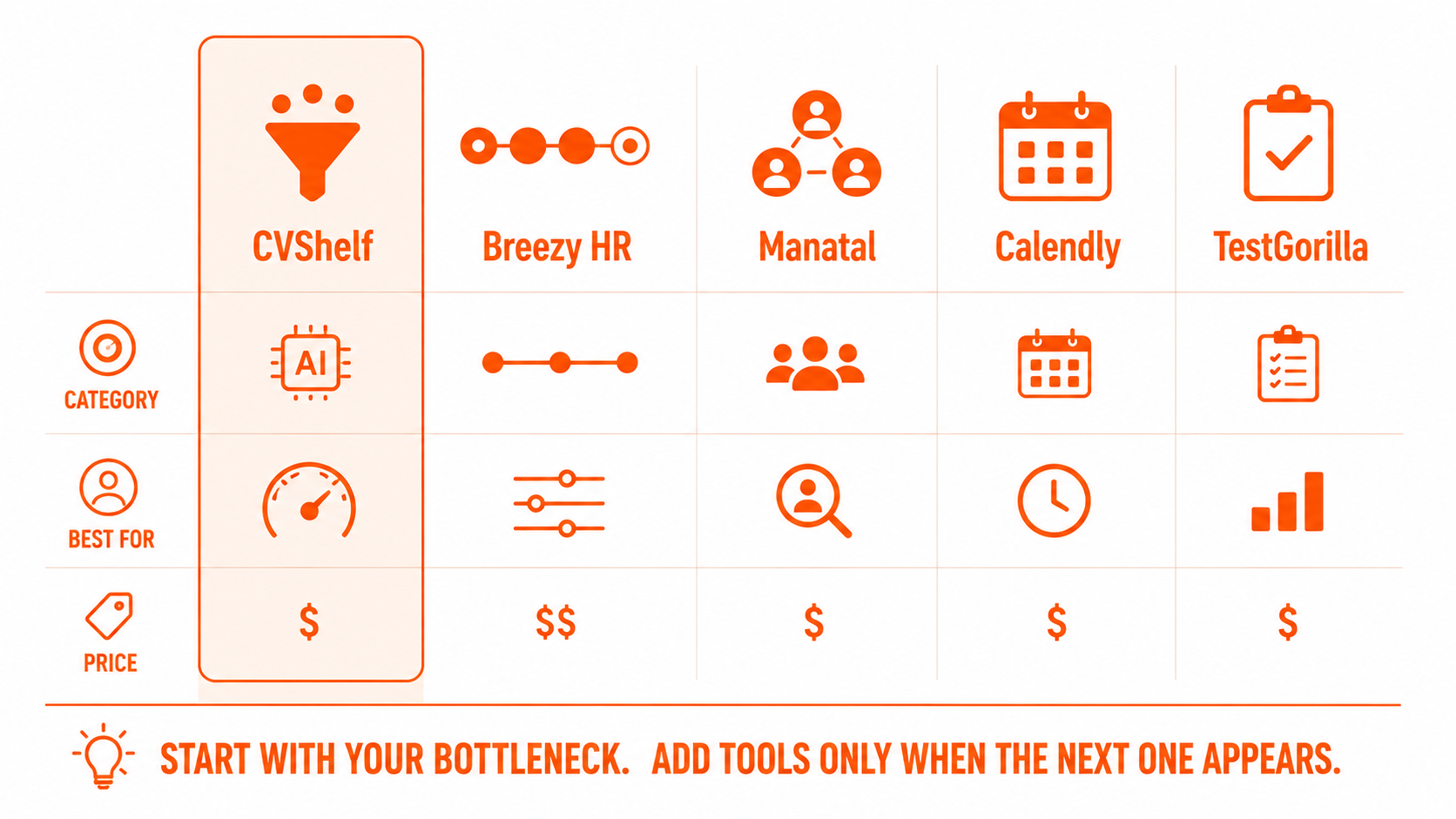
Best Hiring Tools for Small Marketing Agencies in 2026
Most ATS tools were designed for companies with dedicated HR teams, IT departments, and recruitment budgets that small agencies simply don't have.

Automated Candidate Screening and Ranking: A Practical Guide for Modern Hiring Teams
Modern hiring teams face a growing volume of applications that makes manual review impractical and slow. Automated Candidate Screening and Ranking solves this by using AI to parse, score, and prioritize resumes against your exact job <a
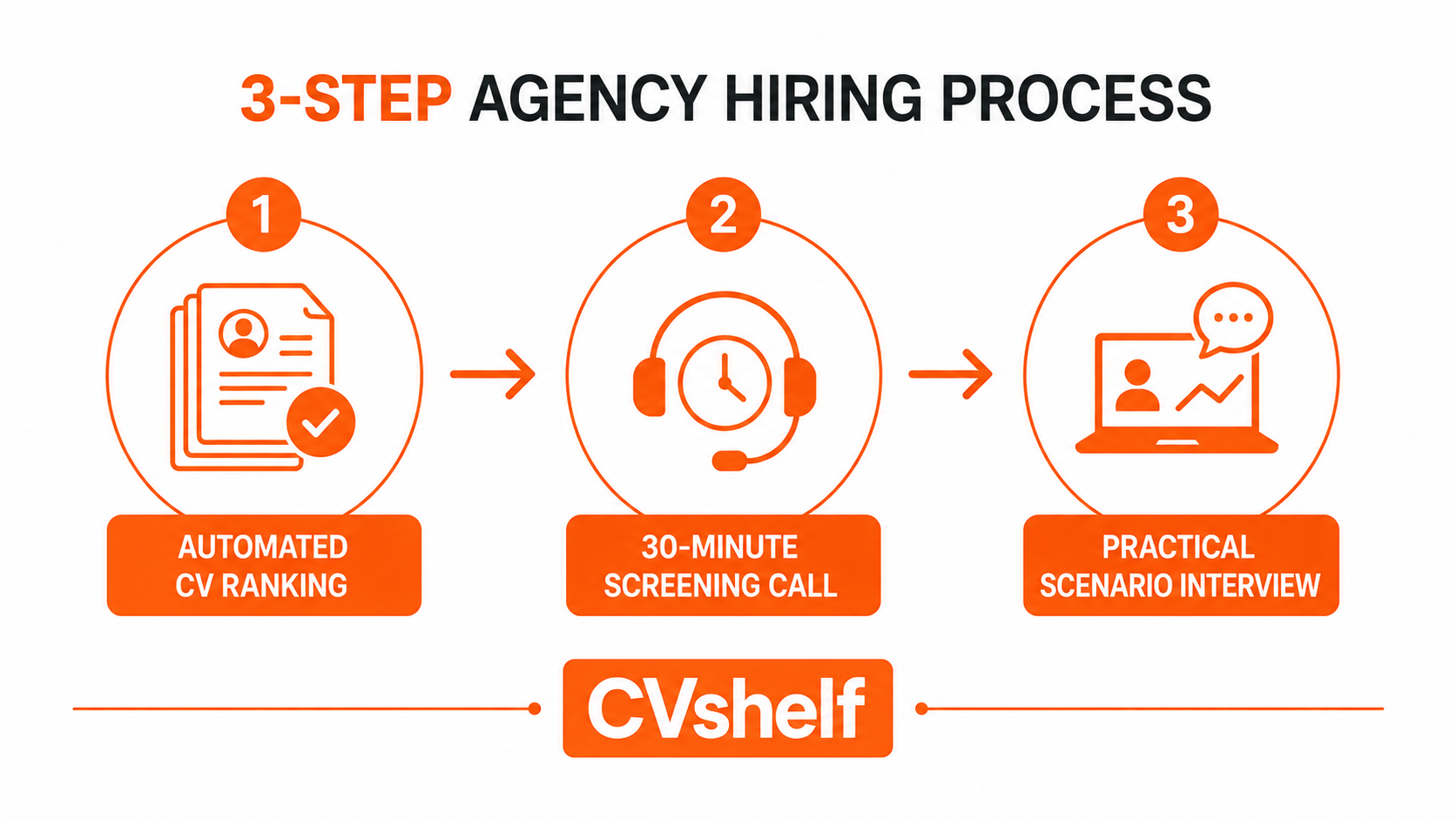
How to Hire an Account Manager Quickly (Without Sifting 200 CVs)
Hiring an Account Manager is usually the bottleneck to growing a boutique agency.