Best Hiring Tools for Small Marketing Agencies in 2026
Most ATS tools were designed for companies with dedicated HR teams, IT departments, and recruitment budgets that small agencies simply don't have.
Enterprise ATS Tools Were Not Built for Your Agency
Greenhouse, Workday, iCIMS. These are real tools. They're also built for companies with 500 employees, dedicated HR teams, IT resources to manage integrations, and months to spend on implementation.
If you run a 30-person digital agency and hire six to ten people a year, none of that applies to you. You need something that works this week, costs less than your monthly software stack already does, and doesn't require a consultant to set up.
The good news: the tools exist. They're just not the ones that come up first in Google when you search "best ATS."
What a Small Marketing Agency Actually Needs
Before the tool list, it's worth being honest about what matters at this size.
Fast setup. You're not hiring a systems administrator to configure it. If it takes more than an afternoon to get running, you won't use it.
No IT dependency. You need to be able to add a role, upload resumes, and get a shortlist without a technical person involved.
AI ranking that explains itself. Not keyword matching. Something that reads the whole resume against the job, scores it, and tells you why. Black-box scores are useless when you need to justify a shortlist to a skeptical hiring manager.
Affordable pricing. For a team doing fewer than fifteen hires a year, paying $500 per month for an ATS is absurd. The tools that work at this size cost $15 to $100 per month.
Clean UI. Hiring at an agency is already the thing nobody has time for. A tool with a complicated interface just adds friction at the worst moment.
None of this is asking for too much. The market has caught up. Here are the tools worth looking at.
Why Traditional ATS Platforms Fail Small Agencies
A standard enterprise ATS implementation takes eight to twelve weeks. The pricing model typically charges per seat, per role, or as a percentage of recruiter headcount, none of which scales sensibly for a team that hires occasionally rather than continuously.
The features you'd actually use at a small agency, posting a job, collecting applications, screening them, tracking candidates through two or three interview stages, represent maybe 10% of what an enterprise ATS does. You pay for the other 90%.
The onboarding process alone is a problem. Enterprise ATS vendors send you an implementation manager. They schedule training calls. They build out your workflow. By the time you're operational, six weeks have passed and you're already overdue on the hire that triggered the decision.
Small agencies need tools that start the same day, not the same quarter.
5 Tools Worth Considering
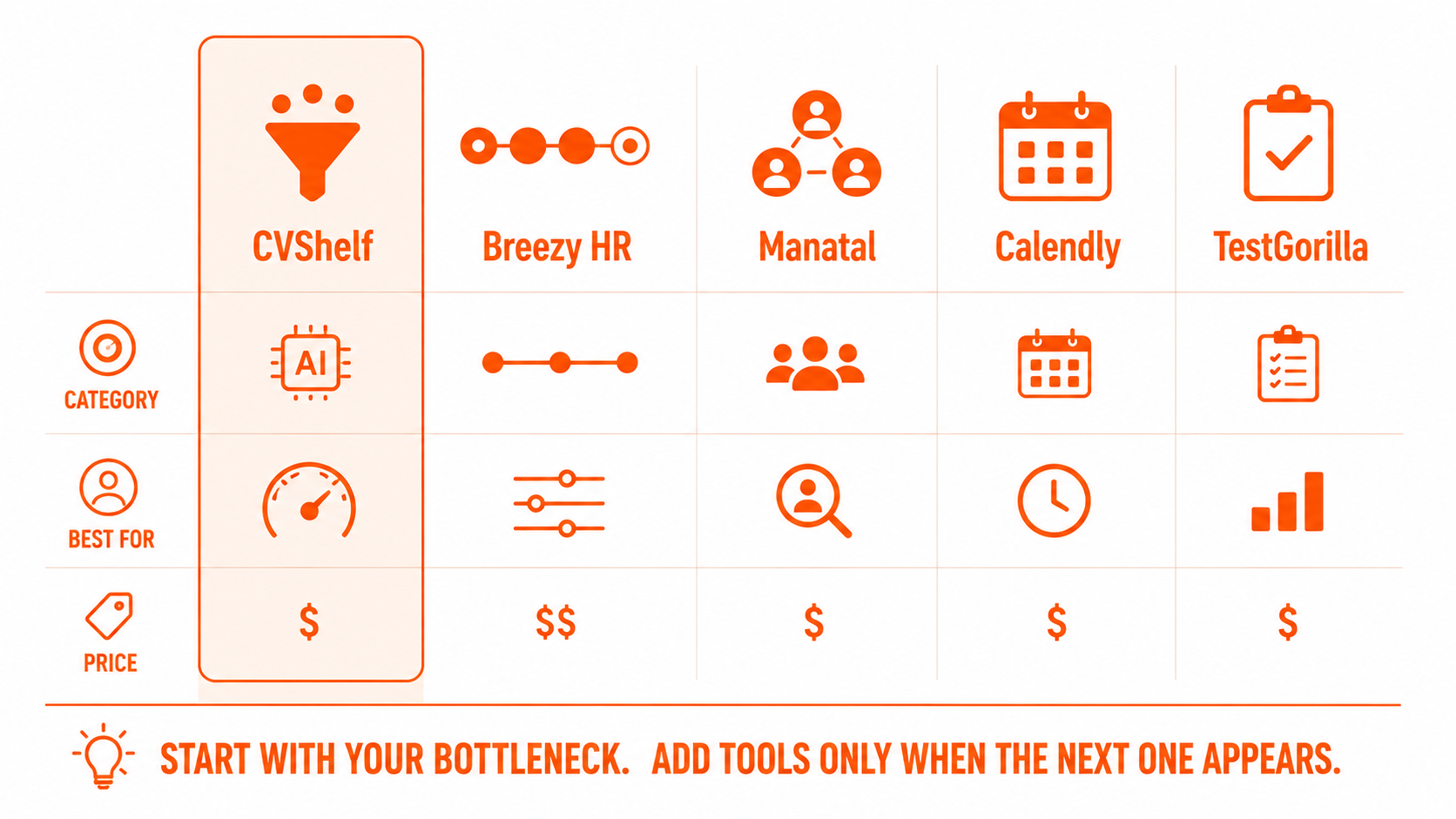
1. CVShelf - AI Resume Screening
CVShelf is not a full ATS. It's an AI screening tool, and that distinction matters. If you're receiving more applications than you can read, CVShelf collapses the screening stage from a week of scattered attention to a 45-minute task.
You paste in your job description (or pull it from LinkedIn directly), upload your resumes in bulk, and get a ranked list with a per-candidate explanation in minutes. The explanation layer is what makes it useful for non-recruiters: you can see why a candidate ranked where they did, override it when context warrants, and present a coherent shortlist to whoever is making the hire. Starts at $29 per month. No setup required.
2. Breezy HR - Pipeline Management
Breezy HR is a lightweight ATS that handles the workflow side: candidate stages, team collaboration on shortlists, automated emails at each stage transition, interview scheduling. It's not trying to do everything. It does the pipeline management part cleanly.
For a small agency that already has a way to screen resumes and wants a simple system to track candidates from shortlist to offer, Breezy is a reasonable fit. Pricing starts around $157 per month, which is on the higher end for this list but includes a full suite of pipeline tools. Worth it if manual tracking via spreadsheet is already causing coordination problems.
3. Manatal - ATS Plus Sourcing
Manatal is a full ATS that includes sourcing, pipeline management, and some AI-powered candidate recommendations. It pulls candidates from LinkedIn and aggregates applications from multiple job boards into a single view. If you don't just want to screen inbound applications but also want to run some proactive sourcing alongside it, Manatal is the most complete tool on this list for the price.
Starts at around $15 per user per month. The trade-off is that it has more features than a small agency typically needs, and more configuration required upfront than CVShelf or Calendly. Worth it if sourcing is a genuine bottleneck.
4. Calendly - Interview Scheduling
Calendly is not an ATS. It's a scheduling tool. It's on this list because interview scheduling is one of the biggest time sinks in small agency hiring, and it's completely automatable.
Candidates pick a time from your available slots. Confirmations and reminders go out automatically. Calendar blocks get created. The back-and-forth email chain that turns a one-hour interview into three days of coordination just doesn't happen. Free tier works for low-volume use. Paid plans start at $10 per user per month. If you're not using something like this, you're spending real hours on a task that takes 90 seconds to automate.
5. TestGorilla - Skills Assessment
TestGorilla lets you send candidates a structured pre-interview skills test. For an AM or strategist hire, this might cover written communication, client scenario thinking, or a channel-specific assessment. It filters candidates before the first interview and gives you something to discuss in the interview beyond what's on the CV.
Useful when you're getting strong-looking resumes but finding in interviews that candidates can't actually do the job. Less useful if your volume is already low and first interviews are short enough to serve the same function. Free tier is limited; meaningful use starts around $25 per month.
Why CVShelf Is the Right Starting Point for Most Agencies
Most small agencies don't need a full ATS. They need to solve the screening problem.
Hiring at a 20 to 60-person agency happens sporadically. A role opens. 150 to 300 applications arrive. The founder or ops manager reads 30 of them, forms rough opinions, and makes a shortlist that mostly reflects energy levels and reading order. The best candidates are somewhere in the pile. Some of them don't get read.
CVShelf fixes that specific problem. Every application gets evaluated against the same criteria. The ranking reflects the job description, not whoever happened to review applications on a Thursday afternoon.
The LinkedIn JD integration is specifically useful for agency operators. You've already posted the role. CVShelf pulls the description directly rather than making you reformat it. Upload your resumes. Get your ranked list. Review the top ten.
No implementation. No training. No consultant. Operational the same afternoon you sign up.
For agencies that want a pipeline tool alongside it, pair CVShelf with Breezy HR. Use CVShelf to get your shortlist, move shortlisted candidates into Breezy to track through interview stages. The two tools cost around $190 per month combined, handle the two biggest pain points in agency hiring, and require no IT resources to run.
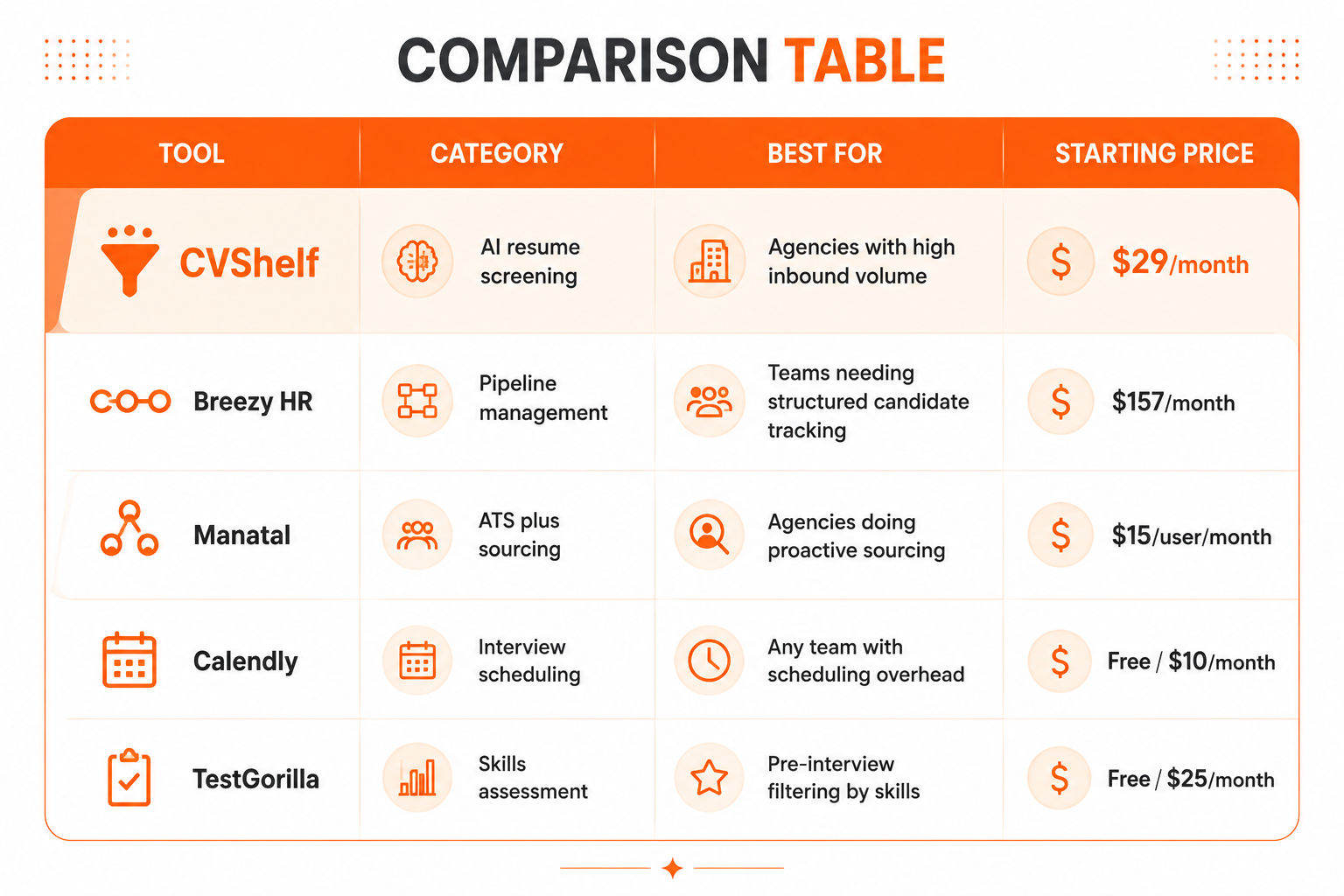
Comparison Table
Start With the Problem, Not the Tool
The right question is not "which ATS should we use?" It's "where is hiring actually slow for us?"
If it's screening, CVShelf. If it's tracking candidates across interview stages, Breezy. If it's sourcing, Manatal. If it's scheduling, Calendly. Start with the bottleneck and add tools only when a new bottleneck becomes genuinely painful.
For most small marketing agencies, the screening stage is where the week goes. That's where to start.
Try CVShelf free at cvshelf.com. Start screening the same day.
FAQs
Q1: Do small marketing agencies need a full ATS?
Probably not, at least not immediately. A full ATS makes sense once you're hiring more than 20 to 25 people per year, running multiple open roles simultaneously, or coordinating hiring across more than two or three people internally. Below that threshold, a lightweight combination of an AI screening tool and a scheduling tool handles most of the actual friction without the cost and setup of a full ATS.
Q2: What is the difference between an ATS and an AI screening tool?
An ATS is a database and workflow tool. It stores candidate records, moves applicants through pipeline stages, handles compliance, and manages communications. An AI screening tool evaluates resumes against job criteria and ranks candidates by relevance. They solve different problems. Most ATS platforms include a basic screening feature, but it typically uses keyword matching rather than real AI ranking, and the output is less useful than a dedicated screening tool.
Q3: How much should a small agency spend on hiring software?
For a 10 to 60-person agency doing five to fifteen hires per year, a reasonable software budget is $50 to $200 per month across all hiring tools. That covers a screening tool, a scheduling tool, and if needed a lightweight ATS. Spending above that requires volume or complexity that most small agencies don't have.
Q4: Can I use CVShelf with my existing ATS?
Yes. CVShelf produces a ranked shortlist with explanations. That shortlist can be exported and the shortlisted candidates moved manually into your existing ATS workflow. CVShelf sits before your ATS in the process: it handles the screening stage, your ATS handles everything from shortlist to offer.
Q5: Which job boards work best for marketing agency roles in the US and UK?
LinkedIn Jobs is the strongest single channel for account manager, strategist, and project management roles at marketing agencies in both markets. Indeed generates higher volume but lower average match quality for agency-specific roles. For more specialist creative or technical roles (UX, paid media, senior strategy), LinkedIn outperforms significantly. Post to one or two boards rather than six: the coordination overhead of more boards doesn't produce proportionally better candidates.
Q6: How do I write a job description that attracts the right agency candidates?
Focus on the first 90 days rather than a comprehensive requirements list. What does success look like at 30, 60, and 90 days? What is the one thing this person must be able to do on day one? Include salary range. Candidates who see "competitive salary" from an agency they've never heard of skip the listing. Keep it under 400 words. Longer descriptions correlate with more applications from people who match the keywords, not the role.
Keep Reading
More from AI Resume Screening.
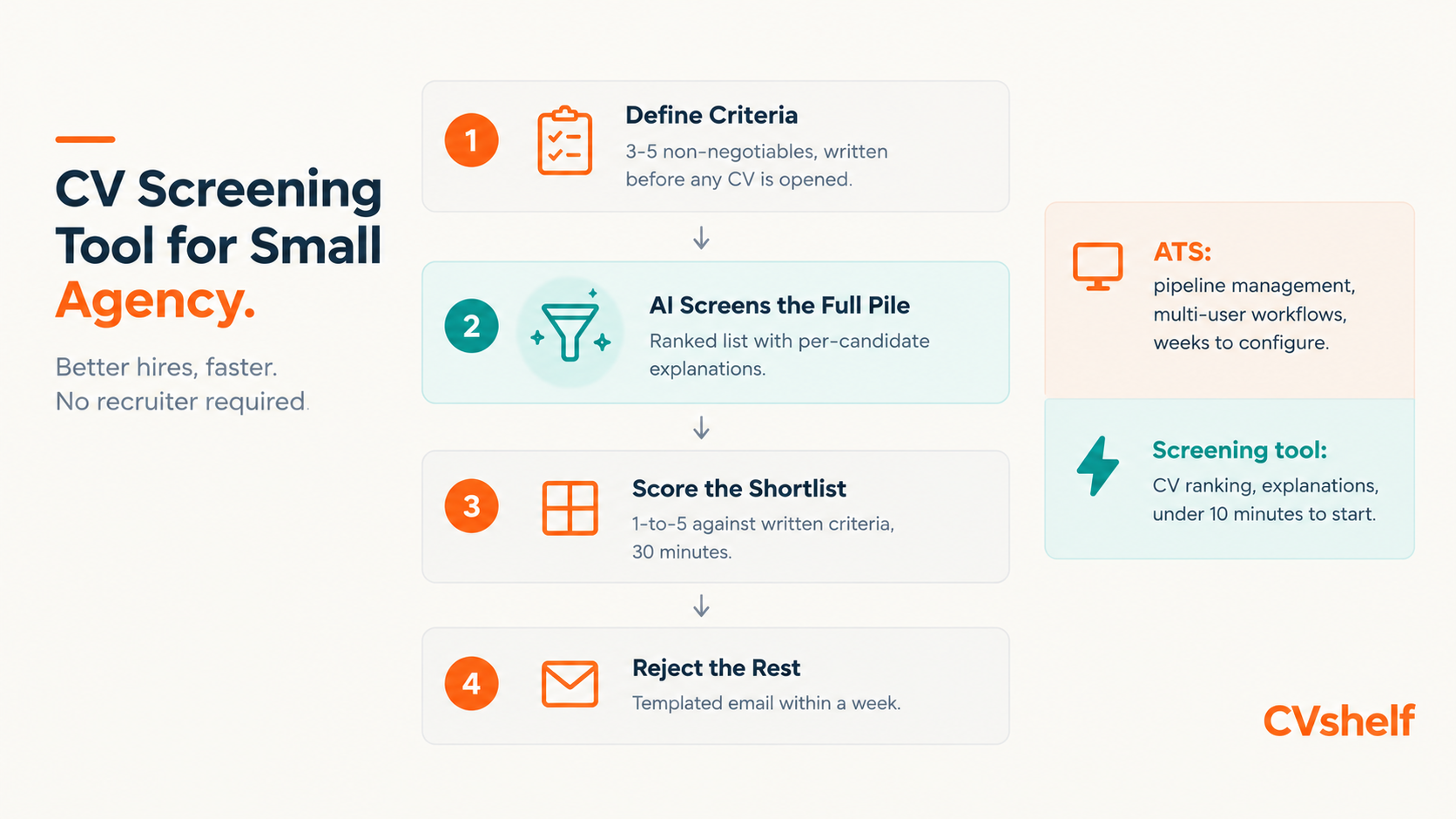
CV Screening Tool For Small Agency
Most CV screening tools were built for companies with dedicated recruiters and continuous hiring pipelines.
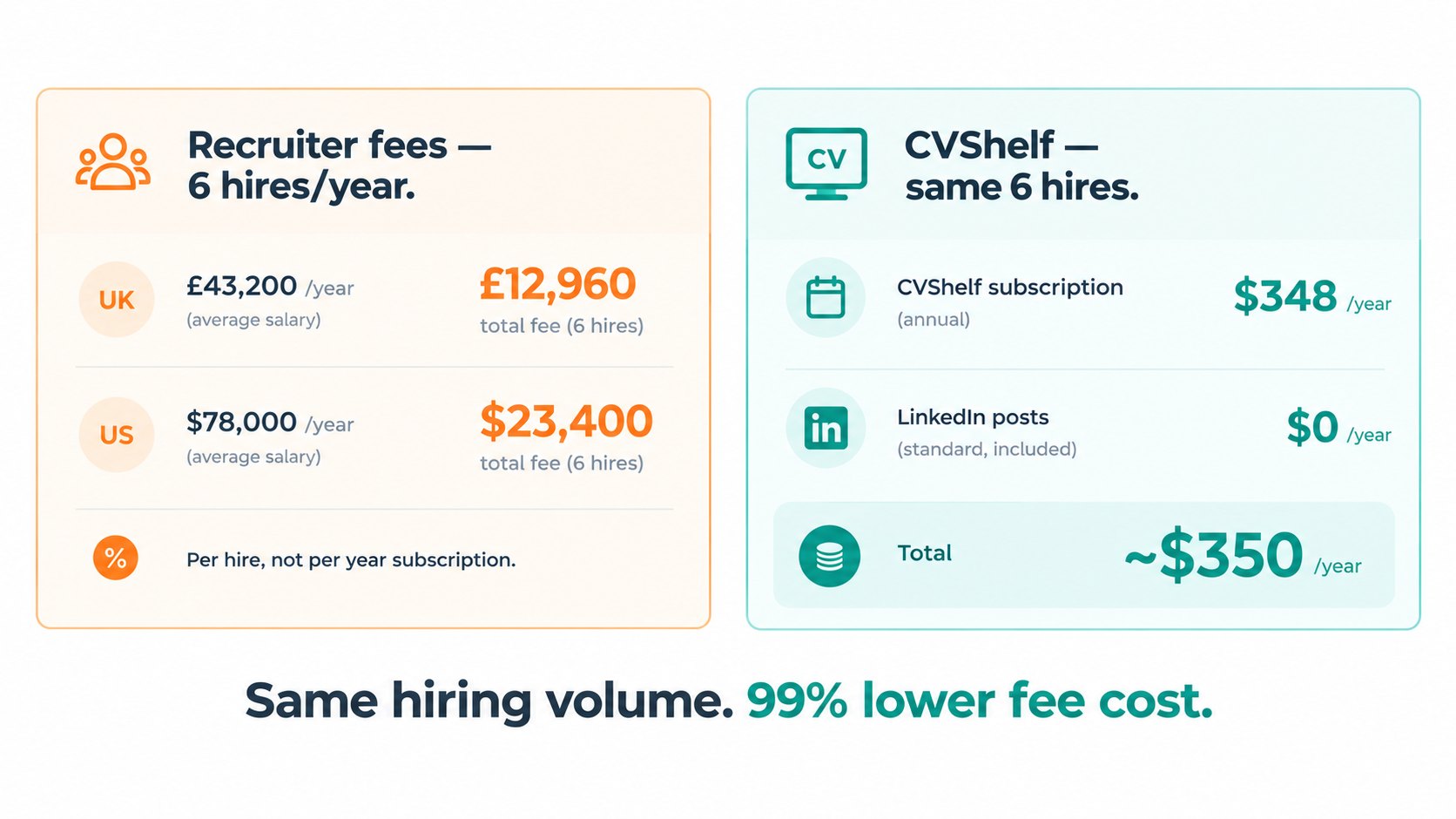
Agency Recruiter Fees Vs Software
A contingency recruiter placing a mid-level account manager.
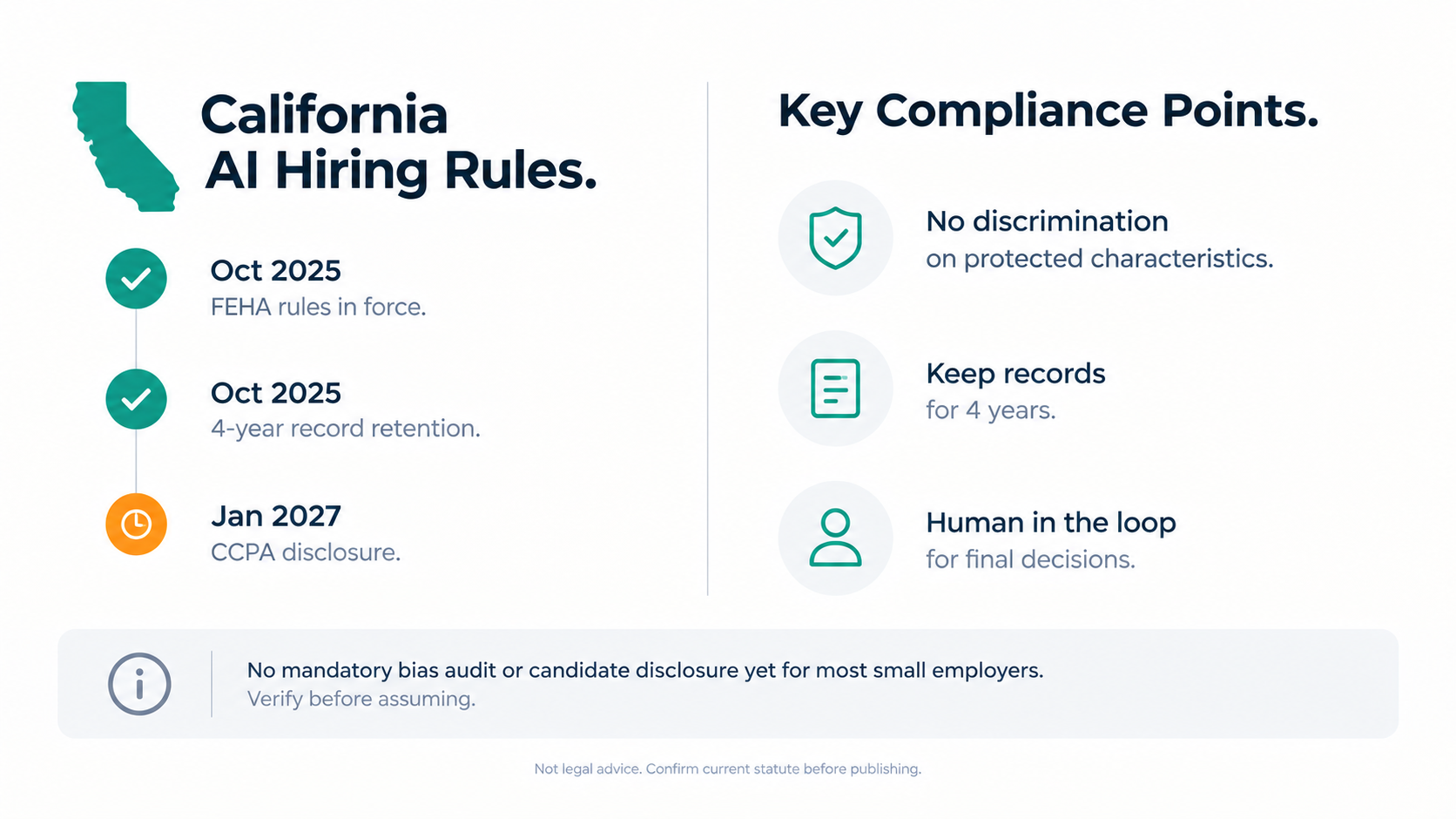
AI Resume Screening Disclosure Law California
California does not currently require employers to disclose to candidates that AI resume screening.