AI Recruitment Tool For Small Agencies
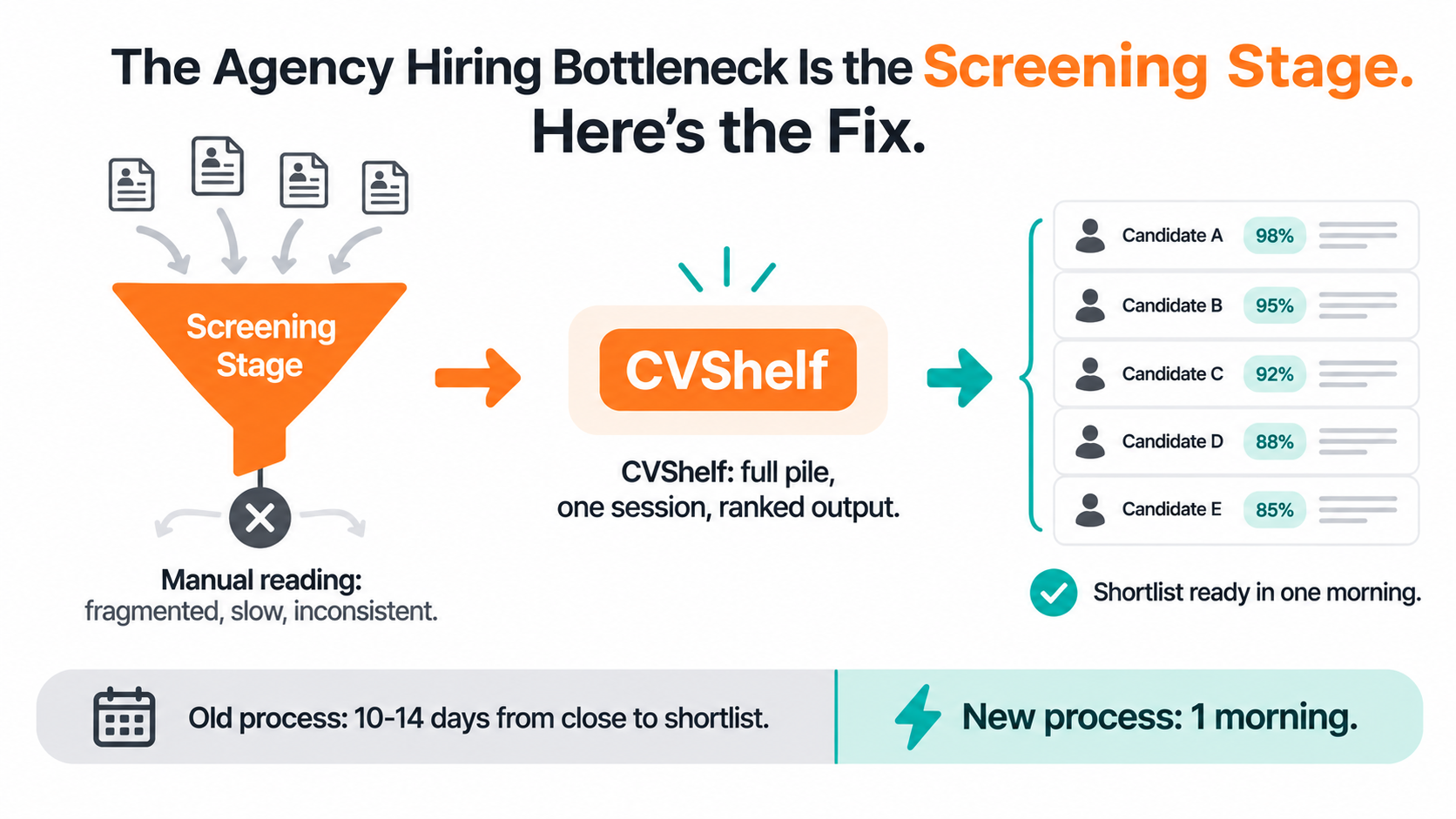
An AI recruitment tool for a small agency needs to do one thing well: take a large pile of inbound CVs
There's a gap in the recruitment software market that most vendors haven't built for: the agency doing six to ten hires a year with no dedicated recruiter, where the ops manager or MD handles hiring between client work and a full operational workload.
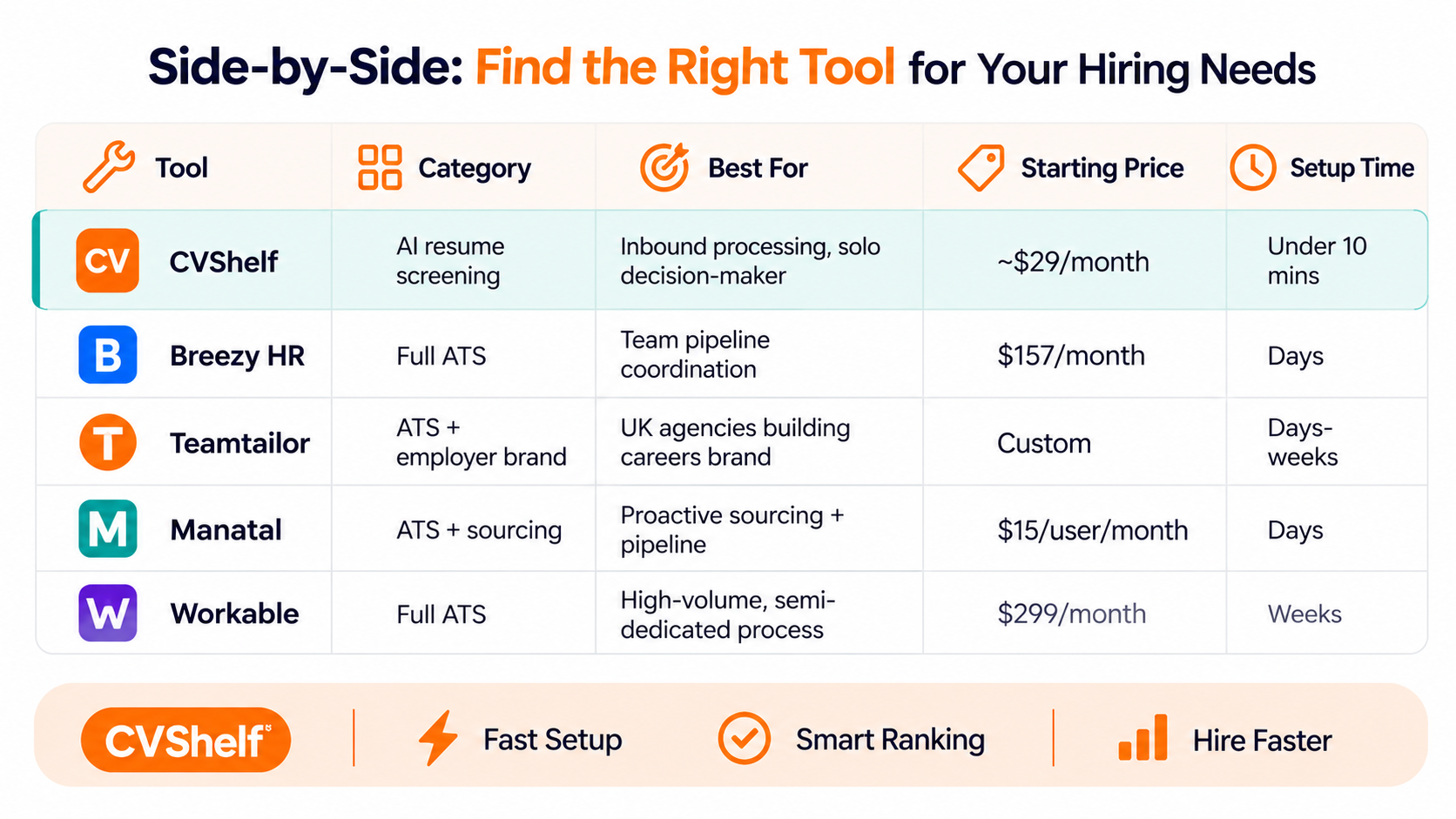
The large platforms, Greenhouse, Workday, iCIMS, are built for enterprise HR teams with implementation budgets and months of onboarding time. The mid-market platforms, Workable, Breezy, are built for teams coordinating hiring across multiple people, running continuous pipelines. Both categories assume a level of infrastructure that doesn't exist at a 40-person agency.
What exists at that agency: one person, a pile of CVs, and a week of other work competing for the same hours.
The Real Problem for Small Agencies
The screening bottleneck at a small agency is specific. It's not a sourcing problem, LinkedIn and Indeed generate enough inbound volume for most account manager, strategist, and coordinator roles. It's not a pipeline management problem, most agencies aren't coordinating hiring across enough people to need multi-stage workflows. It's a volume problem: more applications than one non-specialist can review properly, alongside everything else.
The person reviewing CVs is usually doing it for the third or fourth time this year, with no fresh criteria from the last hire, in fragments between client calls. The shortlist they produce reflects which candidates were read carefully, which were skimmed, and which were missed entirely because the folder was closed before they got to them.
An AI recruitment tool for small agencies needs to solve that specific problem: consistent evaluation of the full application pile, regardless of reading order or reviewer fatigue, with output that a non-specialist can understand and act on.
That's a different product brief from "automate the full recruitment lifecycle." Agencies that evaluate tools against the full lifecycle brief end up buying something that's too complex, too expensive, and gets abandoned after two hires.
What Good Actually Looks Like
Five things. In this order.
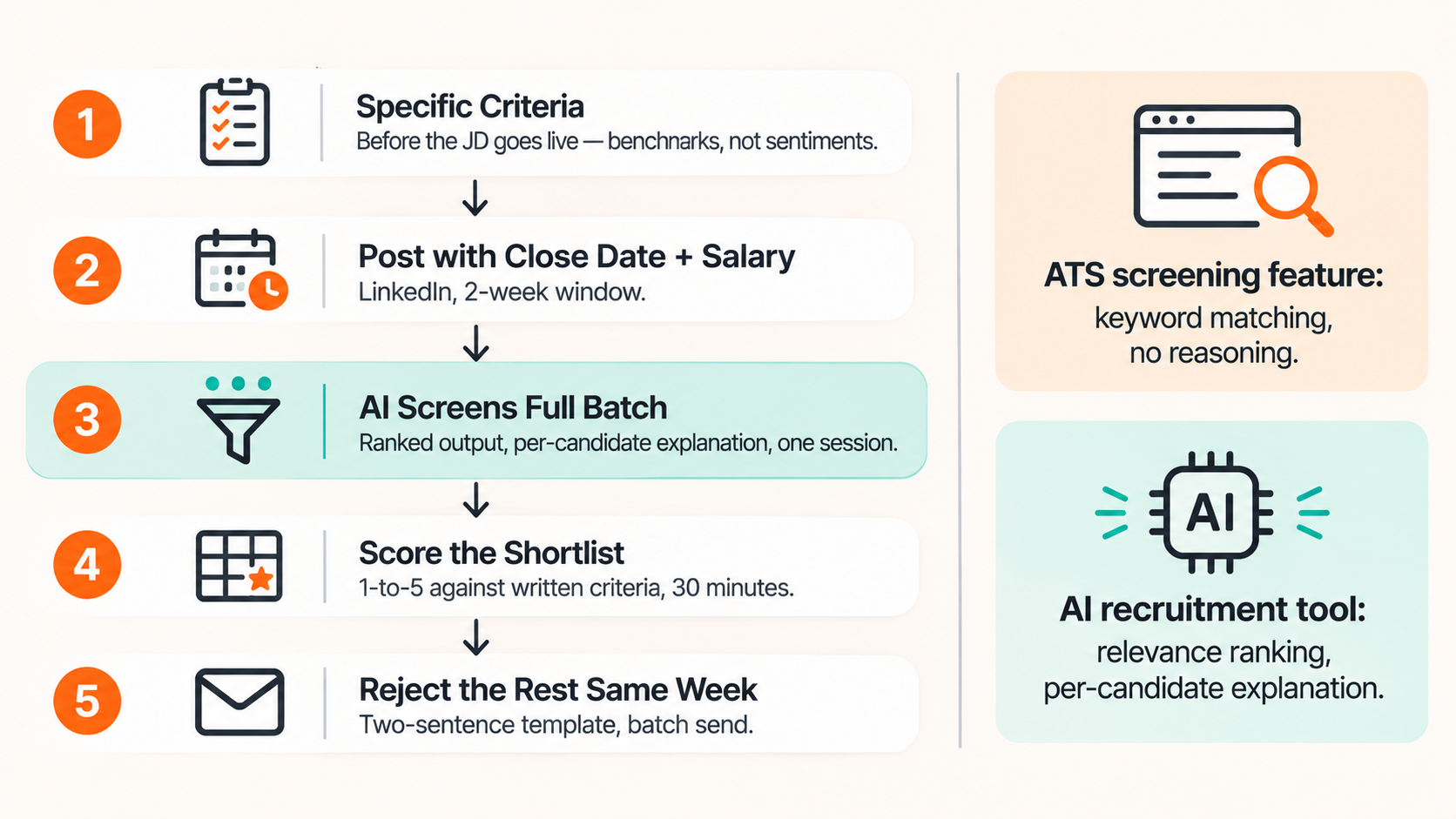
1. Write criteria before the role posts. Not after applications arrive. Not during screening. Before the JD goes live. Three to five non-negotiables, specific ones, not sentiments. "Agency experience required" is a sentiment. "Minimum 3 years managing client relationships at an agency, direct client-facing, not support function" is a criterion. The more specific the criteria, the more useful the AI output.
2. Post with a close date and visible salary. LinkedIn for most agency roles in the US and UK. Close date two weeks out. Visible salary, candidates who can't see the range either skip the listing or discover the mismatch mid-process. A close date means the pile lands as one batch to process rather than a rolling accumulation.
3. Run the full batch through AI screening on close date. Upload every CV, paste in the job description, and let the tool rank the pile and explain the ranking. CVShelf does this: bulk upload, job description input, ranked output with a per-candidate explanation covering what the AI found relevant and what it flagged. Every CV gets the same criteria applied with the same attention. The reviewer reads the top ten to fifteen. A non-recruiter works through this in under an hour.
4. Score the shortlist against written criteria. 1-to-5 per criterion across the top candidates. Takes 30 minutes. Produces a shortlist with a documented basis, when a hiring manager asks why these eight people made the cut, there's an answer that isn't "I thought they seemed strong."
5. Reject the rest the same week. Two-sentence template. Everyone outside the shortlist gets one. Marketing and creative industries are smaller than they look. Candidates who applied to your agency are in your professional network regardless of outcome.
The Most Common Mistake
Conflating AI recruitment tool with ATS.
An AI recruitment tool evaluates incoming CVs and surfaces the best matches with reasoning. An ATS manages the hiring pipeline, candidate stages, automated communications, team visibility, compliance reporting. These are different products solving different problems.
Most ATS platforms have an AI screening feature bolted on. Most of them are doing keyword matching rather than genuine relevance ranking. The output is a sorted list without reasoning. For a trained recruiter, that's workable. For an ops manager who hasn't screened candidates in three months, it isn't.
The second mistake is buying a tool that requires more configuration than the problem is worth. An AI recruitment tool for a small agency should be operational the same afternoon you sign up. If it takes two weeks to configure and requires a training session before you can run a screening, the overhead has already exceeded the value for a team doing this four times a year.
FAQ
Q1. Is there an AI recruitment tool that works without an HR background?
Yes. CVShelf is built specifically for this use case, you paste in the job description, upload the CV pile, and get a ranked list with per-candidate explanations. No configuration, no training, no recruiter methodology required. The explanation per candidate is what makes it navigable for a non-specialist: you're reviewing reasoning, not interpreting a score.
Q2. What's the difference between AI screening and the screening feature in my ATS?
Most ATS screening features use keyword matching, they scan CVs for words from the job description and rank by frequency. AI screening tools evaluate whether the described experience maps to the role requirements at the right level. The practical difference is in the shortlist quality: keyword matching rewards candidates who list every term in the JD; AI ranking rewards candidates whose experience demonstrates genuine fit.
Q3. How long does it take to set up an AI recruitment tool for a small agency?
For CVShelf, under ten minutes per role. Paste in the JD, upload the CVs, run the screening. For most full ATS platforms, days to weeks. The setup time matters more than most buyers account for, a tool that takes two weeks to configure is the wrong tool for a team that hires four times a year.
AI recruitment tools for small agencies work when they're simple enough to pick up, put down, and use again four months later without relearning them.
Try CVShelf complimentary at cvshelf.com.
Keep Reading
More from AI Resume Screening.
Recruitment Software UK Small Agency
This post is for COOs and ops managers at 10 to 100-person UK digital marketing.
How Many Applicants For A Marketing Coordinator Role
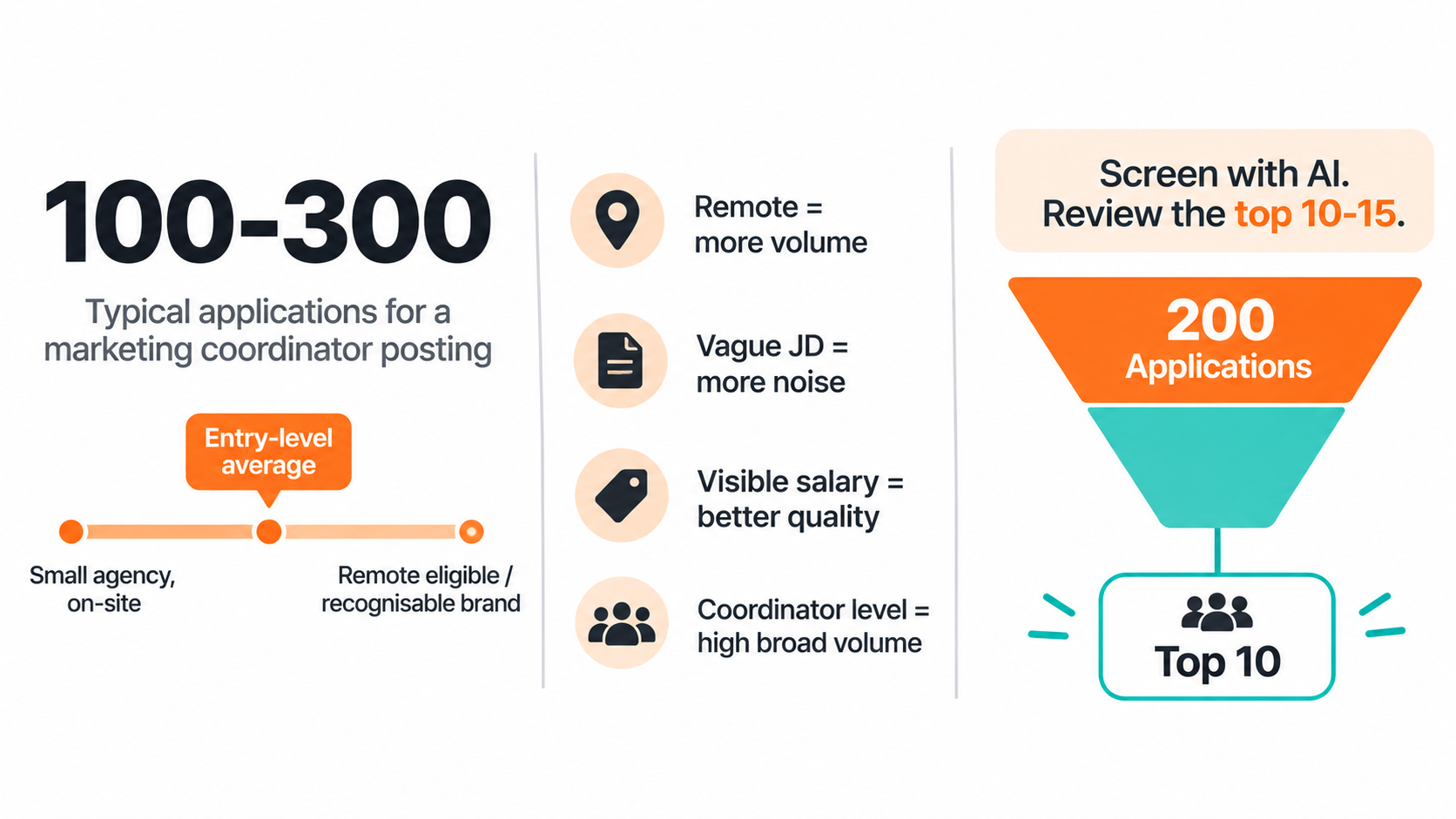
A marketing coordinator role typically attracts 100 to 300 applications on LinkedIn.
Hiring Bottleneck Marketing Agency
The hiring bottleneck at most marketing agencies isn't finding candidates; it's the screening stage.