Hiring Bottleneck Marketing Agency
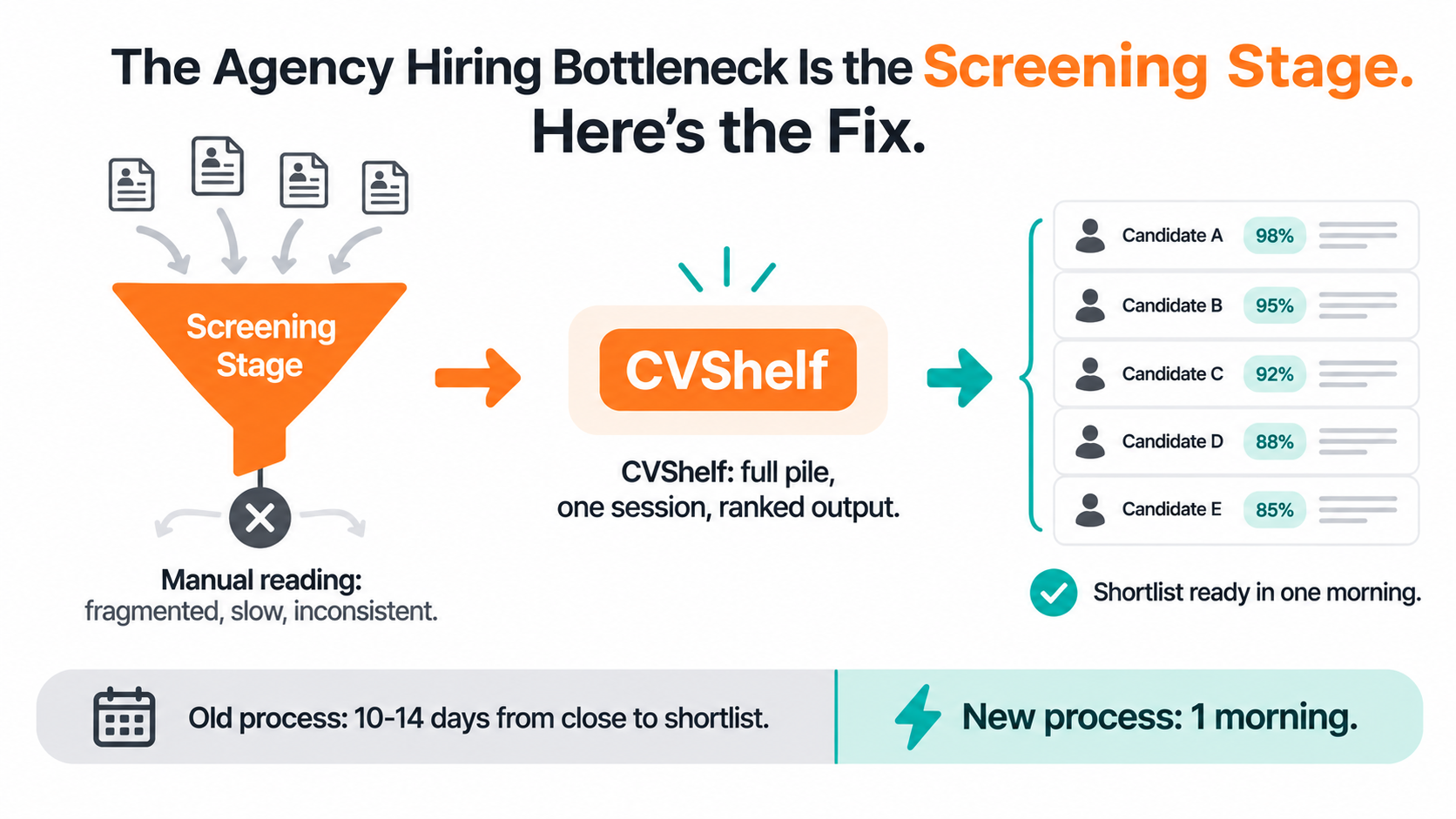
The hiring bottleneck at most marketing agencies isn't finding candidates; it's the screening stage.
The new scope just signed. The account director needs a senior strategist on the team by kickoff.
The job goes live Tuesday. By Friday there are 140 applications sitting in a shared folder.
Monday comes. The folder is still there. So is everything else.
Why the Screening Stage Becomes the Bottleneck
The screening bottleneck at a marketing agency isn't a resourcing problem. It's a process problem.
Applications arrive continuously and sit in an inbox or shared folder with no fixed processing date. The person handling screening, usually the ops manager, COO, or the MD themselves, has competing priorities that always feel more urgent. Client work has deadlines. The CV pile doesn't.
So it gets deferred. Tuesday becomes the following Monday. What should have been a two-day turnaround becomes ten days of the pile growing while it sits.
And when the screening does happen, it happens in fragments. Thirty minutes here, forty minutes there, interrupted by client emails and team questions. Criteria drift across sessions. The candidate reviewed on a tired Thursday afternoon gets less attention than the candidate reviewed on a fresh Monday morning. The shortlist reflects when things were read, not who should be shortlisted.
This is the bottleneck. Not the hiring market. Not the job description. The screening stage, run without a process, by someone doing it in the gaps.
What It Costs
The slow screen has two costs. One shows up in reports. One doesn't.
The visible cost is timeline slippage. A role that should close in ten days takes three weeks. The team covers the gap while it's open. Someone stretches. Delivery quality at the margins drops.
The invisible cost is the new client relationship.
When a marketing agency wins a new account, the client's expectations are set in the pitch. They expect a capable, fully resourced team from day one. When the strategist or AM role is still open in week two of the engagement, the client starts feeling the understaffing before they can name it. Response times are slower. The strategy conversation gets delayed. The energy from the pitch starts to dissipate.
Early client attrition rarely traces to a single deliverable. It traces to the first 60 days and whether the client felt properly looked after. An unfilled role during that window is a retention risk that shows up in renewal conversations three months later, not in the hiring timeline report.
There's also the candidate side. Good mid-level marketing strategists and account managers are in multiple processes simultaneously. They accept the first reasonable offer. An agency that reaches the offer stage in week three is offering to whoever is still available. That's a different shortlist from week one.
A Better Way to Handle It
Three changes that remove the bottleneck without adding headcount.
Set a close date the day the role posts. Not "we'll close when we have enough candidates." A specific date, two weeks out. On that date, the pile gets processed in one session. This converts a rolling inbox problem into a single manageable task with a fixed deadline.
Run the full pile through AI screening on close date. Upload everything, paste in the job description, and get a ranked list with per-candidate explanations in one session. The screening that used to take a week of fragmented reading takes one focused morning. For a deeper look at how to structure this for marketing and creative roles specifically, the guide to resume screening for creative agency hiring covers the framework in detail.
Offer same day as the final interview. Agree on salary and terms internally before the interview. If it goes well, make the verbal offer before you hang up. The deliberation gap is where agencies lose candidates they've already invested three rounds in.
Where CVShelf Removes the Bottleneck
CVShelf handles the screening stage specifically. Paste in the job description, upload the full pile as a batch, get a ranked shortlist with a short explanation per candidate.
The explanation is what makes it useful for non-recruiters. You're not accepting a score. You're reading a reasoned recommendation: what the AI found relevant, what it flagged, why this person ranked above that one, and deciding whether you agree. A COO or ops manager works through the top fifteen candidates in under an hour rather than across a fragmented week.
CVShelf starts at $29/month. No setup call required.
FAQs
Q1. Why does hiring always take so long at a marketing agency?
Usually the screening stage. Applications sit in a folder with no fixed processing date, get reviewed in fragments between client work, and produce a shortlist that takes ten days instead of two. The fix is a close date on every role, a single screening session on that date using an AI tool, and a same-day offer policy for final interviews.
Q2. What is the fastest way to screen 150 marketing agency CVs?
Set written criteria before opening any applications. Run the full pile through an AI screening tool on close date, upload the batch, paste in the JD, get a ranked list with per-candidate explanations. Review the top fifteen with your full attention. The process takes one morning rather than a week.
Q3. How do growing agencies keep up with hiring demand?
Build the hiring process before the next role opens, not after. A brief template that takes 20 minutes to adapt, a close date policy, AI screening for the application batch, and a same-day offer policy at final stage. That system runs in parallel across multiple open roles during growth phases without requiring a dedicated recruiter.
The screening bottleneck is solvable. Close dates, AI screening, one morning per role.
Try CVShelf complimentary at cvshelf.com.
Keep Reading
More from AI Resume Screening.

Resume Screening For Creative Agency Hiring
Resume screening at a creative agency is harder than it looks because the roles are harder.
Resume Screening Software USA
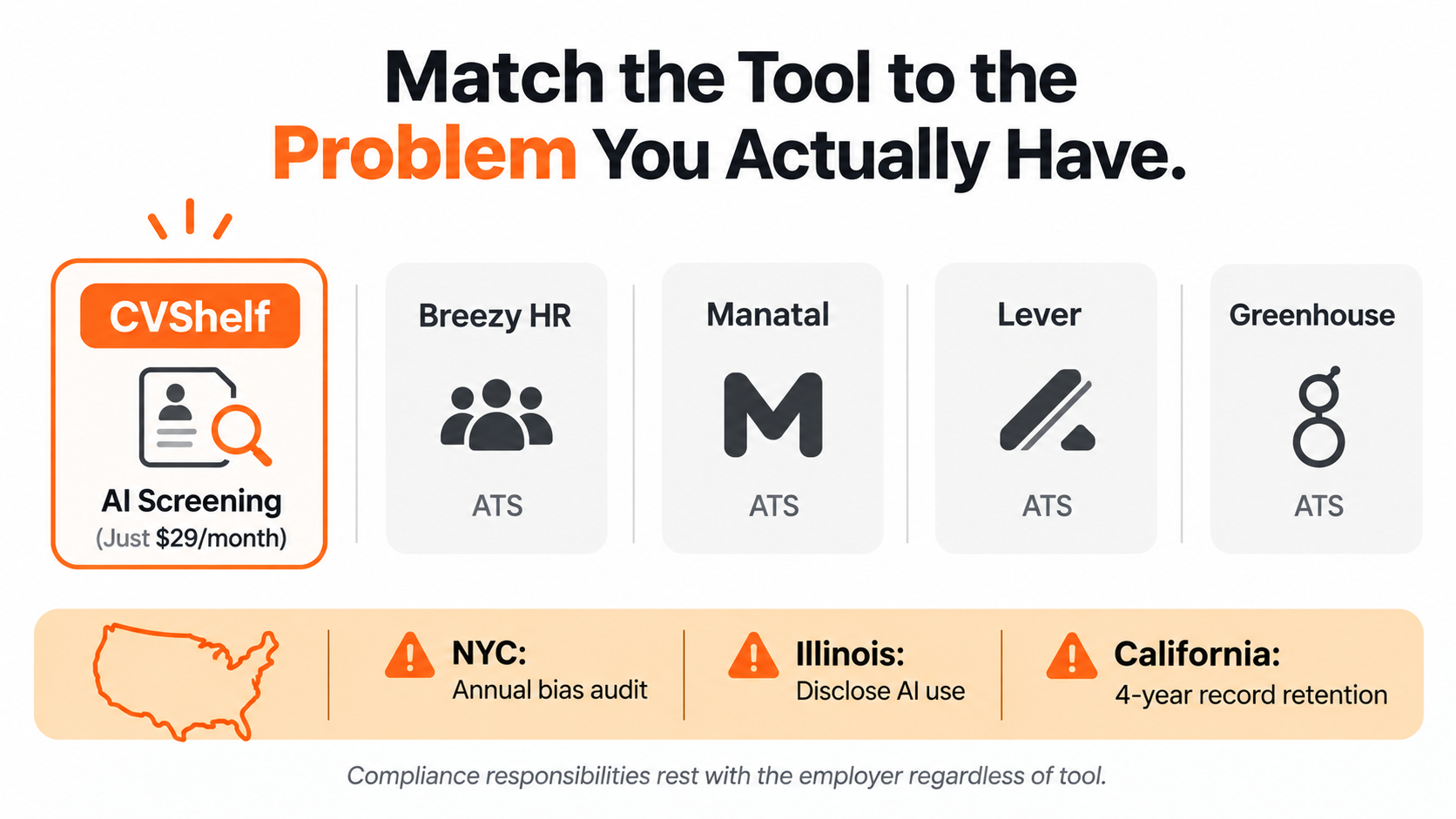
This post is for founders and MDs at 10 to 100-person US agencies, digital marketing, creative, or integrated.
Screening Candidates Without An ATS
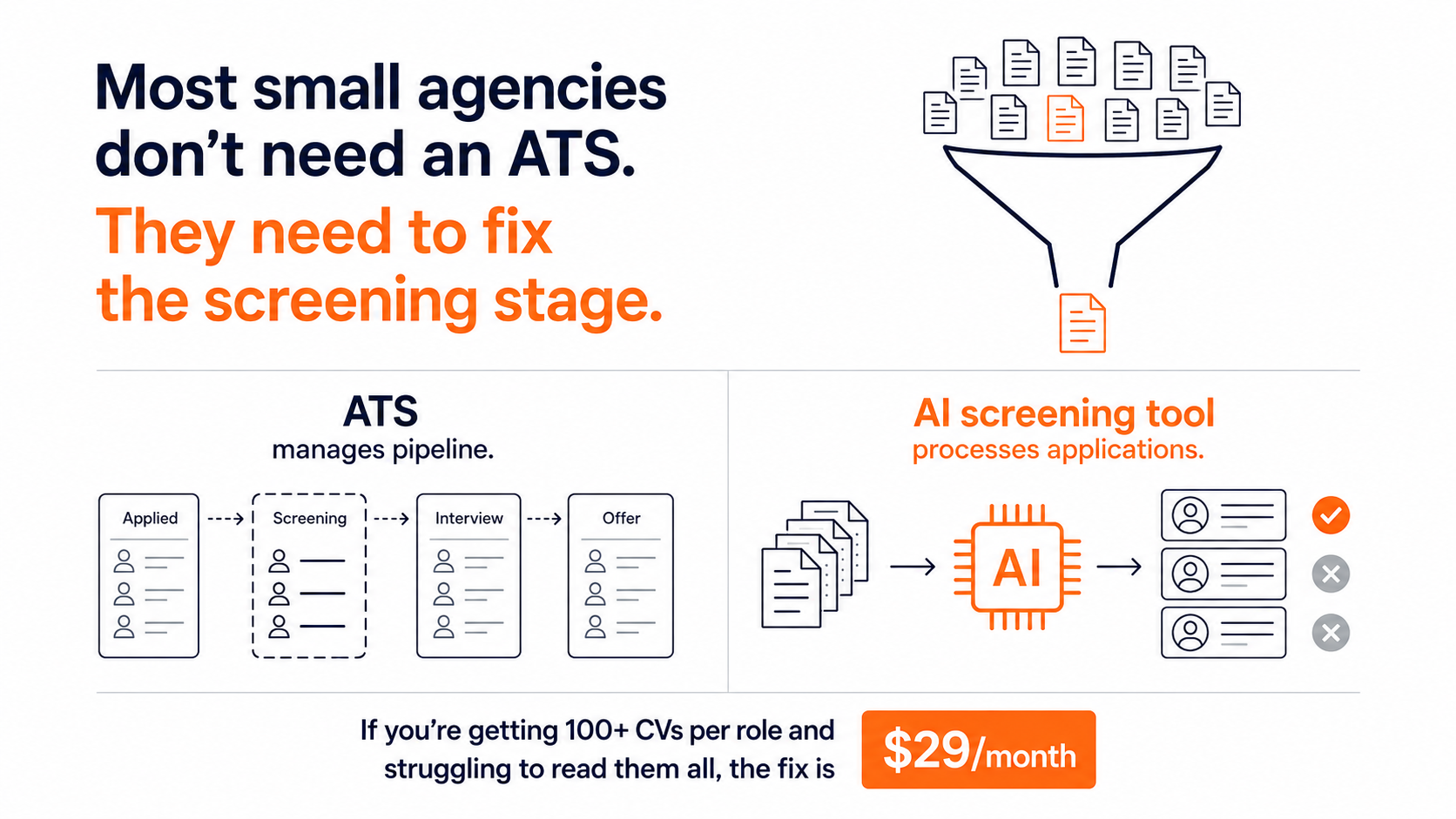
Screening candidates without an ATS is normal for agencies doing fewer than 15 to 20 hires per year.