
Candidate Ranking Tool For Agencies
A candidate ranking tool for agencies needs to do something most ATS screening features don't.
Most agencies that search for a candidate ranking tool have the same underlying problem: a pile of 100 to 200 applications arrived, one person has to process them, and that person isn't a recruiter. They're a COO, an ops manager, or occasionally the MD themselves, someone who needs to surface the right candidates quickly and move on to the next thing.
The tools that claim to solve this are not all doing the same thing. Some are running genuine language model-based evaluation. Most are doing keyword matching with a ranking layer on top. The practical difference matters more than the marketing language around it.
The Real Problem at This Size
An agency doing six to ten hires a year has a specific screening problem. It's not the same as a corporate hiring team's problem, and it's not the same as a staffing agency's problem.
The corporate team has a dedicated recruiter, standing criteria, and a process that gets better with repetition. The staffing agency has specialists who screen candidates every day. The 40-person digital agency has an ops manager who screens four times a year, with no rubric, no screening background, and competing client work.
The gap that matters here is explainability. When a non-specialist reviews a ranked list, they need to understand why candidate A ranked above candidate B. Not because they're going to override every decision, but because they need to be able to defend the shortlist to a hiring manager or MD who wasn't part of the screening. "The system ranked them this way" is not a defensible shortlist. "The AI flagged this candidate because they have three years of direct agency-side AM experience and hit every criterion in the brief" is.
A ranking tool that produces scores without explanation is a black box. For a trained recruiter with 10 years of instinct about what good looks like, that might be workable. For an ops manager handling this four times a year, it isn't.
What Good Actually Looks Like
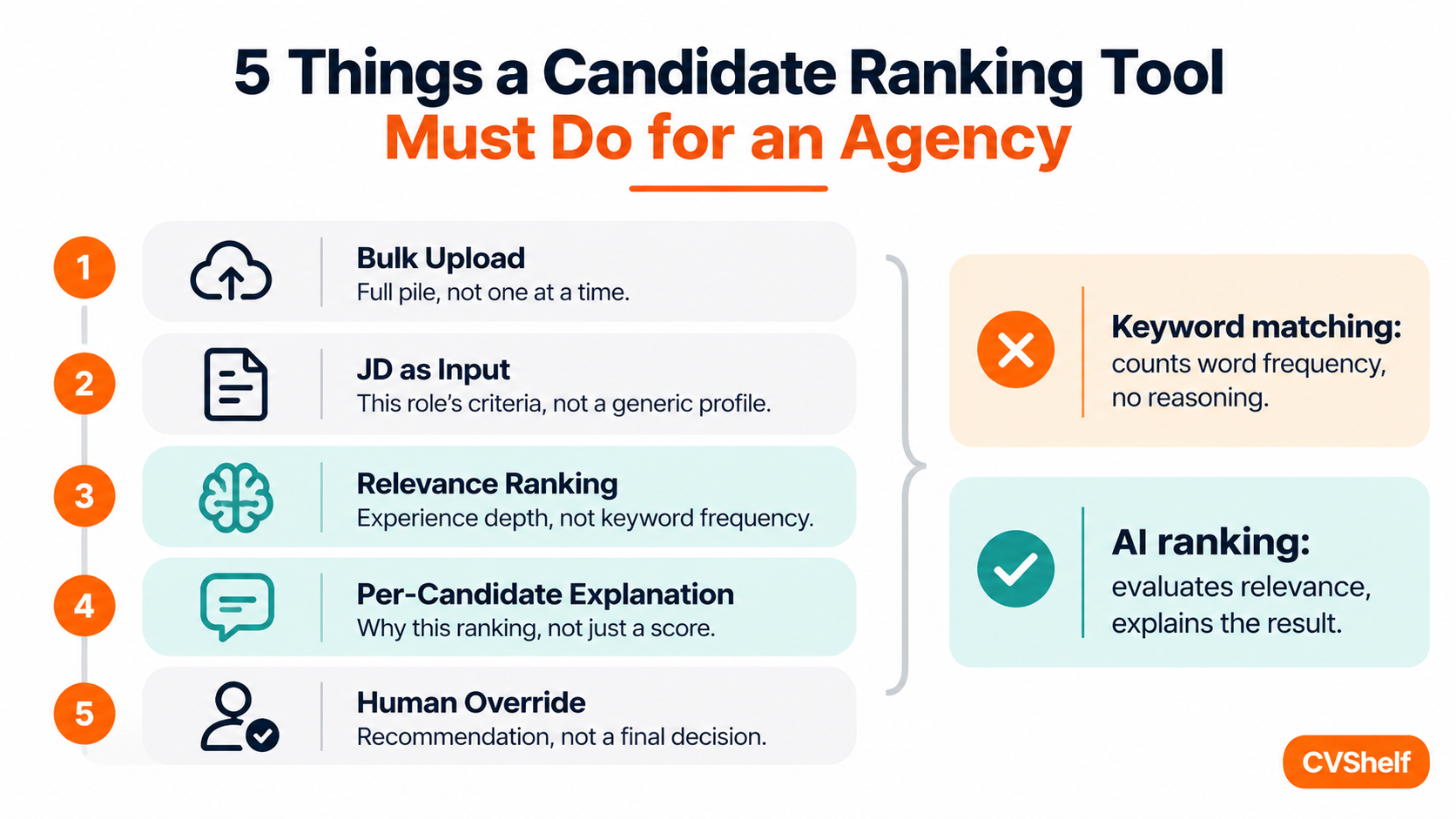
Five things a candidate ranking tool needs to do well at agency scale.
1. Accept bulk uploads. Not one resume at a time. The whole pile, as a zip file, a folder of PDFs, or a batch of Word documents. Any tool that requires manual entry or one-at-a-time upload adds back the labour it's supposed to remove.
2. Take the job description as input, not a generic profile. The ranking should be against this specific role's requirements, not a normalised "account manager" profile the vendor maintains. Paste in the JD or pull it from the job post. The criteria set the benchmark; the ranking reflects how each candidate measures against them.
3. Rank by relevance, not keyword frequency. This is the line between keyword matching and genuine AI ranking. Keyword matching counts how often terms from the JD appear in the CV. AI ranking evaluates whether the described experience maps to the role requirements at the right level. A candidate who "managed a 10-person client services team through a rebrand and migration" demonstrates relevant seniority and capability, even if none of those exact phrases appear in the job description. The tool needs to catch that.
4. Explain the ranking per candidate. Every candidate in the output should come with a short note: what the AI found relevant, what it flagged as missing, and why this person ranked where they did. CVShelf does this, the ranked list includes per-candidate reasoning that the reviewer can read, agree with, question, or override. That explanation is what converts a ranked list into a usable shortlist for someone without a recruiting background.
5. Allow human override. The ranking is a recommendation, not a decision. The reviewer should be able to pull a candidate from position 20 to the shortlist if context warrants it, a career transition that looks unconventional on paper but makes sense given what they know about the role. A tool that presents rankings as final outputs rather than inputs to human judgment is the wrong design for this use case.
The Most Common Mistake
Confusing keyword matching with candidate ranking.
Most ATS platforms market their screening as "AI-powered." Some of them are. Most are running pattern-matching on keywords and calling the output a ranking. The giveaway is the explanation layer, or lack of one. A keyword-based system can show you a score. It can't show you why, because the "why" is just frequency, which isn't meaningful reasoning.
The second mistake is evaluating ranking tools as if they're the same as pipeline tools. A ranking tool processes incoming CVs and surfaces who's worth talking to. A pipeline tool tracks candidates through stages, coordinates communications, and manages team visibility. These are different products. Buying an ATS to get a ranking feature usually produces a weak version of both.
For a 40-person agency doing eight hires a year without a dedicated recruiter, a standalone ranking tool at $29/month outperforms the ranking feature of a $150/month ATS in the only metric that matters: does it produce a shortlist you can act on, explained in terms a non-recruiter can use?
FAQ
Q1. What's the difference between a candidate ranking tool and an ATS?
An ATS is a database and workflow platform, it stores candidate records, tracks stages, handles communications, and manages team visibility. A candidate ranking tool evaluates incoming applications and surfaces the best matches with reasoning. Most ATS platforms include a basic ranking feature, but it tends to be keyword-based rather than AI-based, and it doesn't produce per-candidate explanations. A dedicated ranking tool solves the screening problem better; an ATS solves the pipeline coordination problem. They're different products.
Q2. Does AI candidate ranking work for creative and marketing roles?
Yes, when the job description is specific. Creative and marketing roles require qualitative experience that's harder to capture in keyword frequency, things like client relationship management, campaign strategy, and cross-functional coordination. A genuine AI ranking tool evaluates whether those things are described in the candidate's experience, not just whether the words appear. The quality of the ranking scales with the specificity of the job description.
Q3. How do I know if a ranking tool is actually using AI or just keyword matching?
Ask for a sample output on a role you know well and check whether the top candidates have high keyword density or genuine relevant experience. If a candidate with five years of agency-side AM experience ranks below someone who listed every keyword in the job description without evidence behind them, it's keyword matching. If the ranking reflects experience depth and the output includes per-candidate reasoning rather than just a score, it's doing something closer to genuine evaluation.
Candidate ranking at agency scale requires explainability, not just sorting. A tool that shows its reasoning converts a pile of applications into a shortlist a non-recruiter can own.
Try CVShelf complimentary at cvshelf.com.
Keep Reading
More from AI Resume Screening.
Agency Growing Pains Hiring
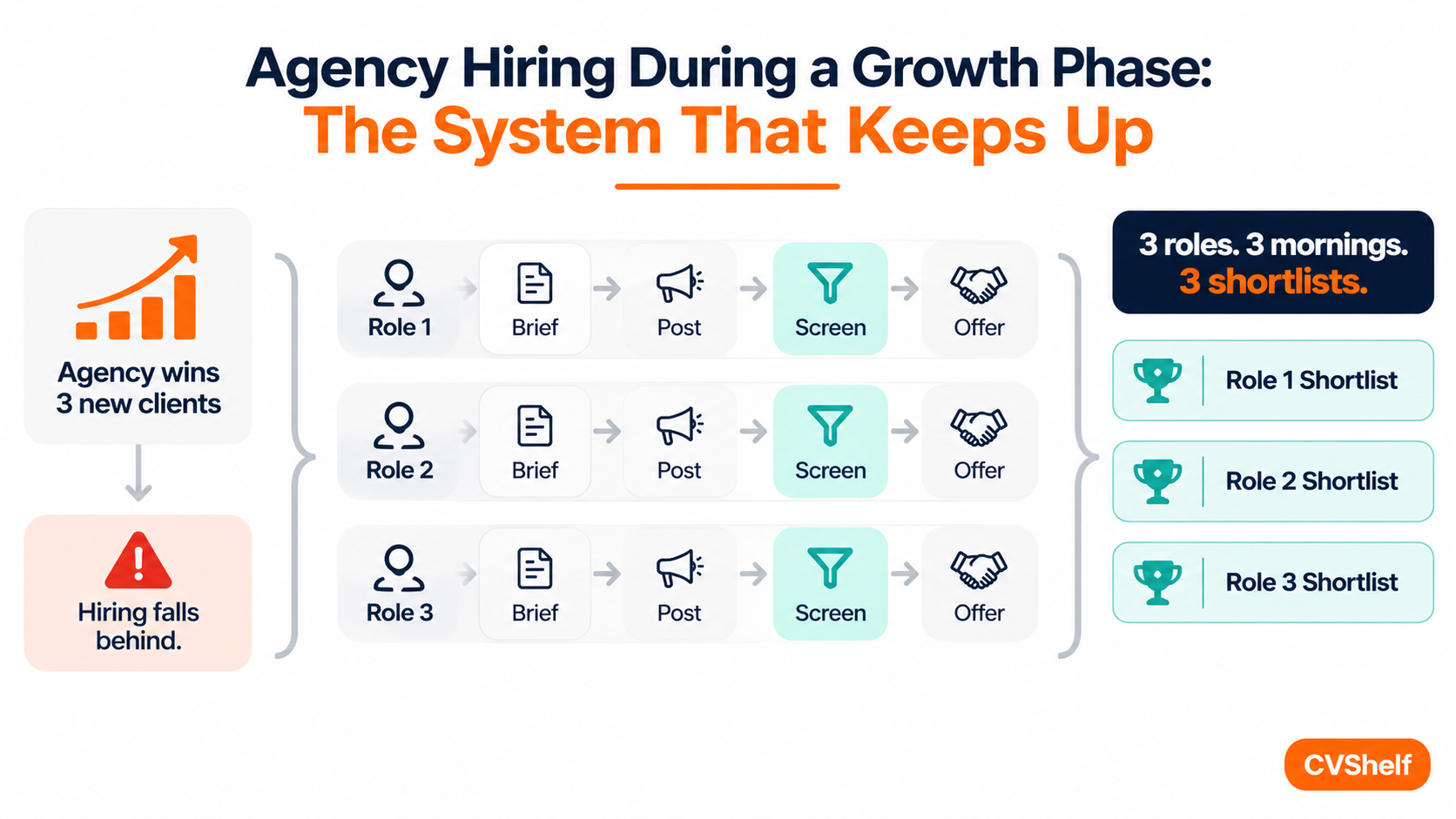
The hiring problems that hit a growing agency aren't random.
AI Hiring Tool UK Small Business
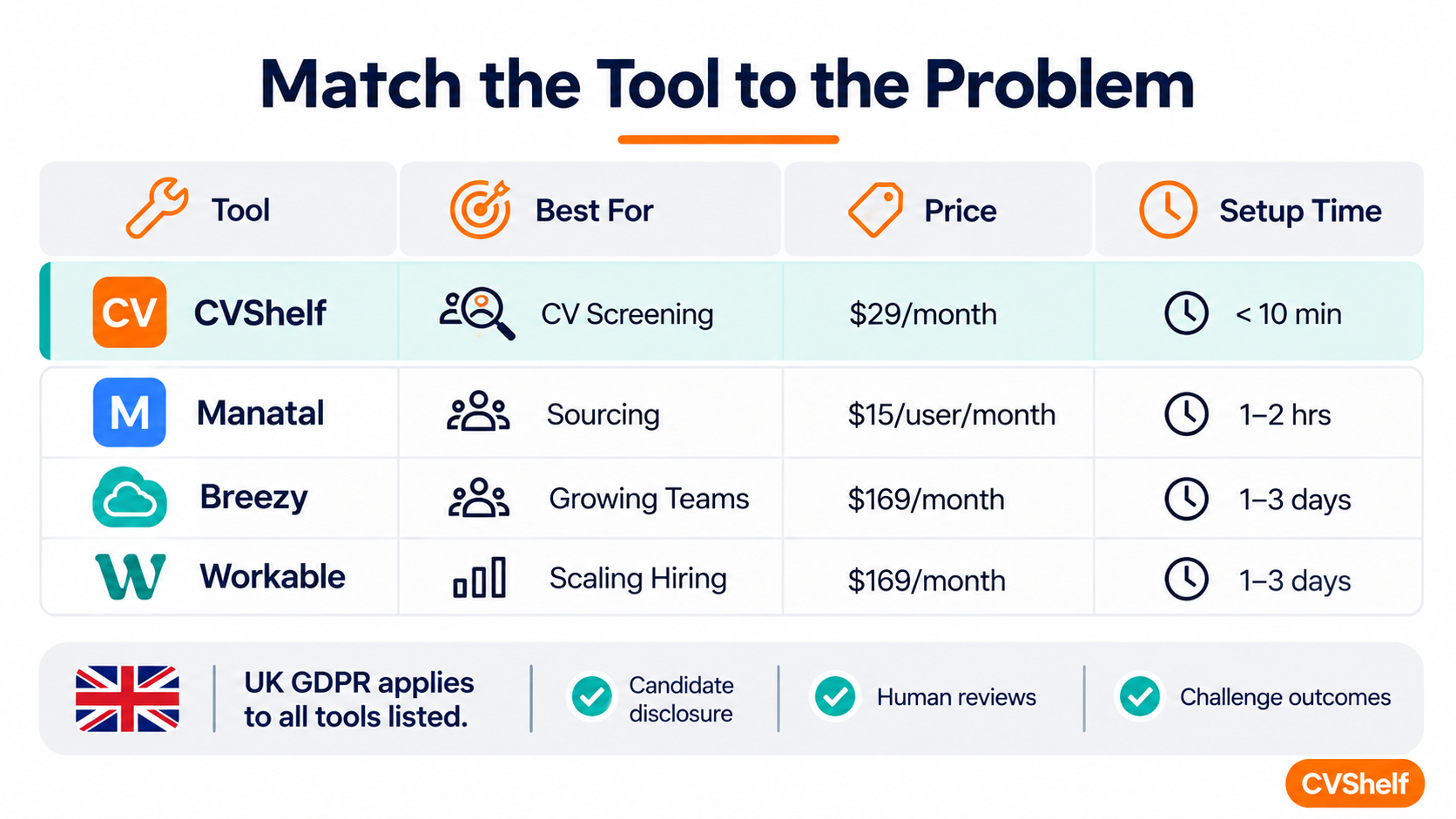
This post is for founders and MDs at 10 to 100-person UK agencies.
Hiring Account Manager Without HR
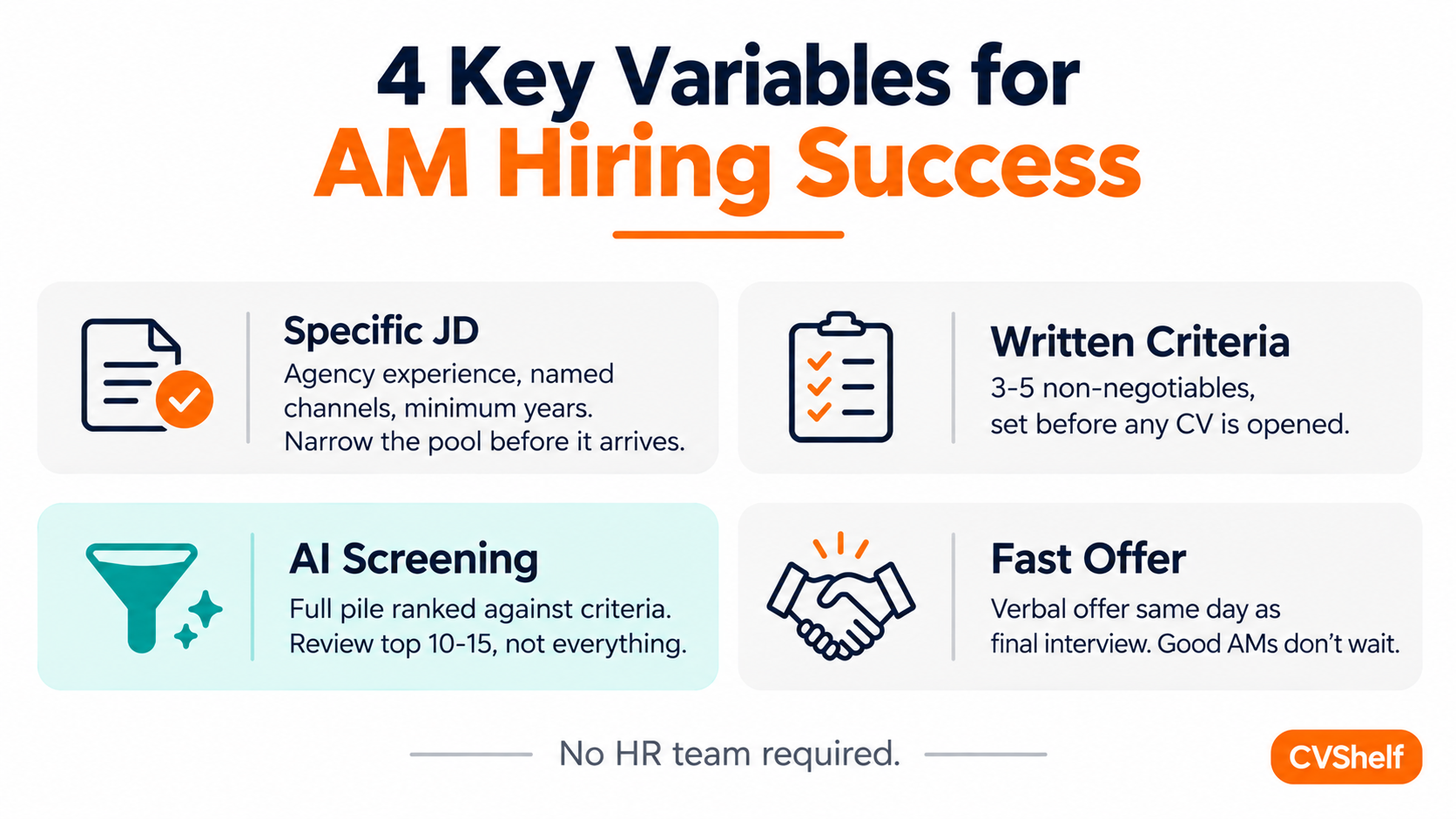
Hiring an account manager without an HR team is standard at most agencies under 100 people.