How Many Applicants For A Small Agency Job Posting
A small agency posting a mid-level role on LinkedIn or Indeed typically receives 100 to 200 applications within two weeks.
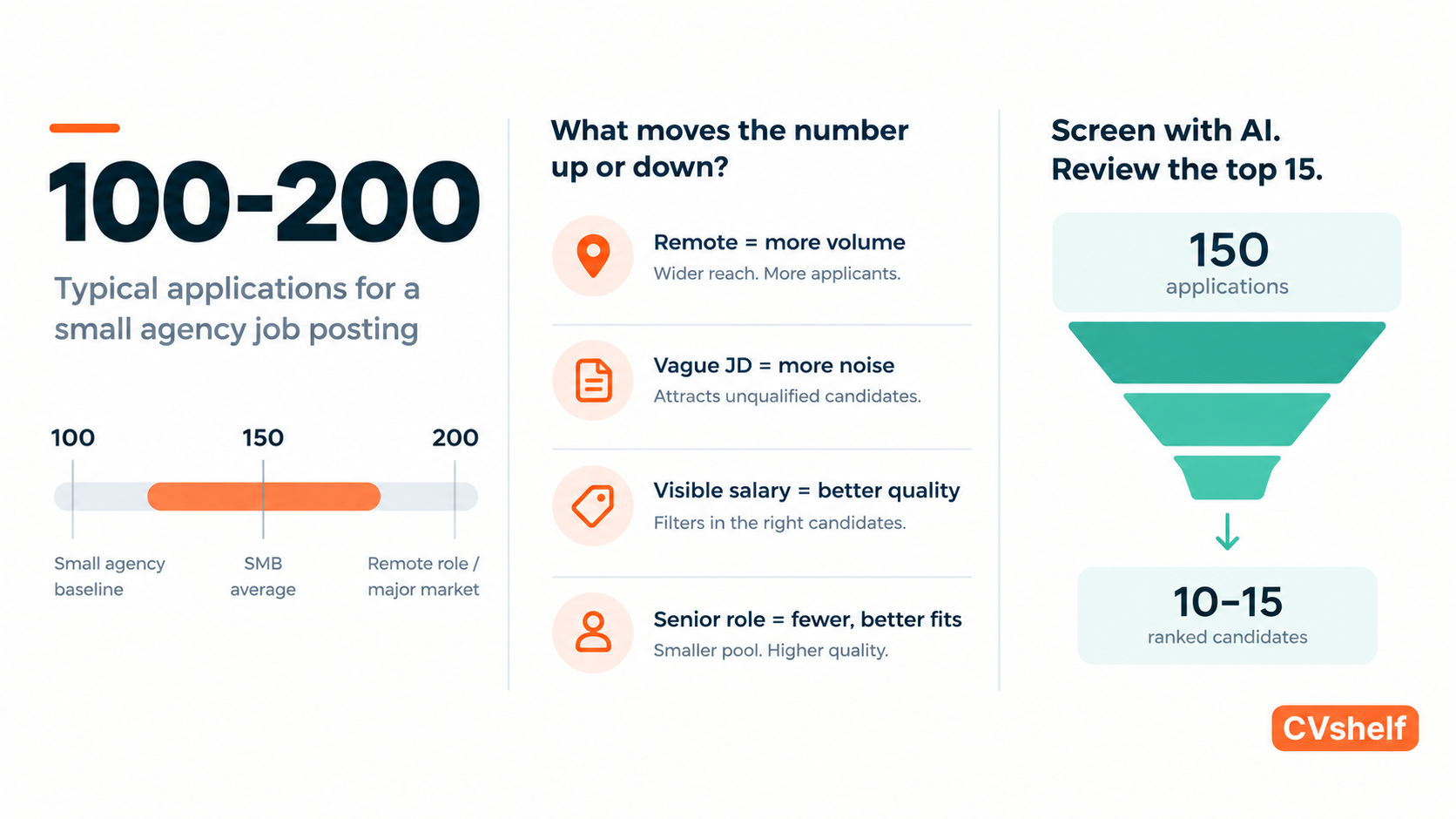
A small agency posting a mid-level account manager, strategist, or project coordinator role can expect roughly 100 to 200 applications within the first two weeks. Data from CareerPlug's 2025 recruiting metrics report puts US SMB applicant volume at around 180 per hire; industry-wide averages across all company sizes sit closer to 242 per posting. For a small agency without a well-known brand or a large LinkedIn following, 100 to 150 is a realistic baseline for a standard role.
That's the short answer. Below is what moves the number up or down.
The Fuller Context
Several factors push applicant volume significantly higher or lower than the baseline.
Role seniority. Entry-level and junior roles attract more applications because the candidate pool is larger and the bar to apply is lower. Mid-level roles (3-6 years experience) pull fewer, but the spread between qualified and unqualified applicants tends to be wider. Senior roles attract the fewest applications but the highest proportion of relevant candidates.
Remote or hybrid eligibility. A fully remote role receives substantially more applications than an on-site one. Remote job postings on LinkedIn attract three to four times more applications than on-site postings If your role is location-flexible, expect the top end of the range.
Salary transparency. Listings with a visible salary range attract more applications than those without one. Counterintuitively, this usually improves quality: candidates who wouldn't accept the range self-select out before applying. Hidden salary ranges generate volume from people who may not be compatible, creating noise in the pile.
Job description specificity. A vague JD, "marketing experience required, strong communicator", matches an enormous range of candidates. A specific one, "agency-side AM, minimum 3 years managing performance marketing accounts for B2B clients", narrows the field before anyone applies. Specificity cuts volume and improves the proportion of plausible candidates.
Platform. LinkedIn generates high application volume for agency roles in the US and UK. Indeed generates more total volume but with wider variance in relevance. Posting on both at once roughly doubles the pile without doubling the quality.
Timing. Applying within the first 10 minutes of a posting going live makes a candidate about four times more likely to hear back. The inverse is true for employers: roles that stay open for more than two weeks accumulate a long tail of applicants who applied late and are often less engaged.
Related Questions
Q1. Is 200 applications for a small agency role too many to screen properly?
Not inherently, but it's more than most agency ops managers can read carefully alongside their other work. The problem isn't the volume; it's the manual process. An AI screening tool processes the full pile against the job criteria in minutes and returns a ranked shortlist. The reviewer reads the top ten to fifteen with full attention rather than reading everything at declining quality.
Q2. Why am I getting so many unqualified applicants for my agency role?
Almost always the job description. Broad language matches a wide range of candidates who technically fit the words but don't fit the role. Adding specifics- agency-side experience required, named channels or tools, minimum years in a directly relevant position- cuts low-relevance applications before they arrive. It won't eliminate volume but shifts the composition of the pile.
Q3. Does posting salary make a difference to applicant quality?
Yes. Visible salary ranges filter out candidates whose expectations are misaligned, reducing the number of applications that waste everyone's time in later stages. The total volume may increase slightly; more candidates apply when they can confirm the role is worth their time, but the percentage of relevant applicants tends to go up.
Q4. What's a normal applicant-to-interview ratio for a small agency?
Data from 2026 suggests an average 40:1 ratio of applicants to interviews across job postings generally. For a small agency running a structured screening process, moving five to eight candidates through to first interview from a pile of 150 is typical and appropriate for a mid-level role.
What This Means for Your Screening Process
Knowing you'll get 100 to 200 applications changes how you should set up the process before the role goes live.
Write your screening criteria before you post, not after the pile arrives. Three to five non-negotiables, written down and applied consistently across every application. This is the step most agency ops managers skip, and it's the one that makes the difference between a shortlist that holds up and one that reflects whoever was reading on a Tuesday afternoon.
For the screening itself, an AI tool processes the full pile against your criteria and returns a ranked list with reasoning per candidate. For a deeper look at how that fits into an end-to-end agency hiring process, the guide to hiring platforms built for digital marketing agencies covers the full setup.
CVShelf handles the ranking and explanation layer. Try it complimentary at cvshelf.com
The pile is coming. Setting up the process before it arrives is what separates a clean hire from a three-week scramble.
Keep Reading
More from AI Resume Screening.
Hiring Without HR Department Small Business
Most small businesses handle hiring the same way: someone gets voluntold, reads a third of the CVs.
Hiring Platform For Digital Marketing Agency
Most hiring platforms were built for companies with dedicated HR teams.
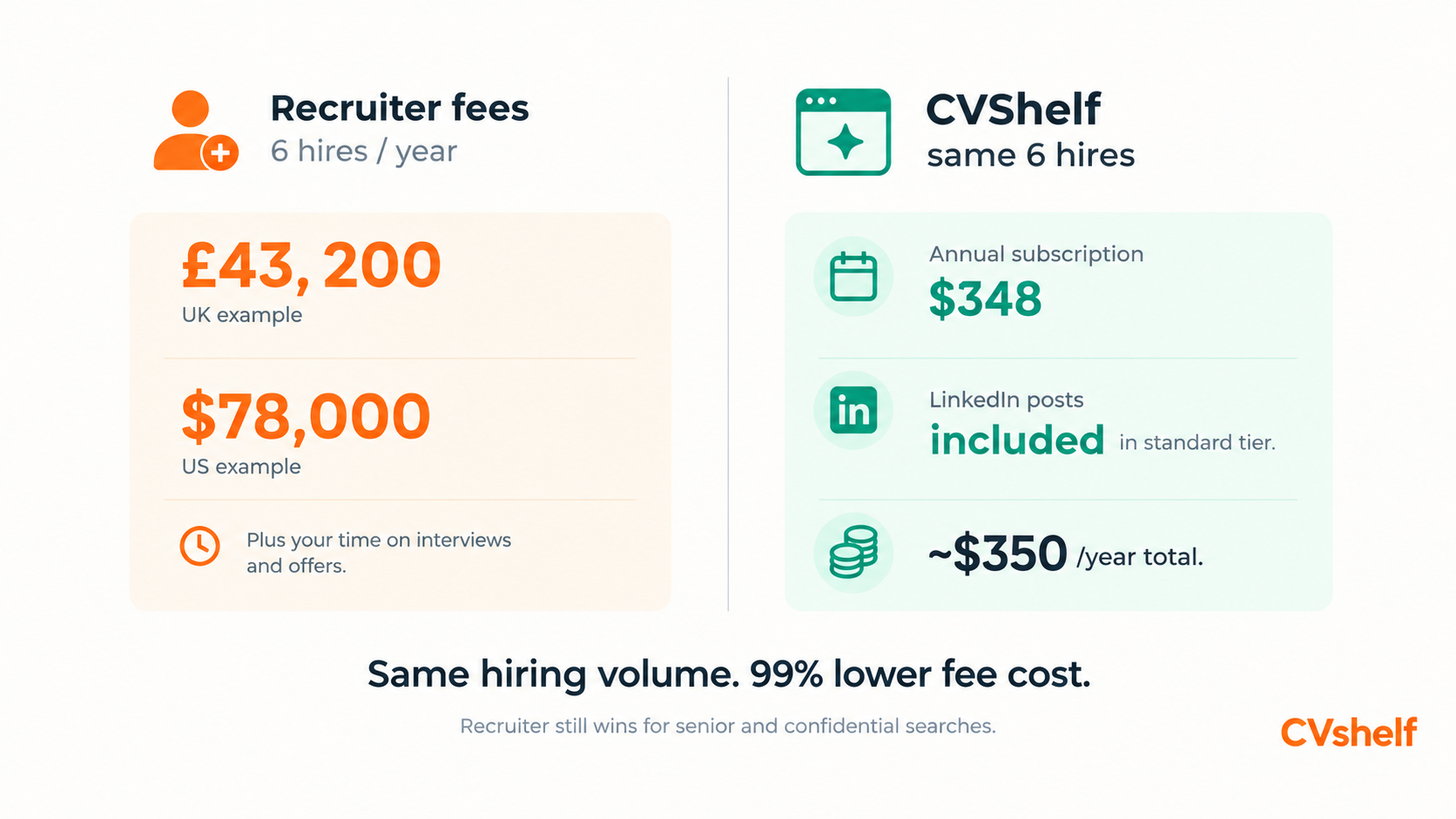
How Much Does A Recruiter Cost Vs AI Tool
A contingency recruiter placing a mid-level account manager or strategist typically charges 15-25% of first-year salary.