
How To Screen Marketing Candidates Faster
Marketing roles at agencies generate large application piles and land on whoever has the most available time that week.
It's Monday. The account strategist role went live on Thursday. You have 160 applications and a client presentation due Wednesday.
You open the folder. Read four. Close the laptop.
By Thursday, the folder has 210 applications. You still have the same presentation, plus two new briefs. The folder stays closed.
Why This Keeps Happening
The screening pile at a marketing agency lands on whoever the MD pointed at when the role opened. That's usually the ops manager, a department head, or occasionally the MD themselves. That person has a full workload that exists independently of the hiring task.
There's no dedicated recruiter to absorb it. No standing process to pick up. No written criteria from the last time this role was hired. Everything starts from scratch, and the manual work of reading 200 CVs sits in competition with billable and client-facing work for the same hours.
Screening also has no natural deadline the way client work does. Client deadlines are hard. The screening pile is a background task that gets deferred repeatedly until someone panics about the vacancy.
That deferral is where the problem compounds. The pile grows. The task feels bigger. It keeps getting moved.
What It Actually Costs
The slow screen produces two kinds of damage.
The first is candidate quality. Good mid-level marketers, strategists, account managers, and performance specialists are typically in multiple processes at once. They accept the first decent offer that arrives. When your screening takes two weeks instead of two days, you're offering to whoever is still available, which is a different pool.
The second is client delivery. If the role opened because you won a new account or an existing client expanded scope, every week the position sits unfilled is a week your team covers the gap. Someone's stretched. Work quality at the edges slips. The client who signed a strong proposal starts noticing the service is thinner than expected.
Early relationship damage is hard to recover from. And it almost always traces back to a hire that took too long.
A Better Way to Handle It
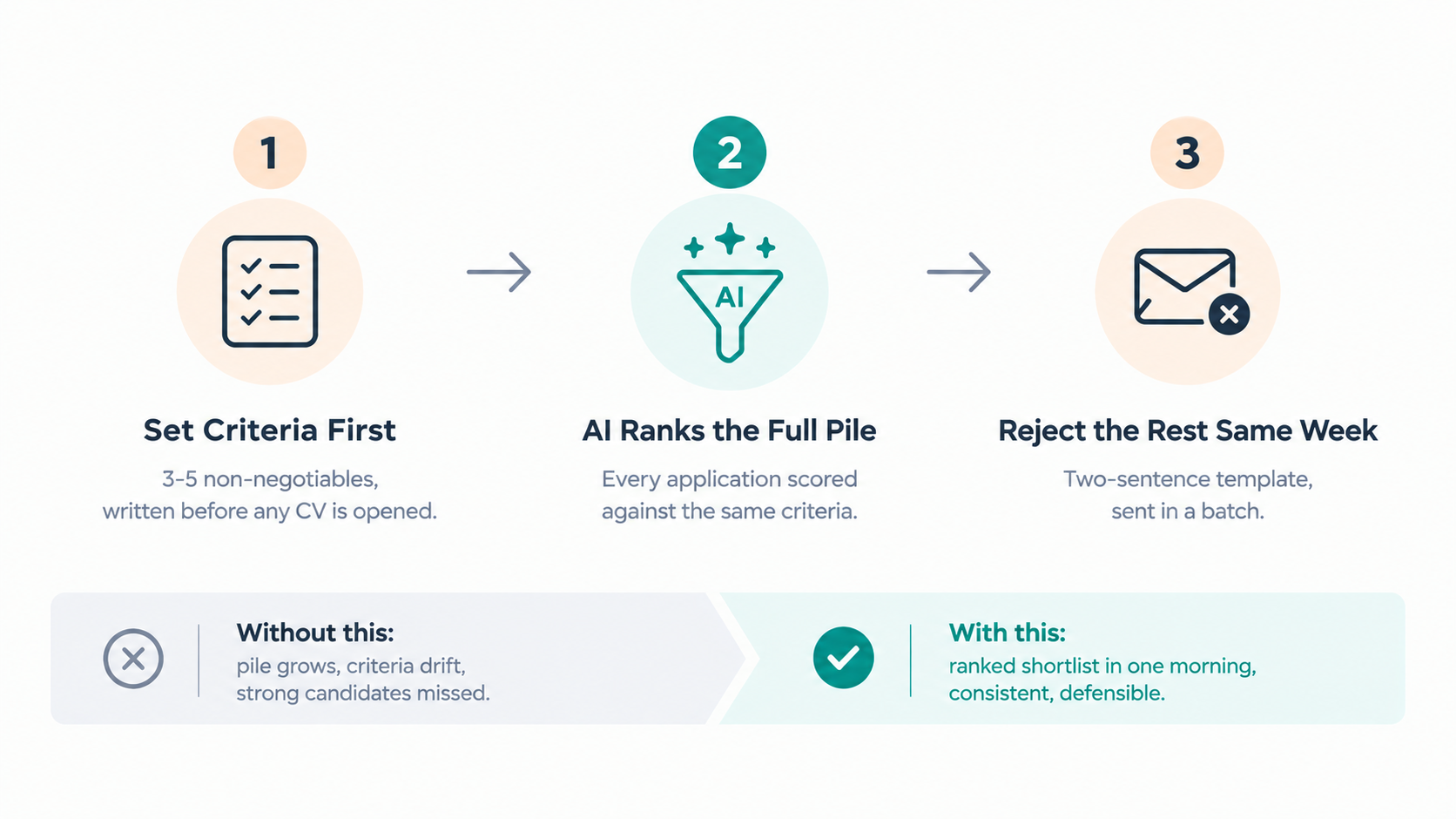
Three changes that actually work, and work this week.
Set the criteria before you touch the pile. Three to five non-negotiables, written down before a single CV is opened. Agency-side experience, required or not. A specific channel if it's a real dealbreaker. Minimum years in a directly relevant role. Write these down. Criteria you set mid-review drift. The standard you apply to candidate 20 is different from the one you apply to candidate 120, and the shortlist reflects that.
Use AI screening to rank the full batch. This is the step that changes the scale of the problem. Run the whole pile through a screening tool: paste in the job description, upload the applications, get a ranked list with a per-candidate explanation. You review the top ten to fifteen. The rest of the pile was evaluated against the same criteria with the same attention. Your time goes to the candidates who deserve it.
Send templated rejections the same week. Everyone outside the shortlist gets a response. A two-sentence template takes ten minutes to write. Candidates who applied to your agency are in your professional network regardless of outcome. Leaving them in silence costs you brand goodwill with people who work in your industry.
Where CVShelf Removes the Bottleneck
CVShelf handles the middle step: taking the full application pile, reading every CV against the job criteria, and returning a ranked list with a short explanation per candidate.
The explanation is what makes it usable without a recruitment background. You're not interpreting a score. You're reading a note that says what the AI found relevant and what it flagged as missing, then deciding whether you agree. A reviewer with no screening training can work through the top fifteen candidates in 45 minutes and produce a shortlist they can defend.
For agencies that want to see how this fits into a complete AM hiring process, the guide to account manager hiring software for agencies covers the end-to-end setup.
CVShelf starts at $29/month. No setup call, no ATS required.
FAQs
Q1. How do I screen 200 CVs without reading all of them?
Set written criteria before you start, then use an AI screening tool to rank the full pile against those criteria. You review the top-ranked candidates with real attention. The tool handles the rest. The time investment shifts from "read 200 CVs" to "review 12 explained recommendations." That's a fundamentally different task, one that takes a morning instead of a week.
Q2. What's the fastest way to screen candidates without a recruiter?
Write down three to five non-negotiables before you open the pile. Run the applications through an AI screening tool that produces a ranked list with explanations. Review the top ten to fifteen. Send templated rejections to the rest. That sequence gets you from open folder to shortlist in a single morning, with consistent criteria applied across every candidate.
Q3. Why do I keep getting unqualified applicants for marketing roles?
Usually the job description. Broad language attracts broad applicants. "Marketing experience required" matches people from every industry that has a marketing function. Adding specific requirements- agency-side experience, named channels, minimum years in a directly relevant role- filters out a significant portion of off-target applications before they arrive. The remaining pile still needs screening, but the proportion of plausible candidates is higher.
The screening pile doesn't have to own your week. Written criteria, AI ranking, reviewed in the morning. That's the whole system.
Try CVShelf complimentary at cvshelf.com.
Keep Reading
More from AI Resume Screening.
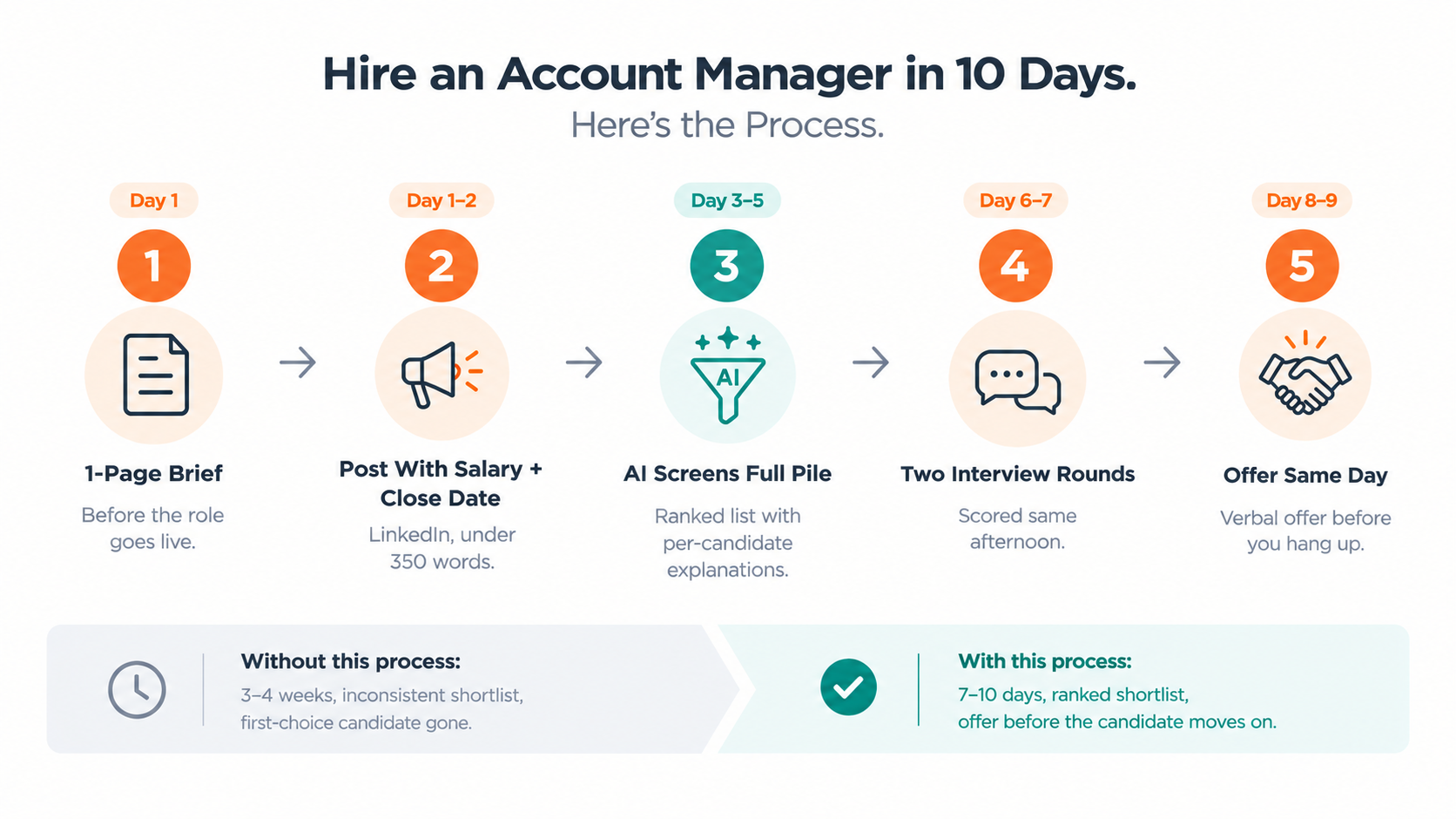
Account Manager Hiring Software for Agencies
Account manager is the most common hire at a growing agency, and the one that most often goes wrong.
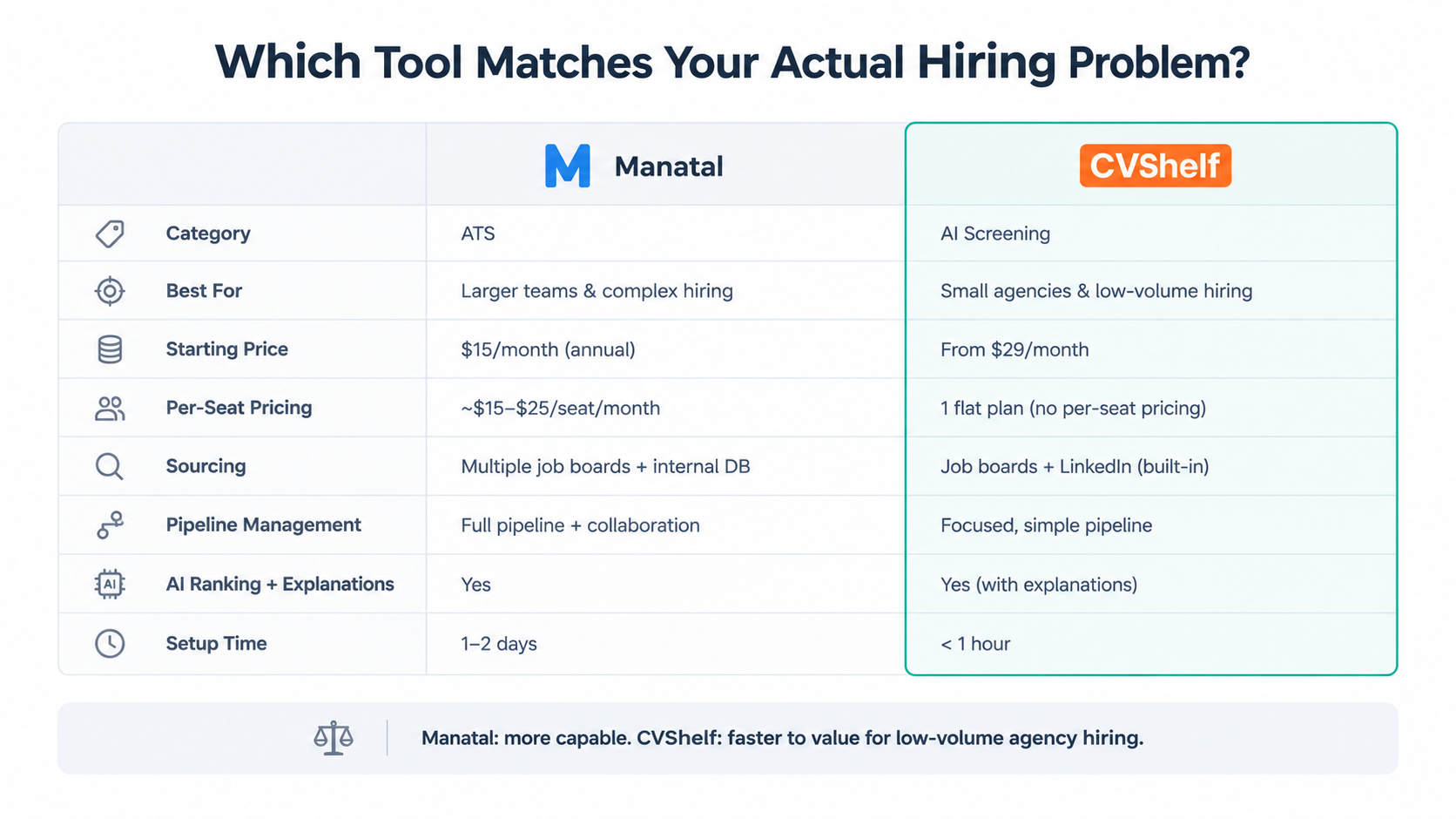
Manatal Alternative For Small Agency
This post is for founders and MDs at 10 to 100-person marketing or creative agencies who are considering Manatal, or trying to decide whether Manatal is the right fit at all.
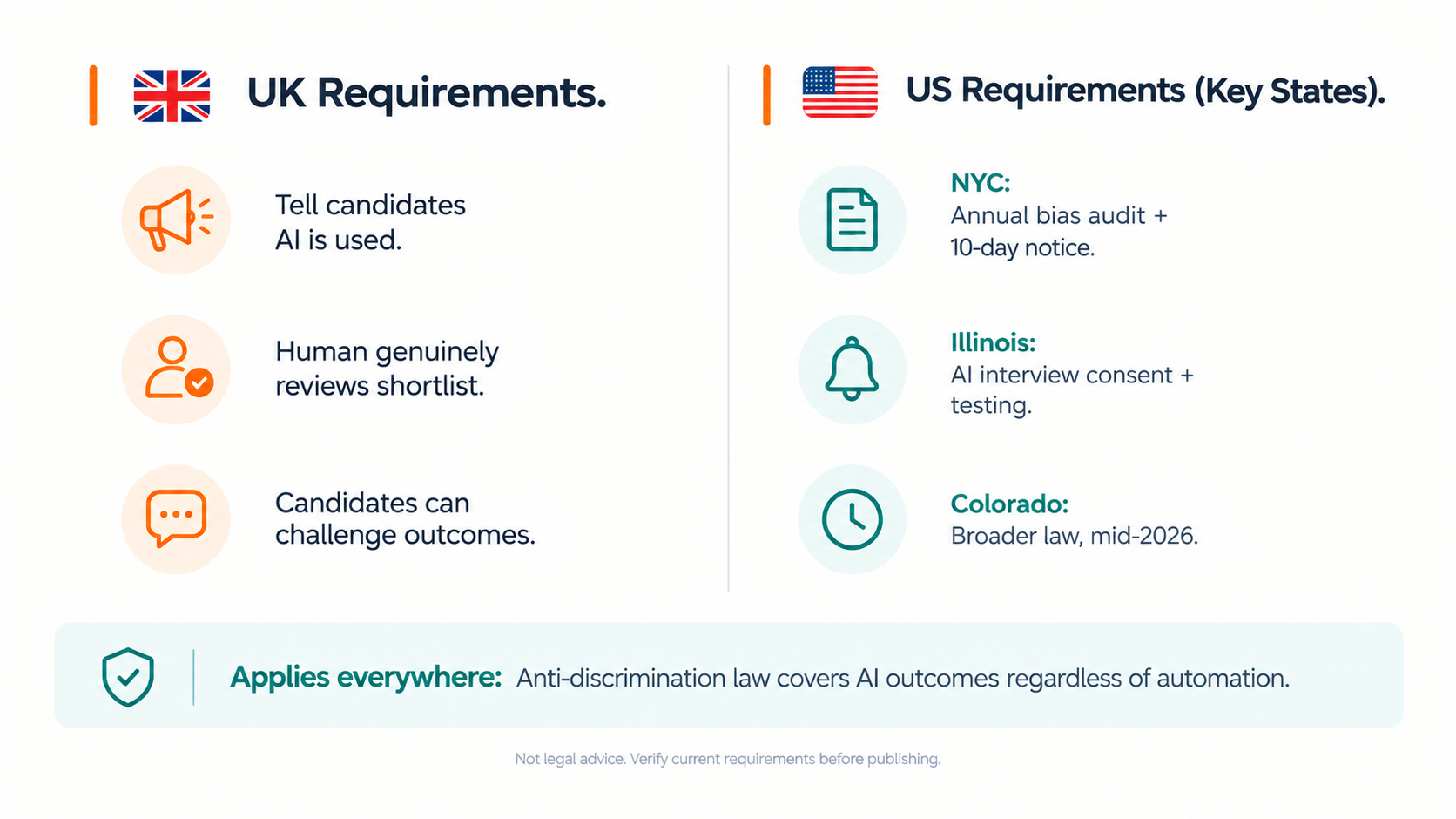
AI Hiring Compliance For Agencies
AI hiring compliance for agencies in 2026 means different things depending on where you're based and where your candidates are.