
Too Many Applicants for a Marketing Role?
Marketing job posts are getting 200+ applicants and most agencies can't screen them properly
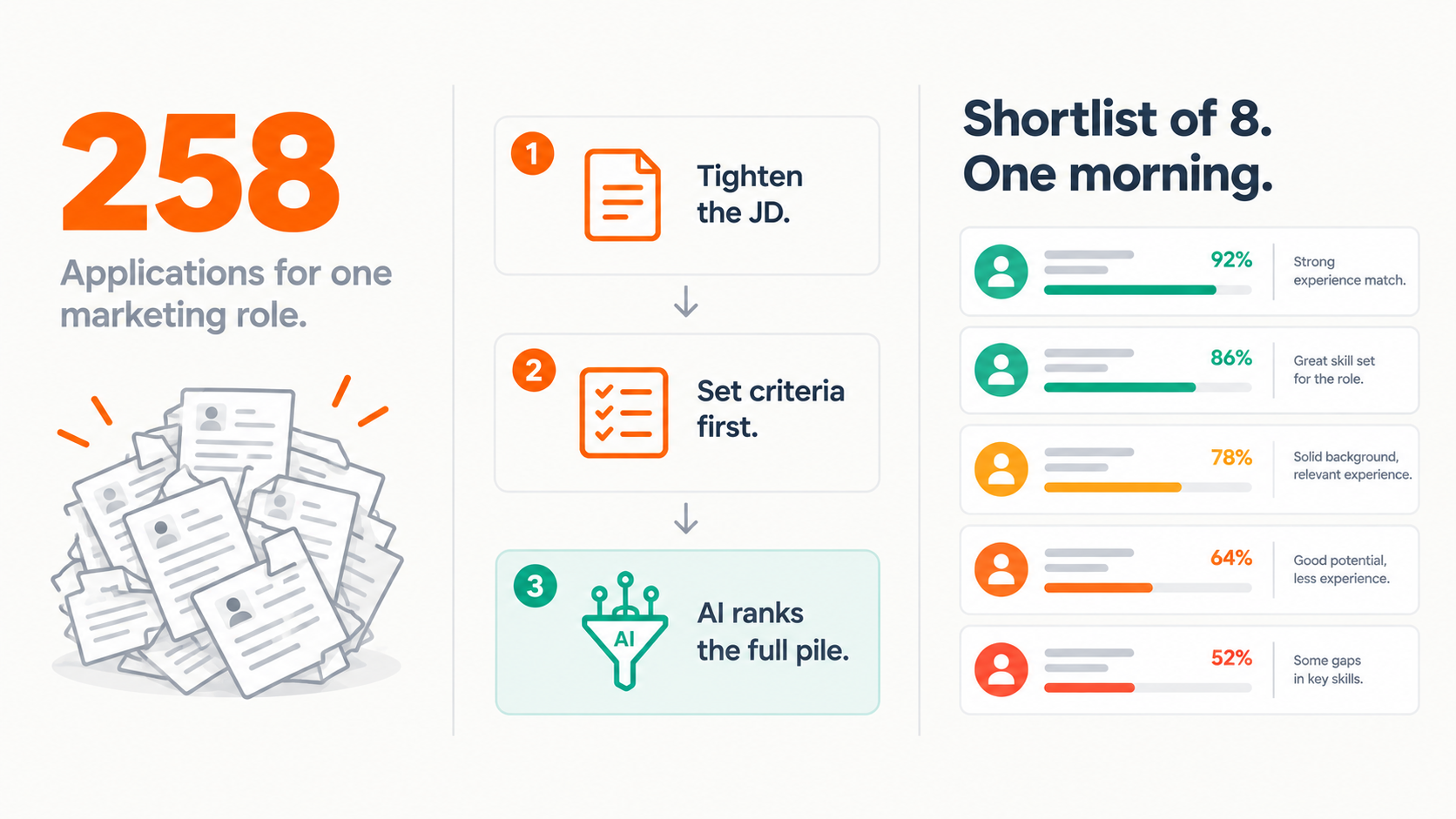
It's Wednesday. You posted the account manager role on Monday. Your inbox has 178 applications and counting.
You open the folder. Read three. A client emails. You close the laptop.
By Friday, the folder has 258 applications. You have a pitch deck due. The role stays open another week while the pile quietly grows.
Why This Keeps Happening
Application volume on LinkedIn for marketing and agency roles has risen sharply. [VERIFY: cite specific volume increase stat here, LinkedIn Q3 2024 Recruitment Trends Report shows 45.5% increase in applications despite fewer jobs posted.] More candidates are applying to more roles because the tools to do it quickly have improved and the job market in marketing has tightened.
But the volume problem is only half the issue. The other half is what your job post says.
Broad job descriptions attract broad applications. "Account manager with marketing experience" matches candidates from insurance, SaaS, hospitality, and every other sector that uses the phrase account manager. They see the title, apply in 30 seconds, and your pile fills with people who've never worked in an agency environment and probably wouldn't enjoy it.
The fix for volume is partly in the post itself. Specific language, agency-side experience, named channels, minimum years in a directly relevant role, cuts down the irrelevant applications before they arrive. It won't get you to 30. It might get you from 258 to 140, which is more manageable.
But 140 is still too many to screen properly by hand.
What It Actually Costs You
Not just time. That's the easy part to measure.
The harder cost is candidate quality. Strong account managers at mid-level are usually in two or three processes at once. They don't wait. They take the first decent offer that arrives from a company that moved decisively.
When your screening takes two weeks because the pile is too large to process alongside client work, you're not just slow. You're selecting from whoever is still available and still interested two weeks in. That pool is smaller, and it skews toward candidates with fewer options.
At an agency, this has a direct downstream effect. The hire you make in week three of the process isn't the same hire you would have made in week one. If that hire goes on to manage a client relationship, the quality of that relationship is affected. Early attrition costs more than the recruiting time did.
A Better Way to Handle It
Three changes that actually work, in order of impact.
Tighten the job description before you post. List three to five genuine non-negotiables only. Agency-side experience if that's truly required. Specific channel knowledge if it's a real dealbreaker. Everything else is a nice-to-have that doesn't belong in the must-have list. A tight JD reduces irrelevant volume before it arrives.
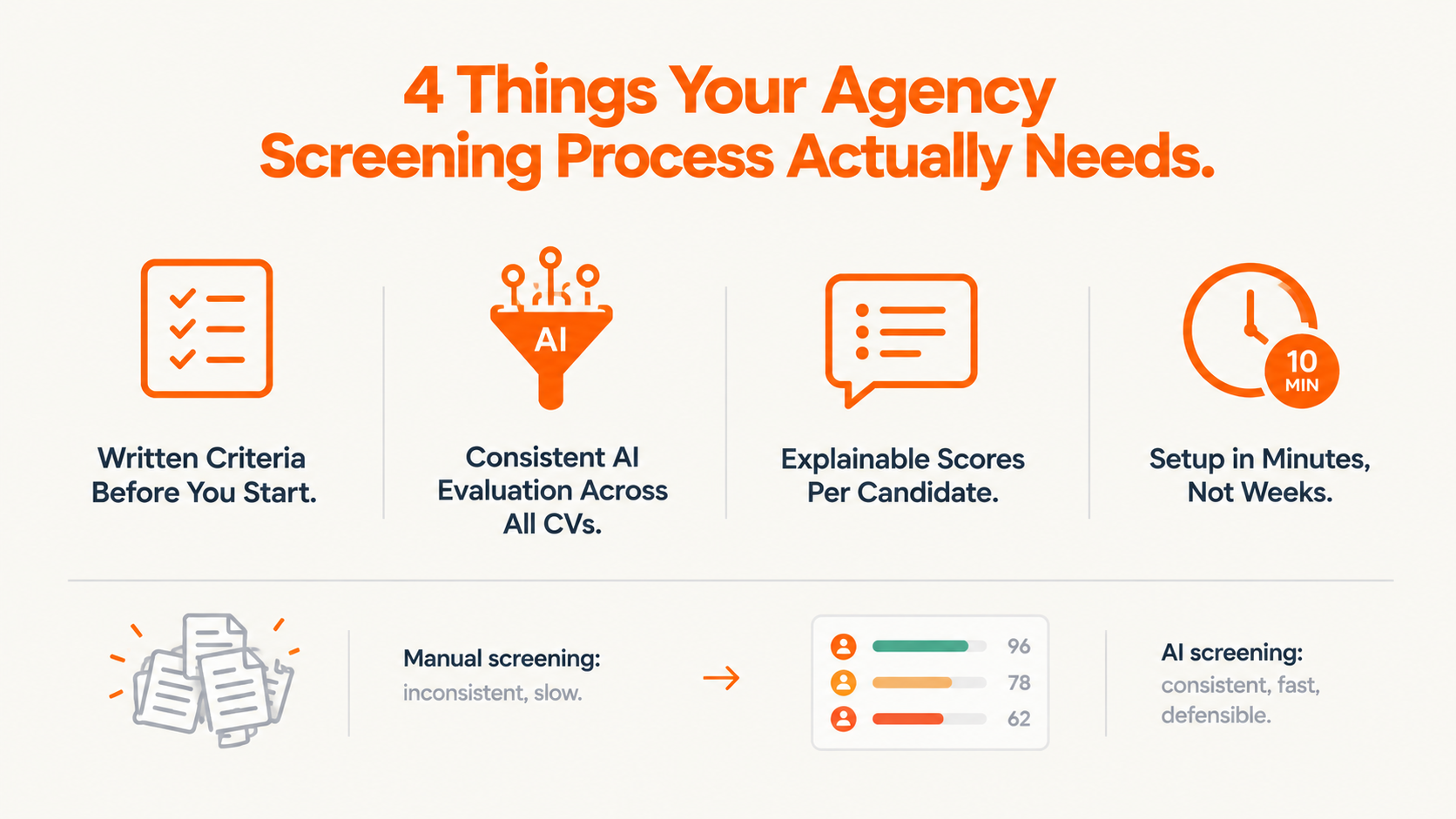
Set your screening criteria in writing before you open the pile. Not during. Criteria you define mid-review drift. Candidate 20 gets held to a different standard than candidate 100 because your mental model of the role has shifted by then. Writing the criteria down takes 15 minutes and prevents the inconsistency that produces bad shortlists.
Use AI screening to rank the full batch. This is the step that changes the scale of the problem. CVShelf takes your job description, runs it against a bulk upload of resumes, and returns a ranked list with an explanation per candidate. You review the top ten to fifteen. The AI handled the full read-through against consistent criteria. You handle the judgment calls on the shortlist.
For agencies building out a proper process around this, the full breakdown of resume screening software that actually fits a 10-100 person agency covers the framework in more depth.
Where CVShelf Removes the Bottleneck
The screening stage is where the week goes. CVShelf collapses it.
You paste in the job description or pull it from LinkedIn directly. Upload the pile as a bulk batch, PDFs, Word docs, zip files, whatever format applications arrived in. CVShelf reads every resume against the job criteria, scores candidates by relevance, and returns a ranked list with a short explanation per candidate.
The explanation is what makes it usable without a recruiter background. You're not interpreting a score. You're reading a note that says what the AI found, what it flagged as missing, and why the candidate ranked where they did. You can override it where context matters. You own the shortlist.
From 258 applications to a defensible shortlist of eight takes one focused morning instead of a week of fragmented reading.
CVShelf starts at $29 per month. No setup process.
FAQs
Why am I getting so many unqualified applicants for my account manager role? Almost always the job description. Phrases like "account management experience" and "marketing background" match an enormous range of candidates. Adding specific requirements, agency-side experience, named tools or channels, minimum years in a directly relevant role, filters out the off-target applications before they arrive. It won't eliminate volume, but it shifts the composition of the pile significantly.
How do I screen 200 job applications without spending a week on it? AI screening tools rank the full pile against your job description automatically. You set the criteria, upload the applications, and review the top-ranked candidates rather than reading everything. The time investment shifts from "read 200 resumes" to "review 12 explained recommendations." CVShelf handles the ranking and explanation layer specifically for this use case.
Is getting 200+ applicants a sign something is wrong with my job post? Not necessarily. High application volume is normal for mid-level marketing roles on LinkedIn in 2025, particularly in major markets. [VERIFY: confirm current average application volume for marketing roles on LinkedIn before publishing.] The signal worth paying attention to is whether the applicants are broadly relevant to the role. If most are clearly off-target, the JD needs tightening. If the pile has a reasonable proportion of plausible candidates, the problem is screening capacity, not post quality.
The pile isn't going away. Application volume for marketing roles has been rising for two years and shows no sign of reversing. The answer isn't a better job post, though that helps. It's a screening process that doesn't require you to read 258 resumes to find the eight worth interviewing.
Try CVShelf complimentary at cvshelf.com.
Keep Reading
More from AI Resume Screening.
Resume Screening Software for Marketing Agencies
Most resume screening software was designed for companies with dedicated HR teams, IT departments, and continuous hiring pipelines.

AI Hiring Compliance USA 2026
Several US states now have live requirements around AI tools used in hiring, covering disclosure, bias auditing, and recordkeeping.
How to hire fast after landing a new client
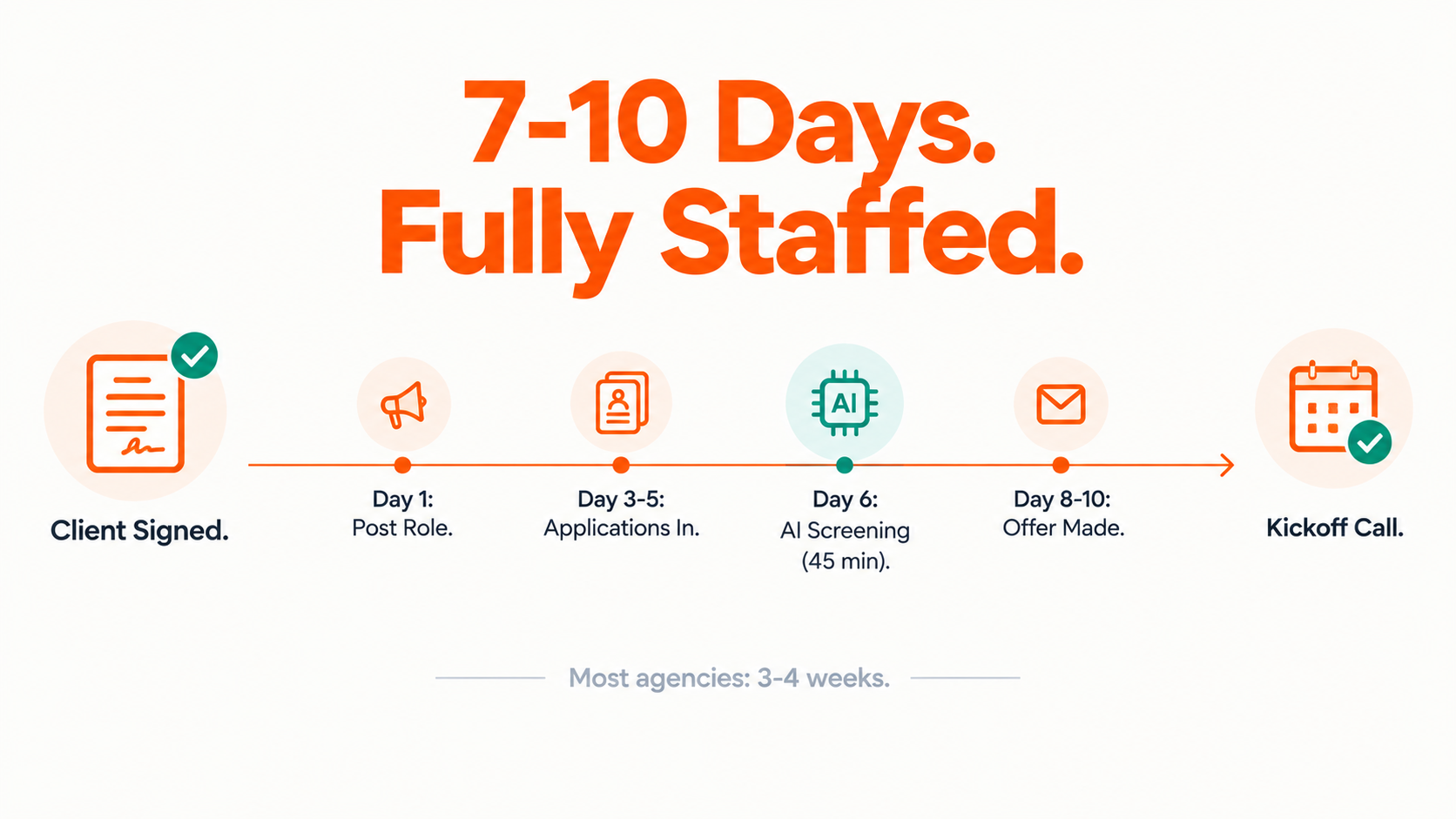
The moment a client signs, a countdown starts.