
Too Many Applicants for Your Marketing Role? Here's What to Do
The average job post now attracts around 258 applicants. For an account manager or strategist role at a marketing agency, that number can climb higher.

258 Applications. No Recruiter. One Week Until You Need Someone.
The average job post gets 258 applications. That number has risen sharply in the last two years as remote work expanded candidate pools and AI tools made it easier to mass-apply.
For a marketing or creative agency posting a mid-level role, account manager, strategist, project lead, the pile can be bigger. Your job post is visible to every marketing professional in a 50-mile radius, plus anyone willing to relocate, plus anyone who spotted it while browsing from another city.
You are not a corporate with a sourcing team, an ATS, and a dedicated recruiter whose entire job is screening. You are a founder or an ops manager who just posted the role, has 48 hours of client work due this week, and now has 258 applications sitting in a folder that isn't going to review itself.
This is the real hiring problem for agencies. Not finding candidates. Handling the ones who already found you.
Why This Hits Agencies Harder Than Corporates
A corporate HR team expects volume. They have systems for it. An ATS that auto-screens on keywords. A recruiter whose full-time job is moving candidates through the pipeline. A process that's been running long enough to have defaults.
Agencies have none of that. Here's what the actual situation looks like for most 10 to 100-person agencies:
No ATS, or one that was set up two years ago and nobody logs into. No recruiter, or one shared across the whole business who also handles onboarding, payroll admin, and three other things. No screening process that anyone has actually written down. And no buffer time, because the role opened because you just won new business and need someone fast.
The application pile lands on whoever had the lightest calendar that week. That person reads carefully for the first 30 resumes, skims the next 60, and abandons the rest by end of day. The result is a shortlist that reflects reading order and energy levels, not candidate quality.
This is not a failure of the person doing the screening. It's a failure of the process. And a 258-person pile without a process is not a hiring task. It's a punishment.
The Cost Nobody Calculates
Slow screening feels like an internal problem. It is actually a candidate pipeline problem.
Marketing professionals at account manager and strategist level are typically in two or three processes at once. They apply broadly. The companies that move fast get the best candidates. The ones that take two weeks to shortlist are seeing whoever is still available and still interested after two weeks.
That pool is smaller and skewed. The candidate who got an offer elsewhere in week one is gone. The one who's still in your process two weeks in is either less in demand or waiting on a decision from someone more decisive. Neither outcome is what you were hiring for.
There is also the downstream cost that agencies feel most directly: under-staffing a new client account because the hire took three weeks instead of one. Existing team members absorb the work. Overextended account managers produce worse client outcomes. The client who signed a great proposal starts to notice the service is thinner than expected.
Speed of screening is not an admin efficiency metric. It's a client retention variable.
5-Step System for Managing High-Volume Screening
Step 1: Write a Tighter Job Description
Most job posts for agency roles are a list of everything the ideal candidate might conceivably have. These attract everyone. They do not help you screen anyone.
Write the job description around the first 90 days. What does this person need to do in the first three months? What is the one thing they must be able to do on day one? What is genuinely non-negotiable?
A tighter JD reduces the volume of low-relevance applications and makes your screening criteria obvious before you start.
Step 2: Set Knockout Criteria Before You Open the Pile
Before you look at a single application, write down three to five things that would immediately rule someone out. Minimum years of experience in a directly relevant role. Required availability. Location or right-to-work requirements if applicable. Specific channel experience if the role genuinely requires it.
These are your filters. Apply them first. Anyone who fails a knockout criterion is out before the detailed review begins.
Do this before reading, not during. Criteria set mid-review drift. You start applying different standards to early versus late applications. Written criteria applied upfront produce consistent results.
Step 3: Use AI to Rank the Full Batch
This is the step that compresses the most time.
An AI screening tool reads every application against your job description, scores each candidate by relevance, and returns a ranked list with an explanation per candidate. You do not read 258 resumes. You review the top 10 to 15 that the AI surfaced, with reasoning attached to each.
CVShelf does this. Upload your application pile, paste in the job description, and get a ranked shortlist in minutes. Each candidate comes with an explanation of why they ranked where they did. You can override the ranking where context matters. You are not trusting a black box. You are reviewing a reasoned recommendation and applying your own judgment to the top of the list.
The time investment shifts from "read 258 resumes" to "review 12 ranked candidates with explanations." That's a different scale of task.
Step 4: Review Only the Top 10 to 15
Resist the instinct to go deeper. If your AI screening criteria were set correctly and your JD was specific, the top 10 to 15 is where your hire is. Going to 30 candidates adds time without adding proportional signal.
Read these carefully. Check the AI's reasoning. Make notes. Decide who you want to speak to. This should take 60 to 90 minutes, not a full day.
Step 5: Automate Your Rejection Emails
Set up a templated rejection email and send it to everyone outside your review pool. Do this the same day you complete your review.
Candidates who applied for your role are real people who deserve a response. Automating rejections is not impersonal. It is respectful. And it protects your agency's employer brand with a pool of marketing professionals who will remember how you treated them, positively or not.
Most email tools and ATS platforms support this. If you don't have either, a Gmail template takes 10 minutes to set up.
From 258 Applicants to 8 Interviews
Here is what the above system looks like end to end.
The role closes. 258 applications are in the pile. You run them through CVShelf in 20 minutes. The ranked list surfaces your top 15. You spend 90 minutes reviewing the top 15 with explanations. You identify 8 people worth a conversation. You send templated rejections to the rest.
You go from 258 applications to 8 qualified interviews in about two hours of actual work. Not a week of reading. Two hours.
That is a week-one shortlist instead of a week-three one. The candidates you're calling in week one are still available, still interested, and have not yet accepted something elsewhere.
CVShelf starts at $29 per month. No recruitment background needed to use it. No setup call. No onboarding process. Upload your CVs, paste your job description, get your shortlist.
Try CVShelf free at cvshelf.com.
FAQs
Q1: How many applications is normal for an account manager role at a marketing agency? Industry data puts the average job post at around 258 applications, and marketing roles tend to attract above-average volume because the candidate pool is broad and remote-friendly. For a mid-level account manager or strategist role, 150 to 300 applications within the first two weeks is typical on LinkedIn or Indeed. The number matters less than your ability to screen it efficiently.
Q:2 How do you filter down 200 applications without reading them all? Knockout criteria applied before you start reading remove the obvious mismatches. AI screening tools then rank the remaining candidates by relevance to your specific job criteria. The combination typically gets you from 200 applications to a shortlist of 10 to 15 worth reviewing in detail, without reading every resume individually.
Q:3 Why are marketing roles getting so many applications right now? A few factors: remote and hybrid work expanded candidate pools beyond local geographies, AI tools made it faster to tailor and submit applications, and economic uncertainty in the marketing sector has increased active job seekers. The result is that a role that might have attracted 60 to 80 applications three years ago now attracts two to three times that.
Q:4 How do you hire quickly without sacrificing quality? Speed and quality are not opposites if the screening process is structured. AI screening produces a ranked shortlist based on consistent criteria applied uniformly across every application. The candidates at the top of a well-configured AI ranking are not random. They scored highest against the specific criteria you defined. The shortcutting comes from not reading the bottom 200 resumes, not from lowering the bar on who you interview.
Q:5 Should I use an ATS or an AI screening tool if I'm a small agency? If you're hiring fewer than 20 people per year, an ATS adds more overhead than it saves. An AI screening tool like CVShelf gives you the high-leverage part, sorting and ranking a large application pile, without the setup cost and ongoing management of a full ATS. Use an ATS when your hiring volume justifies the infrastructure. Use AI screening from the first role that produces more applications than you can read.
Q:6 What should I do with the candidates I don't select? Send a templated rejection email within a week of making your decision. Keep it short and factual. Candidates who applied to your agency are part of your professional network, whether you hired them or not. A clean, timely rejection is better employer branding than silence, and it costs almost nothing with a template in place.
Keep Reading
More from AI Resume Screening.

AI Hiring Compliance USA 2026
Several US states now have live requirements around AI tools used in hiring, covering disclosure, bias auditing, and recordkeeping.
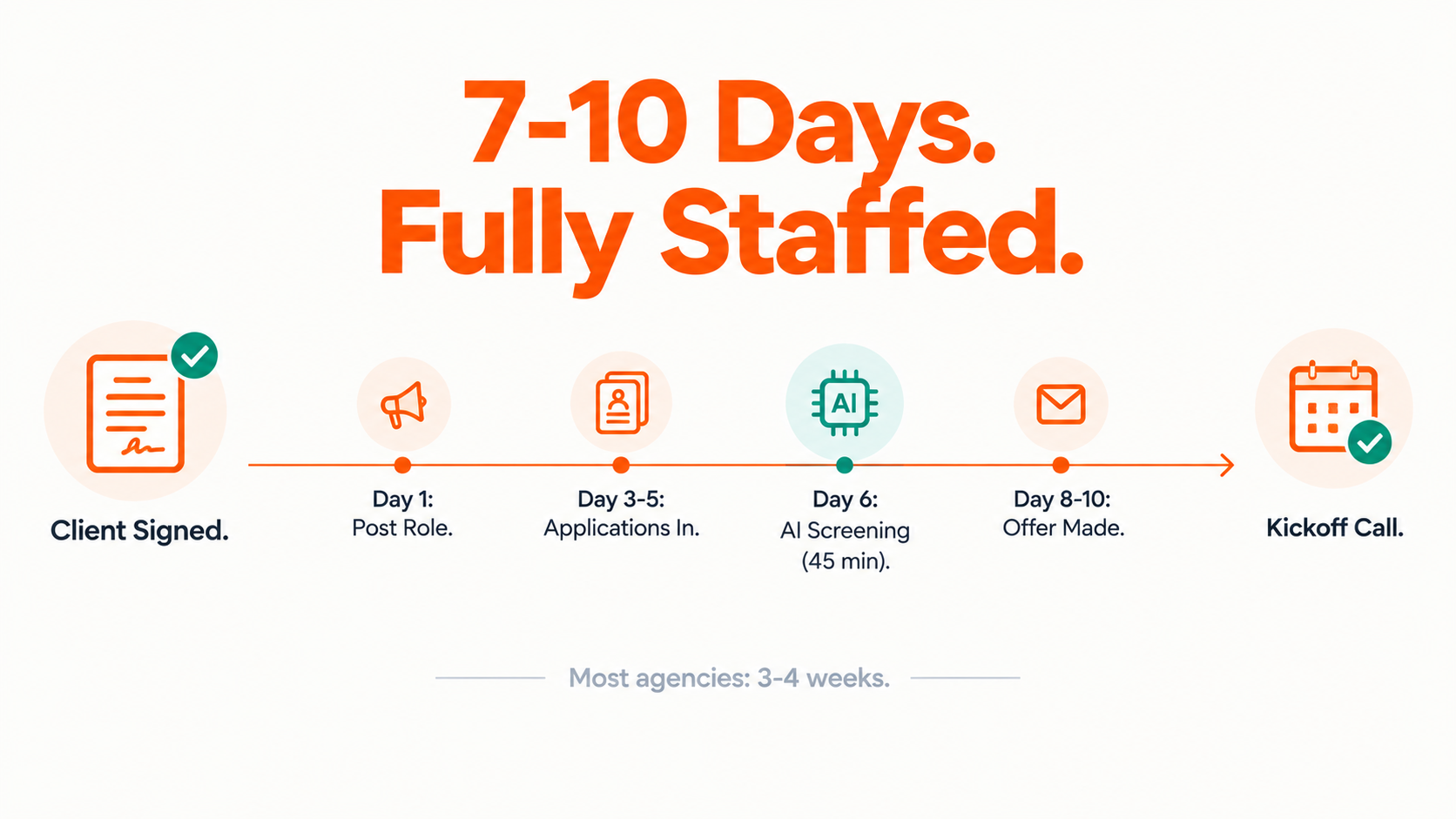
How to hire fast after landing a new client
The moment a client signs, a countdown starts.
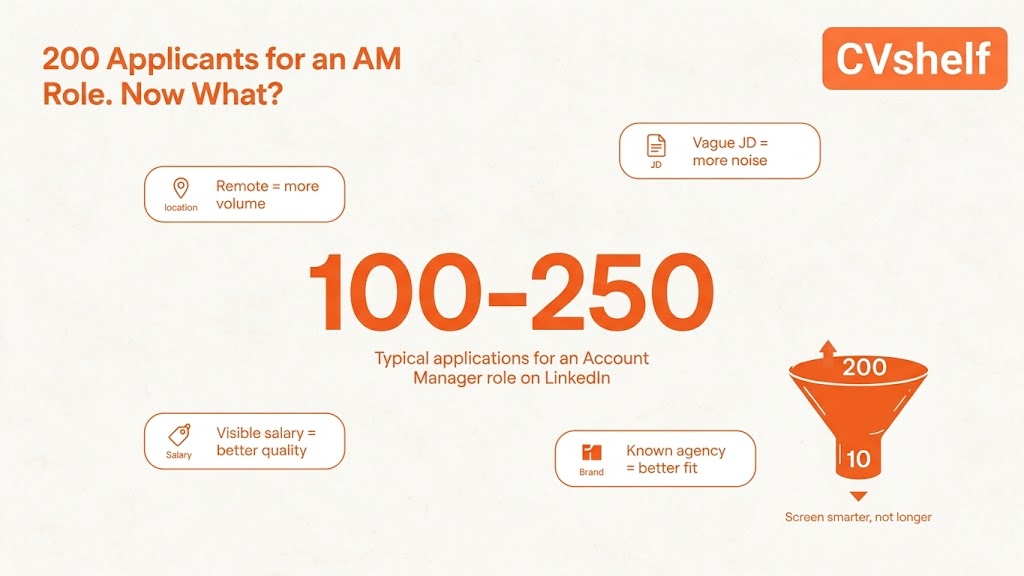
How Many Applicants Is Normal for an Account Manager Role?
A mid-level Account Manager role posted on LinkedIn typically receives 100 to 250 applications within two weeks.