Recruitment Software For Creative Agency
Recruitment software built for enterprise HR teams doesn't fit a creative agency.
Go looking for recruitment software for a creative agency and you'll find tools built for companies that hire continuously, have dedicated recruiters, and can justify a six-month implementation. None of that is the reality at a 30-person design studio or a 60-person integrated agency.
The tools worth using at this size solve a specific problem: a role opens, 150 applications arrive, one person processes them alongside client work, and somehow a shortlist needs to exist by Friday. Software that adds to that workload instead of reducing it is not a solution. It's overhead.
The Real Problem at This Size
Creative agencies hire irregularly. A senior copywriter leaves. A new client requires an account team. A project coordinator is needed immediately. The role opens fast and the pressure to fill it is real, client delivery is at stake.
The applications land on whoever is available. Ops manager, studio manager, the MD. That person has no recruiter instincts, no written criteria, and a full workload competing for the same hours. They read the first third of the pile carefully, skim the middle, abandon the rest. The shortlist reflects what they remember from a session they couldn't finish.
This happens four times a year. Every time, it starts from scratch. No rubric from last time. No shortlist template. No process that improved with use.
The software problem at creative agencies isn't that the tools are bad. It's that most tools were designed for a steady-state hiring operation, continuous pipeline management, multi-user workflows, sourcing integrations. None of that matches how a creative agency actually hires.
What's needed is a tool that handles the one step that takes the most time, with the least setup, for someone with no recruiting background. That's the actual brief.
What Good Actually Looks Like
Four things. In this order.
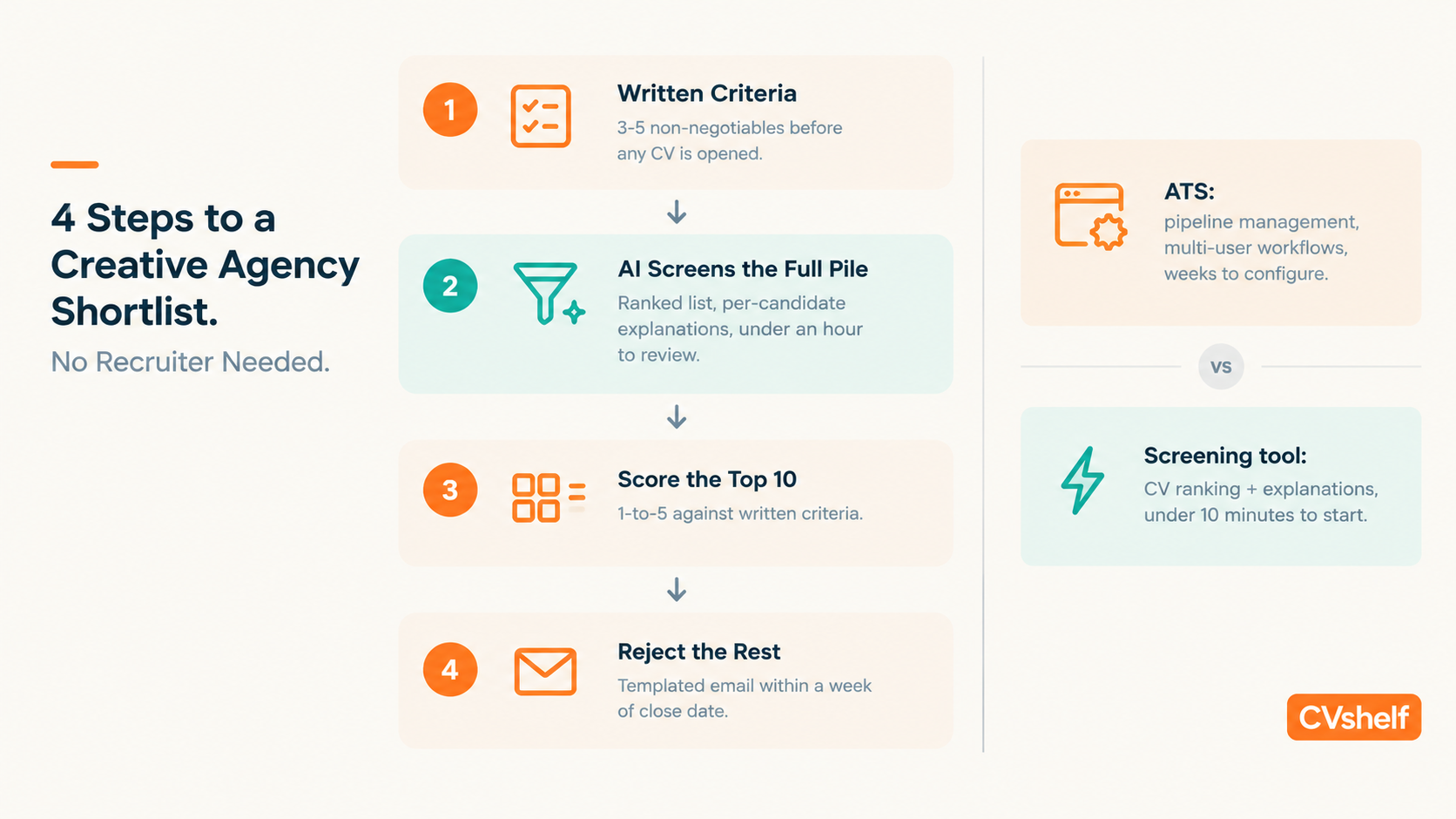
1. Written criteria before the role posts. Three to five non-negotiables, defined before a single CV is opened. For a creative agency: does agency-side experience matter? Is there a specific software requirement that's genuinely a dealbreaker? What's the minimum relevant experience? Write these down. Criteria set in your head shift as you read. Criteria on paper stay consistent across every candidate, regardless of reading order or energy levels.
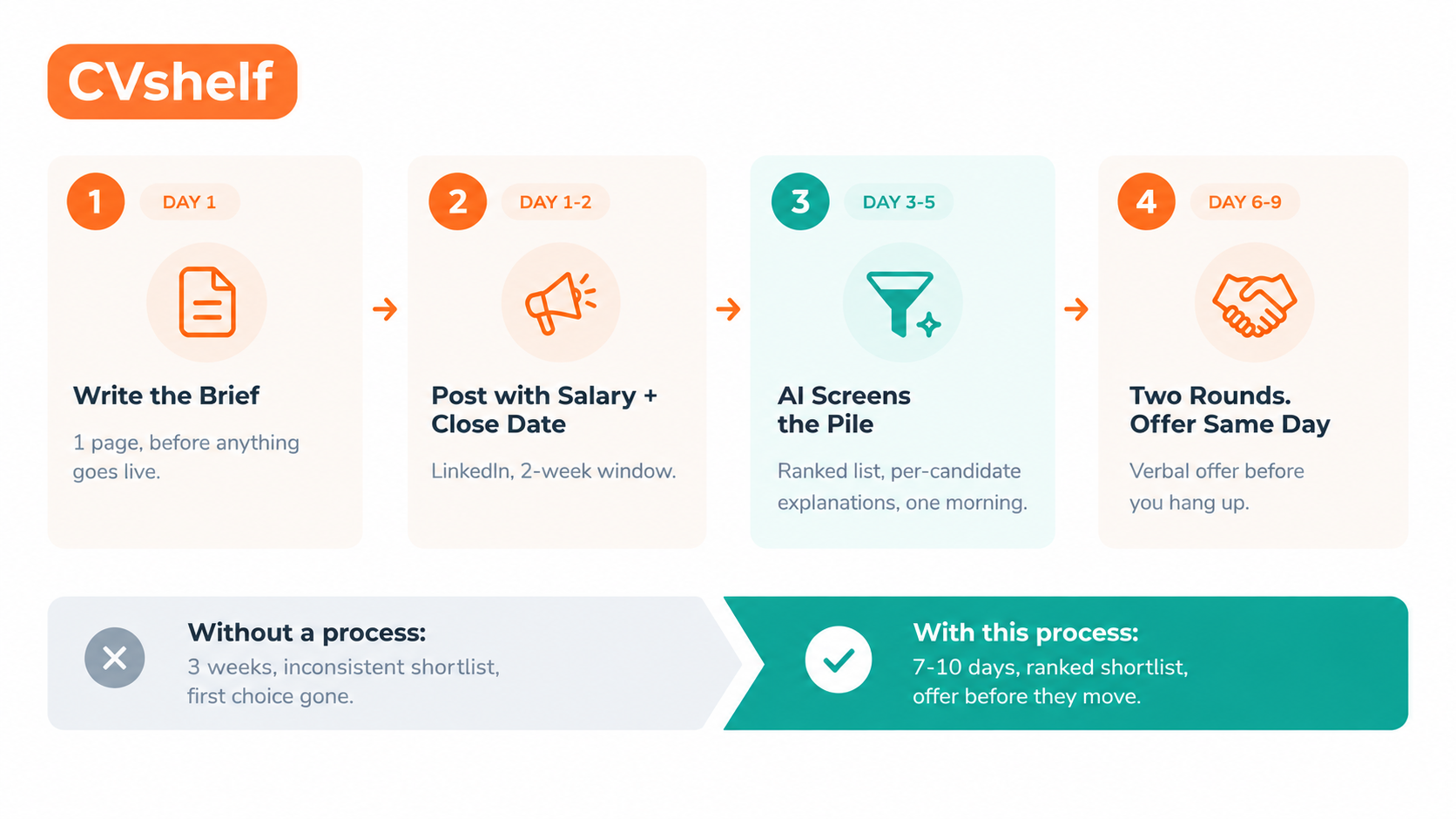
2. AI screening to rank the full pile. Upload every application to a screening tool, paste in the job description, and get a ranked list with per-candidate reasoning. CVShelf does this: bulk upload, job description input, ranked output with a short explanation per candidate covering what the AI found relevant and what it flagged as missing. The reviewer reads the top ten to fifteen. Every other candidate was evaluated against the same criteria, in the same way, without fatigue. A studio manager with no hiring experience can work through the output in under an hour and produce a shortlist they can explain.
3. A scoring pass on the top candidates. For each person in the top ten, score them against the written criteria on a 1-to-5 scale. Takes 30 minutes. Produces a shortlist you can hand to a creative director or MD and explain without saying "I thought they seemed good." The decision has a basis. That matters when someone pushes back.
4. Templated rejections, sent within a week. Two sentences. Their name, the role, a polite no. Everyone outside the shortlist gets one within a week of the close date. Candidates who apply to a creative agency are in your professional network, the industry is smaller than it looks. Silence costs employer brand with people who talk to other people in your sector.
The Most Common Mistake
Buying a full ATS to solve a screening problem.
An ATS earns its place when you're running multiple open roles simultaneously, coordinating hiring across several people, and doing enough hires per year to justify standing infrastructure. For a creative agency doing six to eight hires annually with no dedicated recruiter, that infrastructure creates more work than it saves.
The cycle is consistent. ATS purchased after a painful hire. Partially configured. Used twice. Abandoned. The agency goes back to email and a spreadsheet, now paying a monthly subscription for something nobody opens.
Buy for the problem you have. The problem is that processing a large inbound pile manually takes time you don't have and produces inconsistent results. A dedicated screening tool, not a full ATS, fixes that problem at a fraction of the cost and with no meaningful setup overhead.
The distinction matters: an ATS manages a hiring pipeline. A screening tool processes a CV pile and surfaces who's worth talking to. For most creative agencies at 10-100 people, the second problem exists. The first often doesn't yet.
FAQ
Q1. What recruitment software works for a small creative agency without a recruiter?
For screening inbound applications, CVShelf. Paste in the job description, upload the pile as a bulk batch, get a ranked shortlist with explanations. No ATS required, no training, no configuration. For tracking a small number of candidates through interviews, a shared Google Sheet is often sufficient, add a proper ATS only when coordination across the team becomes genuinely painful.
Q2. Is there recruitment software that doesn't require an ATS setup?
Yes. CVShelf works as a standalone screening tool with no ATS dependency. You run it when a role opens, get a shortlist, and move on. It starts at $29/month and is operational within minutes of signing up. Breezy HR is worth considering if you want pipeline management alongside screening, it's more setup and more cost, but it handles both in one tool.
Q3. Do creative agencies need different recruitment software than other businesses?
The role types are different (creative, production, account, strategy), but the hiring process problem is the same: too many applications, not enough time to screen them, one person doing it alongside other work. What matters is whether the software is simple enough to pick up four times a year without re-learning it each time. Complexity that requires a trained recruiter to operate is the wrong fit regardless of industry.
Recruitment software at creative agency scale doesn't need to be comprehensive. It needs to be fast to set up, easy to run without recruiting expertise, and good at the one thing that takes the most time: processing a large application pile consistently.
Try CVShelf complimentary at cvshelf.com.
Keep Reading
More from AI Resume Screening.
Agency Hiring Without Recruiter Fees
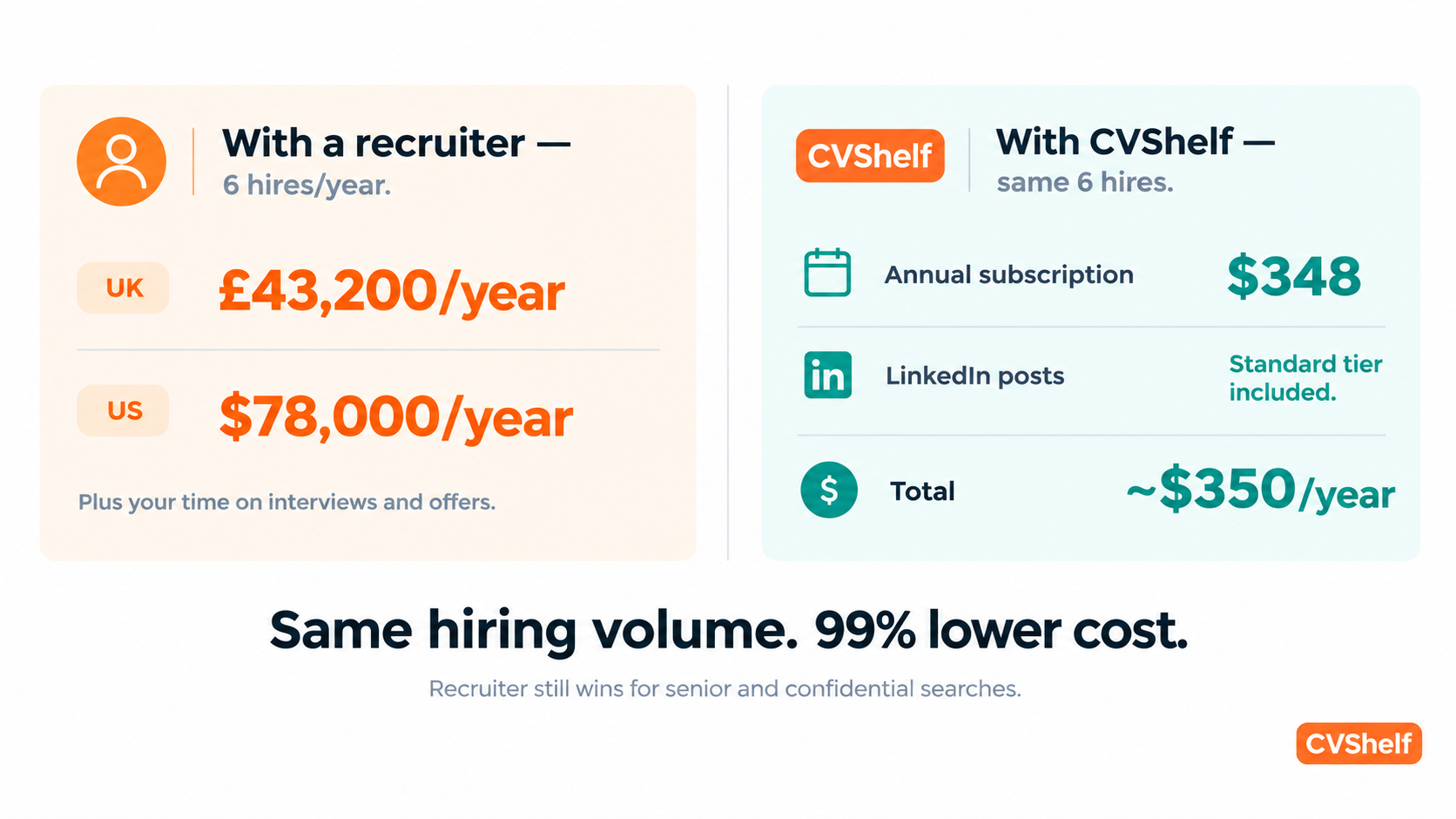
Contingency recruiters charge 15-25% of first-year salary for mid-level placements, that's $9,000 to $15,000 for a single account manager hire.
How Many Applicants For A Small Agency Job Posting
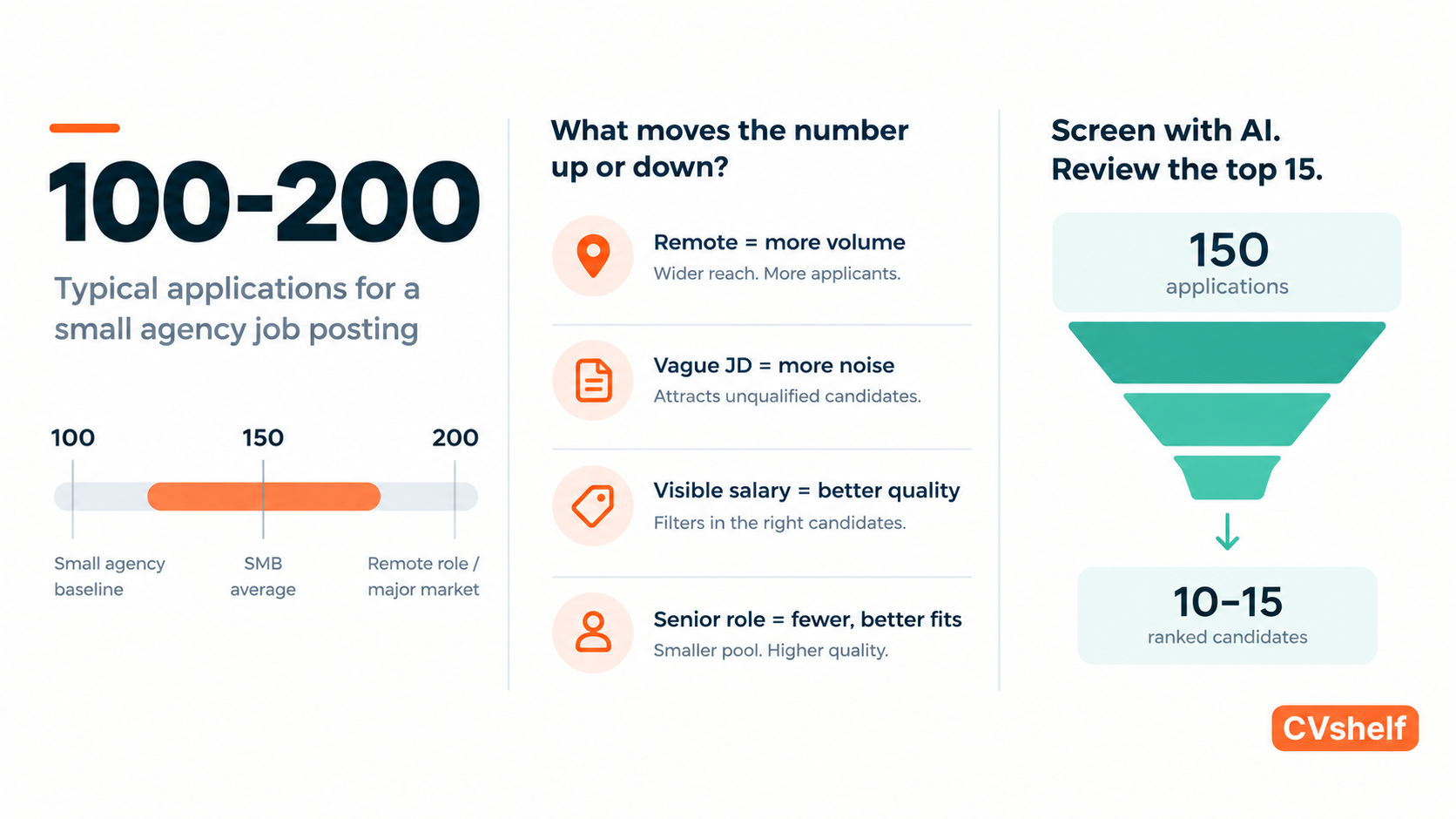
A small agency posting a mid-level role on LinkedIn or Indeed typically receives 100 to 200 applications within two weeks.
Hiring Without HR Department Small Business
Most small businesses handle hiring the same way: someone gets voluntold, reads a third of the CVs.