
Top 7 Mistakes Recruiters Make While Shortlisting Candidates (And How to Fix Them)
Recruiters often make critical mistakes like relying on gut feeling, manual screening, and inconsistent evaluation, which leads to missed top talent and biased decisions.

In the fast-paced world of talent acquisition, even the most seasoned professionals can fall into common traps that compromise hiring quality. Understanding the Top 7 Mistakes Recruiters Make While Shortlisting Candidates (And How to Fix Them) is essential for any team looking to optimize their hiring process. When manual resume review takes up to 87% of a recruiter's time, it is easy to succumb to unconscious bias or rush through applications, which ultimately hurts the candidate experience.
By exploring the Top 7 Mistakes Recruiters Make While Shortlisting Candidates (And How to Fix Them), we can identify how to shift from subjective, manual screening to objective, data-driven workflows. Modern recruitment technology, such as AI-powered resume screening and candidate fit scoring, allows teams to eliminate these errors by focusing on skills-based matching. Whether you are struggling with high application volumes or inconsistent job description alignment, leveraging automation ensures that your hiring managers receive only the most qualified talent. Adopting these smarter strategies not only saves time but also builds a more diverse and capable workforce through consistent, transparent evaluation standards.
Relying on Subjective Gut Feelings Over Data
Relying on gut feelings is one of the most common entries in the Top 7 Mistakes Recruiters Make While Shortlisting Candidates (And How to Fix Them). When hiring managers trust their intuition over objective data, they often introduce unconscious bias that clouds their judgment. This subjective approach frequently leads to missed talent and inconsistent hiring outcomes. By shifting to an AI-powered candidate fit scoring system, you replace guesswork with measurable metrics. CVShelf provides transparent reasoning for every score, ensuring that your hiring process remains fair and evidence-based.
Using objective data helps you focus on core competencies rather than personal impressions. This transition is a key takeaway from the Top 7 Mistakes Recruiters Make While Shortlisting Candidates (And How to Fix Them), as it directly improves the candidate experience by providing every applicant with a fair chance. When you standardize your evaluation, you remove the noise of human error and improve the quality of your talent acquisition strategy. Embracing automation allows your team to spend less time on manual sorting and more time engaging with the most qualified individuals for the role.
Ignoring Skills-Based Matching During Initial Screening
Another entry in our Top 7 Mistakes Recruiters Make While Shortlisting Candidates (And How to Fix Them) is the failure to align specific skills with job requirements during initial screening. Many recruiters scan resumes for keywords without verifying if the candidate actually possesses the required proficiency. This oversight often leads to a mismatch where qualified talent is ignored while underqualified applicants advance. When you ignore skills-based matching, you risk wasting time on interviews that do not yield results.
To fix this, implement an AI-powered resume screening tool that performs semantic analysis to verify skill depth. By using automated candidate ranking, you ensure that every applicant is measured against the specific competencies defined in your job description. This shift is a core component of the Top 7 Mistakes Recruiters Make While Shortlisting Candidates (And How to Fix Them), as it replaces manual guesswork with objective, data-driven insights. Utilizing technology to parse resumes for actual skill application—rather than just keyword density—drastically improves your hiring process efficiency and ensures you only engage with candidates who truly meet your technical standards.
Getting Bogged Down by Manual Resume Review
When you spend hours manually sorting through stacks of applications, your efficiency drops significantly. This is a primary entry in the Top 7 Mistakes Recruiters Make While Shortlisting Candidates (And How to Fix Them), as manual review often leads to burnout and oversight. By automating your initial screening with CVShelf, you can reduce administrative time by up to 87%. This allows your team to focus on high-value tasks like building relationships with top talent.
Automated parsing transforms your workflow by instantly extracting data from diverse file formats. This technology ensures that no candidate is overlooked due to formatting errors or simple human fatigue. When reviewing the Top 7 Mistakes Recruiters Make While Shortlisting Candidates (And How to Fix Them), it becomes clear that relying on manual processes is no longer sustainable in a competitive market. Implementing an AI-driven platform provides the scalability needed to handle massive application volumes without sacrificing quality. By shifting to automated parsing, you ensure that every applicant receives a consistent, objective evaluation, ultimately improving your hiring process and allowing your team to engage with the best candidates faster than ever before.
Failing to Maintain Consistent Candidate Evaluation Standards
Failing to maintain consistent evaluation standards is a major pitfall among the Top 7 Mistakes Recruiters Make While Shortlisting Candidates (And How to Fix Them). When different hiring managers apply unique criteria to the same role, the resulting inconsistency creates a fragmented and unfair process. This lack of uniformity often leads to high-volume hiring bottlenecks where qualified talent is overlooked simply because they did not align with one interviewer's specific preference.
To solve this, implement a standardized scorecard system that forces every evaluator to rank candidates against identical, pre-defined metrics. By leveraging the CVShelf platform, you can automate this alignment by ensuring every resume is parsed and scored against the exact same job description requirements. This data-driven approach removes the ambiguity that defines the Top 7 Mistakes Recruiters Make While Shortlisting Candidates (And How to Fix Them). When your team uses a centralized dashboard to track objective fit scores, you eliminate the guesswork and ensure that every applicant receives a fair, transparent evaluation. This shift not only accelerates your hiring process but also significantly improves the overall quality of your talent acquisition strategy by keeping everyone on the same page.
Overlooking Passive Candidates Due to Slow Workflows
One of the most damaging entries in the Top 7 Mistakes Recruiters Make While Shortlisting Candidates (And How to Fix Them) is the tendency to overlook passive talent due to sluggish, manual workflows. When your team is buried in administrative tasks, you lose the agility required to engage high-quality candidates who are not actively searching for a new role. By the time a recruiter manually reviews a resume, that top-tier talent has often already accepted another offer.
Automation is the ultimate fix for this bottleneck. By integrating AI-powered resume screening, you can instantly parse and rank incoming applications, allowing your team to focus exclusively on proactive outreach. This shift is a central theme in the Top 7 Mistakes Recruiters Make While Shortlisting Candidates (And How to Fix Them), as it highlights how technology transforms a reactive hiring process into a competitive advantage. With CVShelf, you can reduce manual review time by up to 87%, ensuring that your hiring managers engage with the best talent the moment they appear in your pipeline. By removing the friction of manual sorting, you create a seamless, responsive experience that keeps your talent acquisition strategy ahead of the curve.
Neglecting Transparent Communication with Every Applicant
Neglecting transparent communication is a silent killer of your employer brand. When applicants are left in the dark, frustration builds, and your reputation as a professional recruiter suffers. This is a critical entry in the Top 7 Mistakes Recruiters Make While Shortlisting Candidates (And How to Fix Them), as poor engagement often leads to top talent withdrawing their applications early.
The most effective way to fix this is by implementing automated status updates. By leveraging the CVShelf platform, you can trigger personalized, timely emails at every stage of the hiring process. This ensures that every candidate feels valued, regardless of whether they move forward. Research shows that 75% of job seekers expect a response, yet many recruiters fail to provide one due to manual workload constraints. By automating these touchpoints, you maintain a professional candidate experience without adding to your daily administrative burden. Addressing this mistake is essential to the Top 7 Mistakes Recruiters Make While Shortlisting Candidates (And How to Fix Them), as it transforms your recruitment workflow into a transparent, candidate-centric engine that keeps your talent pipeline engaged and informed throughout the entire journey.
Missing Opportunities to Optimize Hiring Through Analytics
Many recruiters fail to leverage platform analytics, which is a critical entry in the Top 7 Mistakes Recruiters Make While Shortlisting Candidates (And How to Fix Them). Without tracking key metrics like source quality or time-to-shortlist, you are flying blind. Data-driven hiring allows you to identify exactly where your funnel leaks talent. By using the CVShelf recruitment dashboard, you can monitor real-time performance indicators to refine your search strategy continuously.
Ignoring these analytics leads to stagnant processes that repeat past errors. To fix this, start tracking your conversion rates at each stage of the hiring process. When you analyze which job boards or outreach methods yield the highest-scoring candidates, you can reallocate your budget toward high-performing channels. This transition from intuition to intelligence is vital. As you explore the Top 7 Mistakes Recruiters Make While Shortlisting Candidates (And How to Fix Them), remember that actionable insights are your best tool for reducing unconscious bias. By reviewing your platform data, you ensure that your talent acquisition strategy remains agile, objective, and highly efficient, ultimately helping you secure top-tier talent faster than your competitors.
Frequently Asked Questions
What are the Top 7 Mistakes Recruiters Make While Shortlisting Candidates (And How to Fix Them)?
The Top 7 Mistakes Recruiters Make While Shortlisting Candidates (And How to Fix Them) include relying on gut feelings, ignoring transferable skills, and rushing the review process. Other common pitfalls are failing to define clear job requirements, letting unconscious bias influence decisions, inconsistent screening criteria, and poor communication. To fix these, you should adopt AI-powered tools like CVShelf. Our platform automates resume parsing and provides objective, skills-based scoring, which removes human error and ensures every candidate is evaluated consistently against your specific job requirements.
How can I avoid unconscious bias when shortlisting candidates?
Unconscious bias is one of the most critical issues addressed in the Top 7 Mistakes Recruiters Make While Shortlisting Candidates (And How to Fix Them). To eliminate it, move away from manual, subjective reviews. Use CVShelf's AI-driven platform to standardize your evaluation process. By focusing purely on skills and experience data parsed by our software, you ensure that every applicant is ranked based on merit alone. This objective approach helps you build a more diverse and talented team while keeping your hiring process fair and transparent.
Why is manual resume screening considered a major recruiting mistake?
Manual screening is often cited as a top error because it is slow, prone to fatigue, and highly susceptible to human bias. As highlighted in the Top 7 Mistakes Recruiters Make While Shortlisting Candidates (And How to Fix Them), manual processes cannot handle high volumes efficiently. By switching to CVShelf, you can reduce manual review time by up to 87%. Our automated resume screening and ranking tools allow you to process thousands of applications in minutes, ensuring you never miss a top-tier candidate due to human oversight.
How does technology help in fixing shortlisting mistakes?
Technology acts as a force multiplier for your hiring strategy. When you look at the Top 7 Mistakes Recruiters Make While Shortlisting Candidates (And How to Fix Them), most can be solved by implementing an AI-powered recruitment platform. CVShelf helps by providing:
Automated resume parsing to extract key skills.
Consistent candidate fit scoring to remove subjectivity.
Bulk operations to manage high-volume hiring without rushing.
These features ensure your workflow remains efficient, data-driven, and focused on quality rather than just speed.
What is the best way to improve candidate experience during the shortlisting phase?
Improving candidate experience is a key takeaway from the Top 7 Mistakes Recruiters Make While Shortlisting Candidates (And How to Fix Them). Candidates value timely and objective feedback. You can improve this by using automated outreach and tracking tools within CVShelf. When your screening process is fast and bias-free, you can provide quicker updates to applicants. This professional approach keeps candidates engaged and reflects positively on your employer brand, making it easier to attract top talent in a competitive market.
Can AI really help me avoid the most common recruiting mistakes?
Yes, AI is highly effective at overcoming the Top 7 Mistakes Recruiters Make While Shortlisting Candidates (And How to Fix Them). Because AI operates on predefined logic and data, it does not get tired or distracted. CVShelf offers semantic search and skills-based matching, which ensures that your shortlisting is always aligned with the specific job description. By automating the repetitive parts of the hiring process, you gain more time to focus on meaningful interviews and building relationships with the best-fit candidates.
Keep Reading
More from AI Resume Screening.
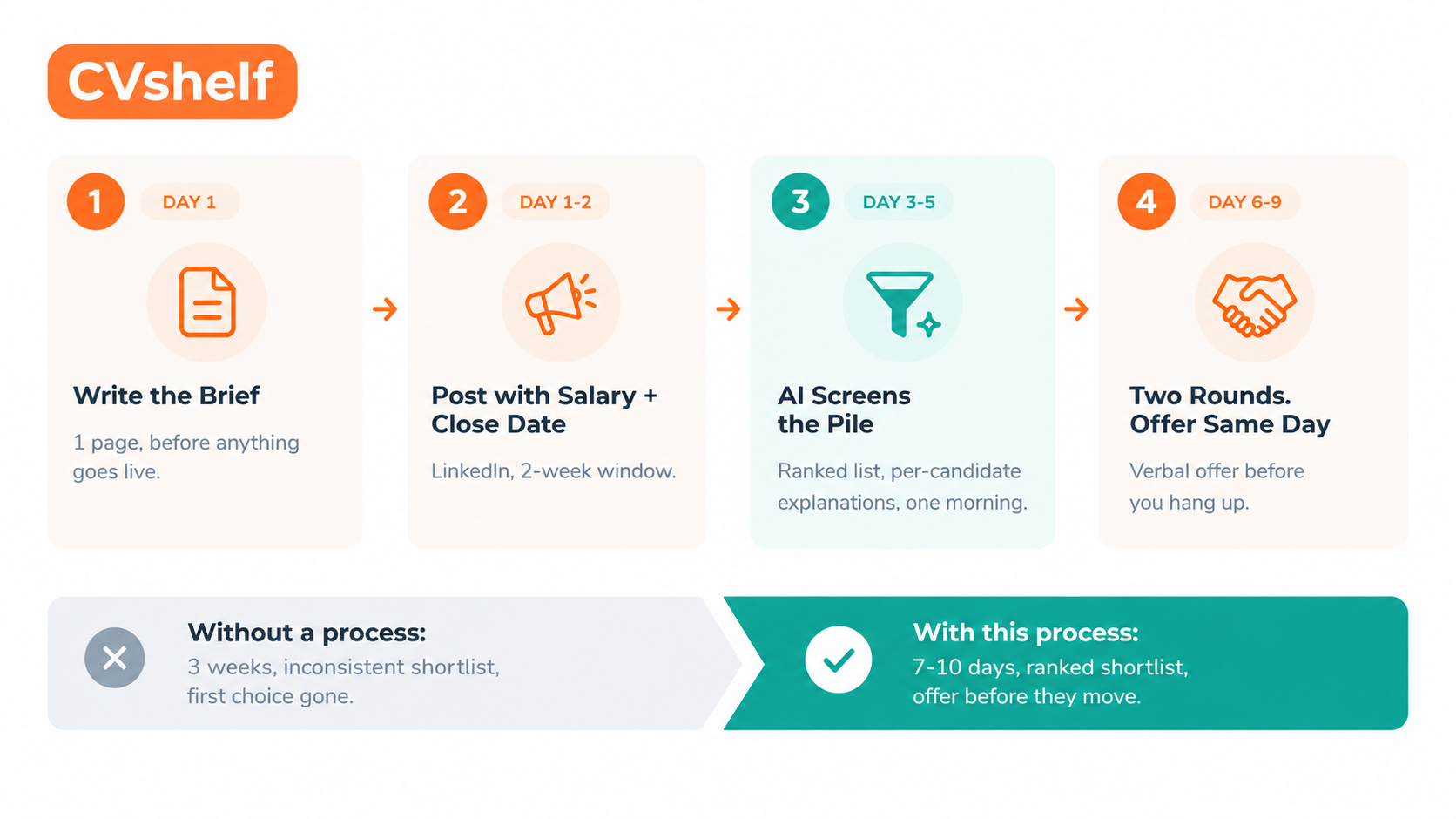
Hiring Without HR Department Small Business
Most small businesses handle hiring the same way: someone gets voluntold, reads a third of the CVs.
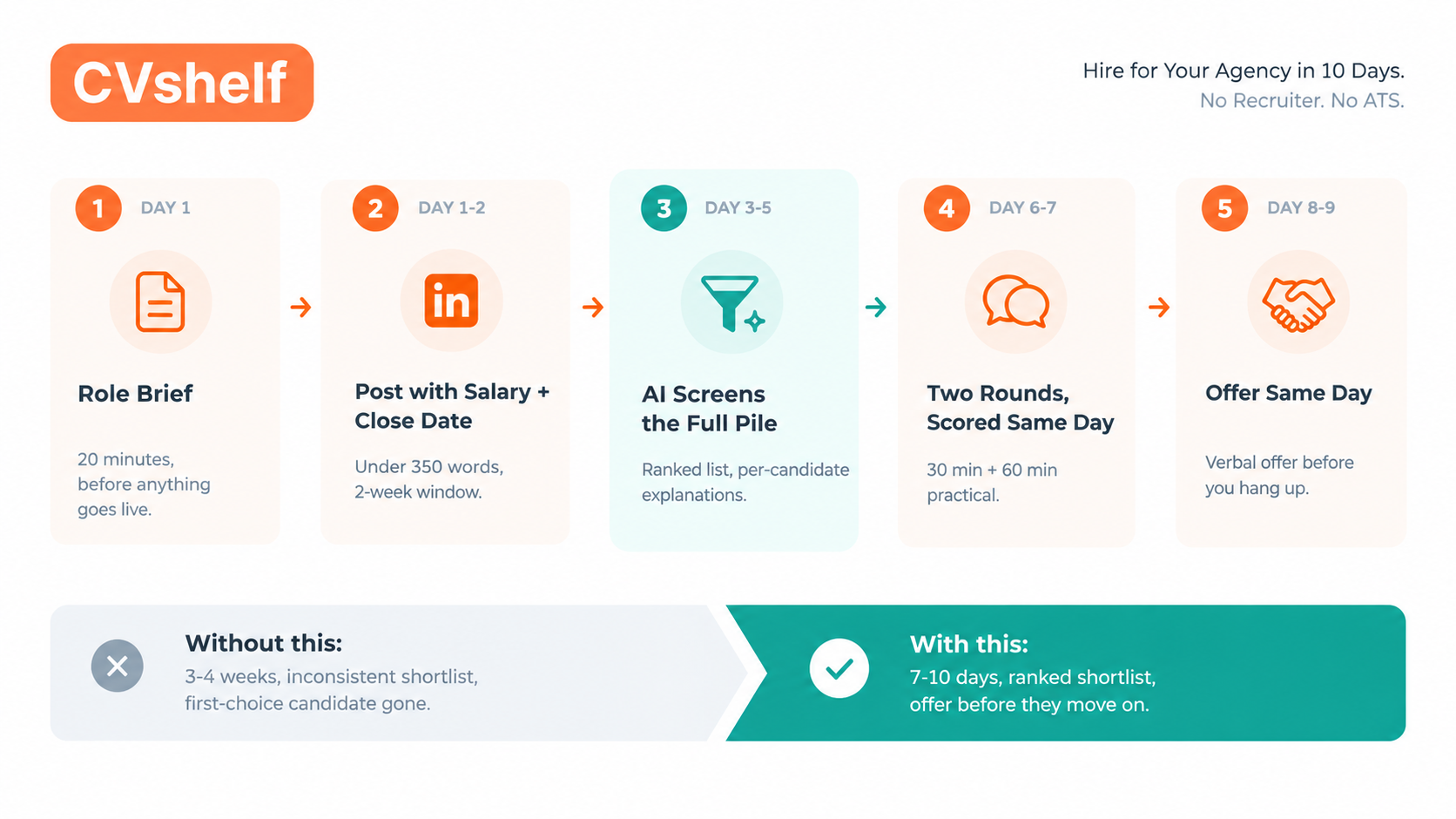
Hiring Platform For Digital Marketing Agency
Most hiring platforms were built for companies with dedicated HR teams.
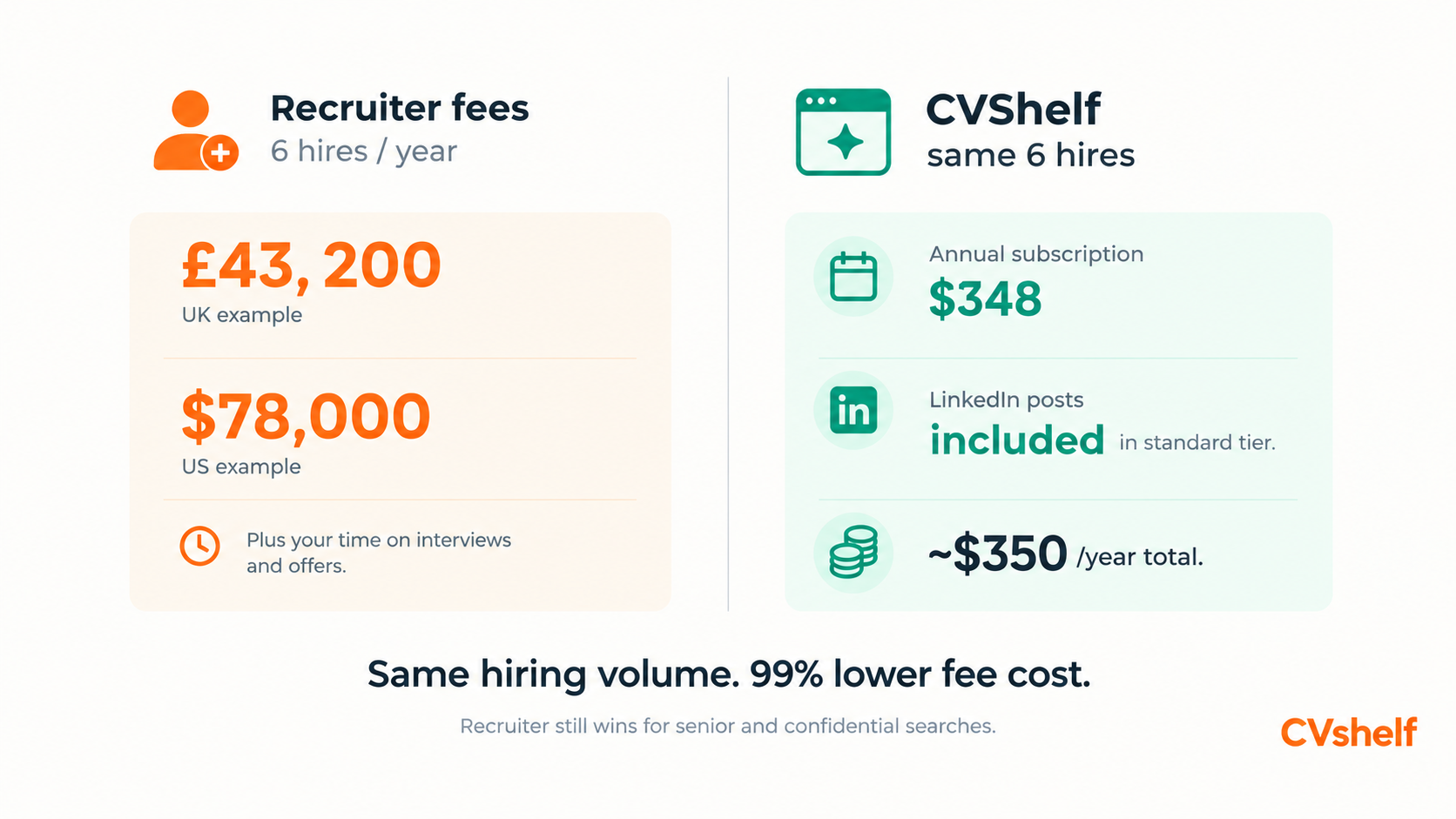
How Much Does A Recruiter Cost Vs AI Tool
A contingency recruiter placing a mid-level account manager or strategist typically charges 15-25% of first-year salary.