
Account Manager Hiring Software for Agencies
Account manager is the most common hire at a growing agency, and the one that most often goes wrong.
Most agency founders who search "account manager hiring software" are not looking for a 12-month ATS contract. They posted a role, 180 applications arrived, and they need to know who to call by Friday.
That's the real problem. And it's worth naming clearly before getting into tools, because most of the software built for this use case was designed for something slightly different, a dedicated recruiter, a continuous hiring pipeline, an IT team to manage the integration. None of that is the situation at a 40-person creative agency where the MD is handling the hire between client calls.
What you actually need is a process that a non-specialist can run in a few hours per role, supported by software that removes the manual labour from the highest-volume step.
The Real Problem When You're Hiring an AM at an Agency
The account manager role is the most frequently hired position at agencies in the 10 to 100-person bracket. It's also the one with the most chaotic process.
Here's why. The AM role tends to open suddenly, a client was won, someone resigned, or an existing AM got stretched past the point of functioning properly. The hire becomes urgent. The ops manager or MD posts the role, and within a week there are 150 to 250 applications sitting in a shared inbox.
That pile doesn't get read properly. The person doing the screening has other work. They read the first third carefully, skim the middle third, and never open the rest. The shortlist reflects reading order and energy levels more than candidate quality. A strong AM candidate who applied on day three sits in the bottom half of an unopened folder.
Meanwhile, good mid-level account managers in the US and UK are typically in two or three processes at once. They don't wait three weeks for a disorganised agency to produce a shortlist. They accept the fastest decent offer. The agency's slow process doesn't just produce a bad shortlist, it produces a different candidate pool by the time it finishes.
Software doesn't fix a broken process. But the right software removes the part of the process that takes the most time and produces the most inconsistency.
What Good Actually Looks Like
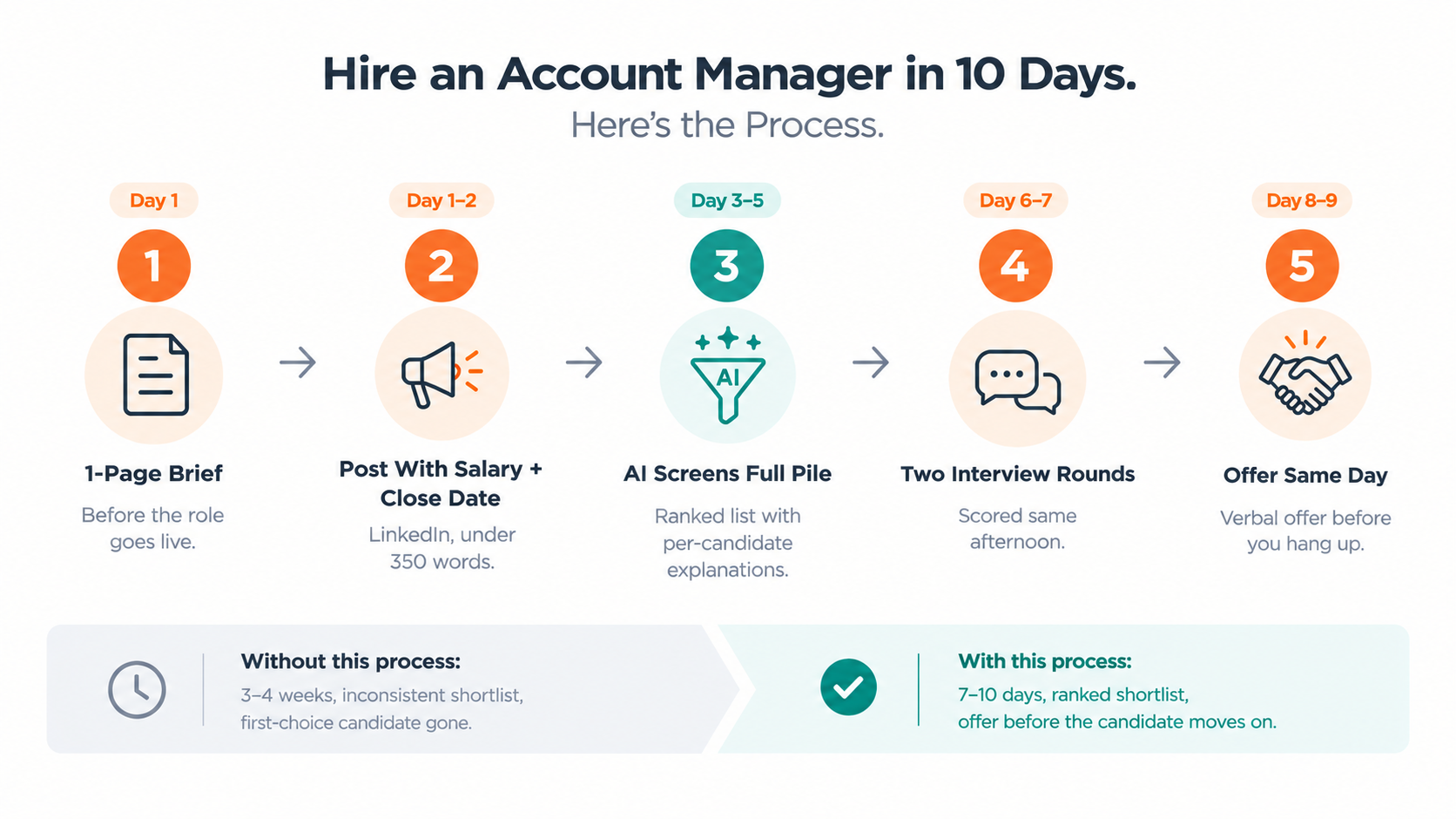
Five steps. All of them actionable this week.
1. Write a 1-page brief before the role goes live. What does this person need to do in the first 90 days? What are the two or three actual non-negotiables, not a wishlist, genuine dealbreakers? Agency-side experience, specific channel knowledge, right-to-work requirements. Write this down. It becomes your JD source material, your screening criteria, and the thing you hand to anyone else involved in the hire so they're all evaluating against the same standard.
2. Post with a close date and visible salary. LinkedIn is the channel for AM roles at agencies in the US and UK. Keep the JD under 350 words. Include the salary range, candidates who can't see a range either skip the listing or waste everyone's time finding out late. Set a close date two weeks out so the pile doesn't accumulate indefinitely.
3. Run the full pile through AI screening. This is the step that changes the scale of the problem. CVShelf takes the job description and a bulk upload of resumes, PDFs, Word files, a zip of everything, processes every application against the role criteria, and returns a ranked list with a per-candidate explanation. You review the top ten to fifteen. The AI handled the read-through against consistent criteria. Each explanation covers what it found relevant and what it flagged, so the reviewer can agree with the ranking or push back where context matters. A non-recruiter can do this confidently in one focused morning rather than a week of fragmented reading.
4. Two interview rounds, scored consistently. A 30-minute first call, basics, fit for agency life, how they've handled a difficult client situation. A 60-minute second with a practical element: a real (anonymised) client scenario, a brief, something that shows how they think under light pressure. Score each round against your written criteria the same afternoon, while the conversation is fresh.
5. Offer same day as the final interview. Agree on salary, start date, and key terms internally before the final interview takes place. If it goes well, make the verbal offer before you hang up. Send the written offer the same day. Every day between the final interview and the offer is a day the candidate is entertaining something else.
The Most Common Mistake
Buying an ATS to solve a screening problem.
A full ATS, Breezy HR, Manatal, Workable, is the right tool when you're coordinating hiring across multiple people, running several open roles simultaneously, doing 20-plus hires a year. For an agency doing eight AM hires per year with no dedicated recruiter, a full ATS generates overhead that cancels out what it saves. Setup takes weeks. Adoption requires getting multiple people into a new workflow for something that fires up four times a year. Most of the features collect dust.
The pattern is predictable: ATS purchased, partially configured, used twice, abandoned. The agency goes back to the inbox, slightly poorer.
Buy for the problem you have now. The problem is that a large inbound pile takes a week to screen properly and the manual process produces inconsistent shortlists. An AI screening tool fixes that specific problem. Add pipeline infrastructure when manual tracking across a team becomes the actual bottleneck, which, for most agencies at this size, it isn't yet.
FAQ
Q1. What's the best software for hiring an account manager without a recruiter?
For inbound screening at volume, CVShelf. Paste in the job description, upload the resumes, get a ranked shortlist with explanations. No ATS required, no setup call, no recruiter background needed. For scheduling, Calendly handles interview coordination without a coordinator. For pipeline tracking if you're managing more than two or three candidates across stages, a shared spreadsheet works until the coordination itself becomes the bottleneck.
Q2. How do I screen 200 account manager applications without spending a week on it?
Set written criteria before opening the pile, three to five non-negotiables, written down before a single application is read. Then run the full batch through an AI screening tool. You review the top ten to fifteen ranked candidates with your full attention. The rest is handled. The screening that would take a week of fragmented reading takes one morning.
Q3. What should I look for when hiring an account manager for an agency specifically?
Agency AM experience is different from corporate account management. The questions worth testing for in interviews: have they managed multiple clients simultaneously, worked without a formal project management structure, handled a client who pushed back on creative or strategy decisions, and kept relationships intact through a difficult delivery period. Someone with five years in corporate account management may not have the same instincts as someone with two years at an agency. The CV doesn't always signal this, the interview does.
The AM hire doesn't have to take three weeks. With written criteria, AI screening, two interview rounds, and an offer made the same day as the final conversation, it can take seven to ten days without cutting any of the evaluation quality.
CVShelf handles the screening step. Try it complimentary at cvshelf.com.
Keep Reading
More from AI Resume Screening.
Manatal Alternative For Small Agency
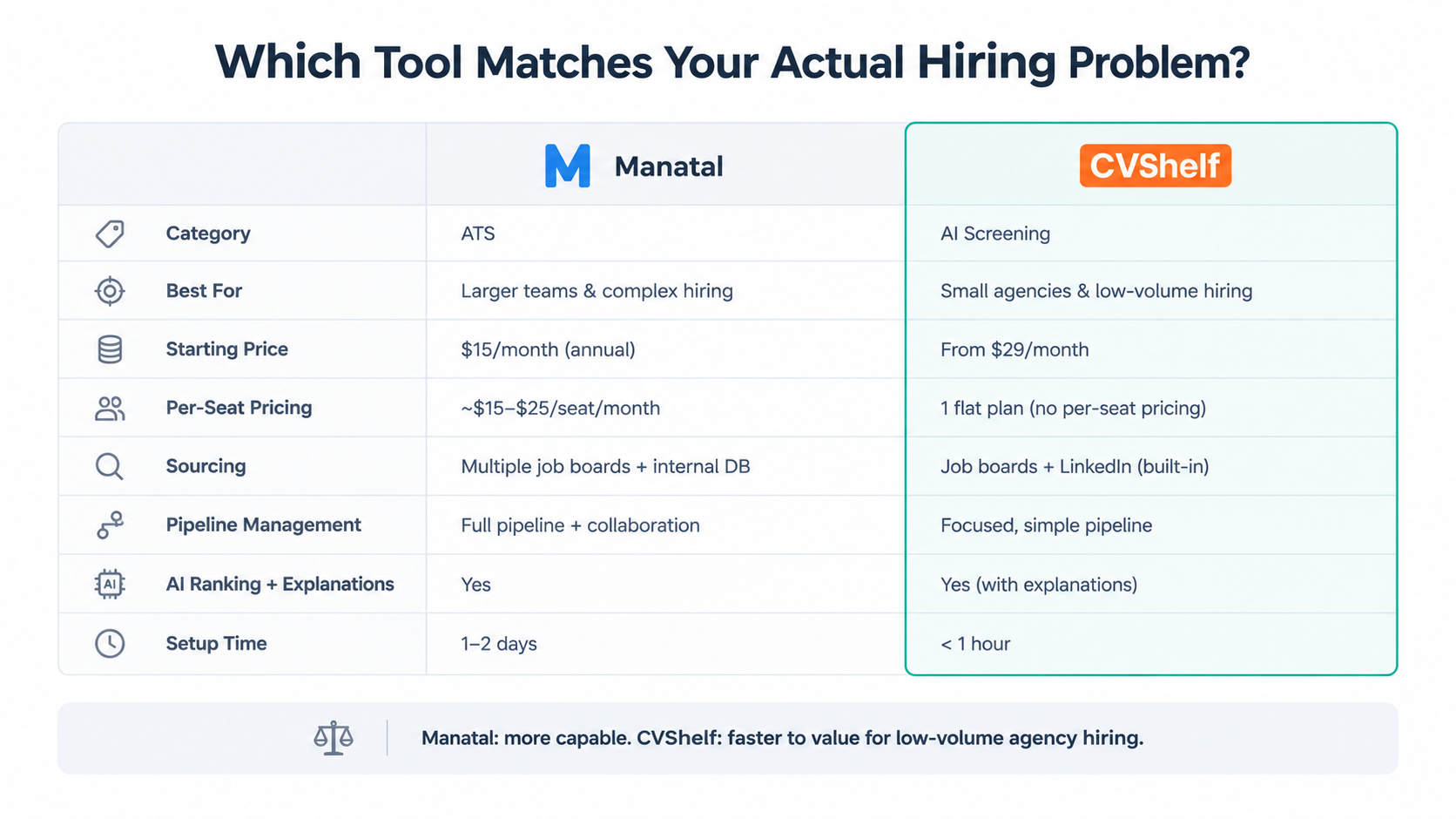
This post is for founders and MDs at 10 to 100-person marketing or creative agencies who are considering Manatal, or trying to decide whether Manatal is the right fit at all.
AI Hiring Compliance For Agencies
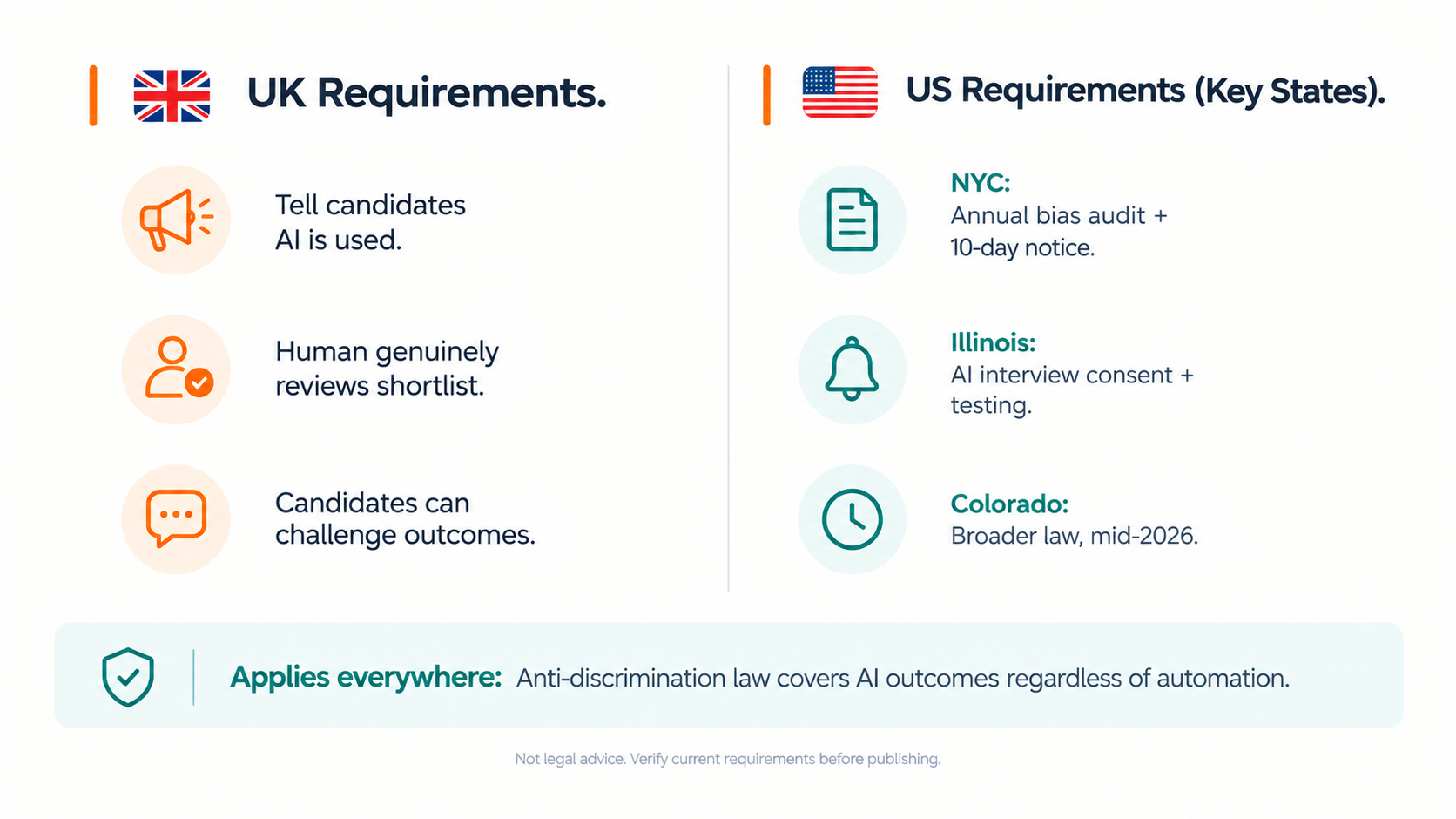
AI hiring compliance for agencies in 2026 means different things depending on where you're based and where your candidates are.
Hiring Without an HR Team: How Agencies Actually Do It
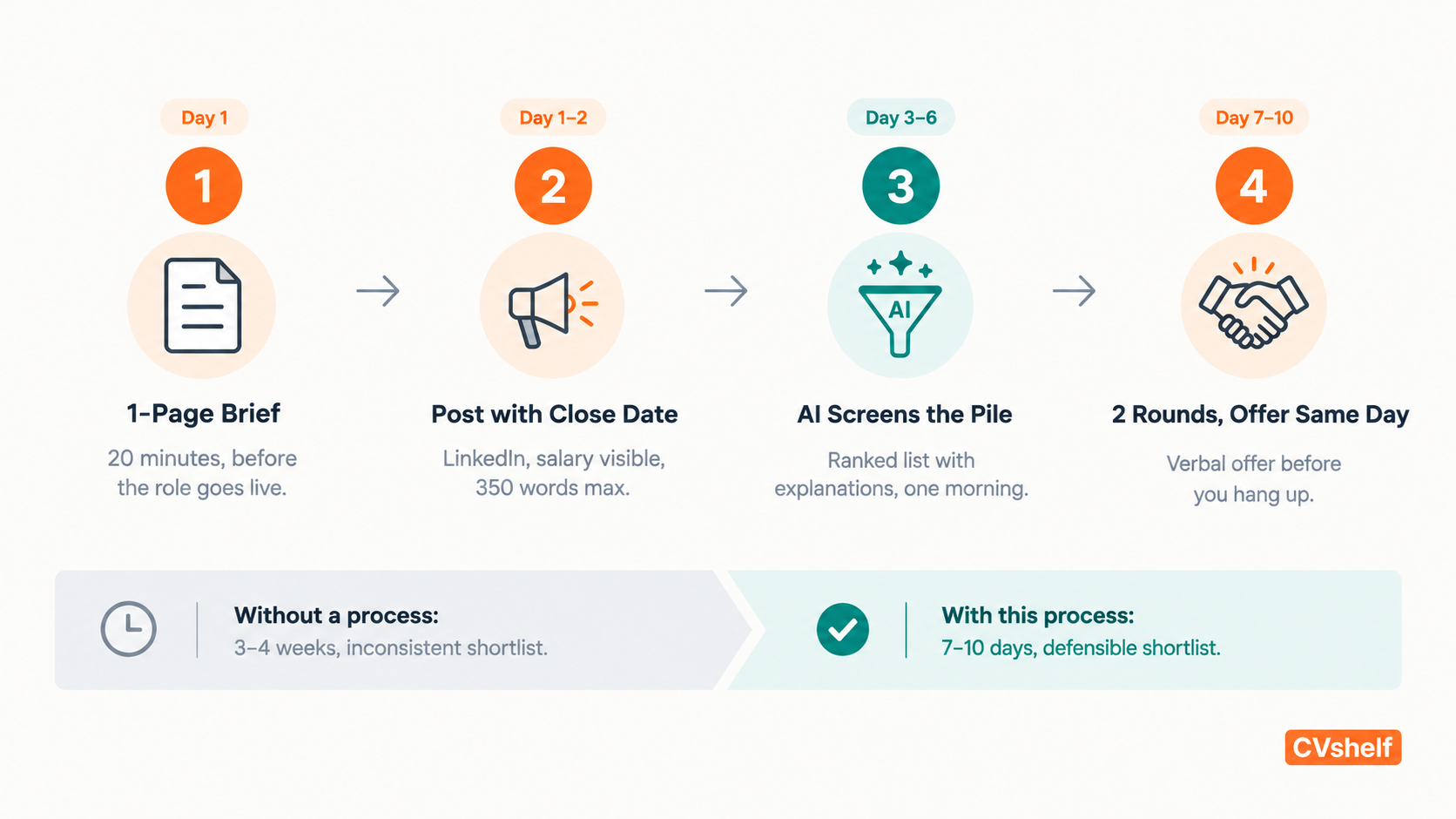
Most agencies under 100 people have no HR team.