
Resume Screening For Creative Agency Hiring
Resume screening at a creative agency is harder than it looks because the roles are harder.

Creative agency hiring is different from corporate hiring in one important way: the roles are harder to define clearly, and the people screening CVs are usually doing it for the first time in months, with no process, under time pressure.
A creative director position or a senior account manager role at an integrated agency requires a combination of skills, instincts, and cultural fit that's genuinely hard to capture in a job description, which means the screening criteria are often either too vague to be useful or too rigid to catch the unconventional candidates who would actually thrive.
The result is shortlists built on gut feel, reading order, and whatever impressed the reviewer at position 12 in the pile. This post is about replacing that with something more reliable.
The Real Problem for Creative Agency Hiring
Most creative agencies screen CVs the same way: someone opens the pile, reads the first third carefully, skims the middle, and stops somewhere before the end when something more urgent demands attention.
The shortlist that comes out reflects three things: the candidates who applied early and landed near the top of the pile, the candidates whose CV formatting looked polished and professional, and the candidates the reviewer remembered because something specific caught their eye. This is not a systematic evaluation. It's pattern recognition under fatigue.
For a strategist or account manager role, this approach misses two groups of candidates consistently. The first are strong candidates who applied mid-week when the pile was already large. The second are strong candidates with unconventional backgrounds, someone who came up through client-side marketing before moving to agency, or someone with a shorter CV that reads as junior but reflects genuinely impressive work.
The root cause isn't poor judgment. It's asking one person to make consistent, high-quality evaluations across 150 applications alongside a week of other responsibilities. That's not a skills problem. It's a process problem.
What Good Actually Looks Like
Five steps. All of them runnable by a founder or ops manager without a recruitment background.
1. Write specific criteria before the role posts. For creative agency roles specifically, "agency experience preferred" is not a criterion, it's a sentiment. A criterion is "minimum 3 years managing client relationships at an agency, ideally with B2B brand experience." The more specific the criteria, the more useful the screening output. Write three to five non-negotiables before a single CV is opened. These become the job description and the screening benchmark.
2. Post with a close date and visible salary. For creative and account roles in the US and UK, LinkedIn is the right channel. A close date creates a clean batch to process rather than a rolling pile. A visible salary filters out mismatched expectations before applications arrive.
3. Run the full pile through AI screening. This is the step that changes the scale of the problem. CVShelf takes the job description, reads every application against the criteria, and returns a ranked list with a per-candidate explanation covering what the AI found relevant and what it flagged. For a creative agency hiring a senior designer or a strategist, the explanation shows whether the AI identified the kind of depth and specificity in the CV that matters for the role. Not just whether the right words appeared. The reviewer reads the top ten to fifteen. Every other candidate was evaluated consistently, without fatigue or reading order bias.
4. Score the top candidates with a rubric. For each person in the top ten, score them against the written criteria on a 1-to-5 scale. For creative roles, add one criterion around portfolio fit or demonstrated creative thinking. This takes 30 minutes and produces a shortlist with a documented basis. When the creative director asks why you shortlisted these eight people, you have an answer.
5. Send templated rejections within a week. Two sentences per candidate. The creative and marketing industry in both the US and UK is smaller than it looks. Every rejected candidate is potentially a future client referral, a collaborator, or a hire in two years. Leaving them in silence costs brand goodwill it's hard to earn back.
The Most Common Mistake
Treating the screening process like a reading task rather than an evaluation task.
Reading CVs and evaluating CVs are different activities. Reading is passive and sequential; you form impressions as you go and the impressions from resume 12 influence how you read resume 45. Evaluating is active and criteria-driven; you apply the same benchmark to every candidate, and the benchmark doesn't shift based on what you read before.
Most agency founders and ops managers default to reading because that's the natural approach when you sit down with a pile of PDFs. The result is a shortlist that reflects the reviewer's evolving mental model of the role rather than a consistent assessment of each candidate.
The fix is sequential: set the criteria, then evaluate. Not the other way around. An AI screening tool enforces this discipline automatically; the criteria are the input, and the ranking reflects how each candidate measures against them, regardless of the order they were read.
For creative roles specifically, the second most common mistake is relying on portfolio quality to replace criteria. A strong portfolio is necessary but not sufficient. A candidate who has exceptional work but no track record managing client relationships is not the right AM hire, no matter how good the creative. The criteria must reflect what the role actually requires, not what impresses at first glance.
FAQ
Q1. How do you screen CVs for creative roles where the requirements are hard to define? Start with what success looks like in the first 90 days rather than a requirements list. What does this person need to do from day one? What's the experience that makes that credible? For a strategist role, that might be: led the strategic development on at least three separate client campaigns, presented recommendations at a senior level, worked within an agency team rather than in-house. Translate that into three to five specific criteria before screening starts.
Q2. Does AI screening work for creative and account management roles? Yes, when the job description is specific. AI screening tools evaluate whether a candidate's described experience maps to the role requirements. For a vague JD, the output is vague. For a specific one, the output is sharp. The most common failure mode is using an AI tool with a JD that says "strong communicator with marketing experience"; the tool can't distinguish meaningfully from that. Give it the specific criteria, and it performs well.
Q3. How many CVs is too many to screen without a tool? Manual screening with consistent quality is hard to sustain above 30 to 40 applications. Above 80 to 100, it's not realistic alongside other work; the quality of attention per CV drops significantly as the pile grows. For most creative agency roles on LinkedIn in the US and UK, a standard posting generates well above that threshold. AI screening at that volume isn't a convenience. It's the only way to apply consistent criteria across the full pile.
Resume screening for creative agency hiring works when the criteria are specific before screening starts and the evaluation is consistent across every candidate.
Try CVShelf complimentary at cvshelf.com.
Keep Reading
More from AI Resume Screening.
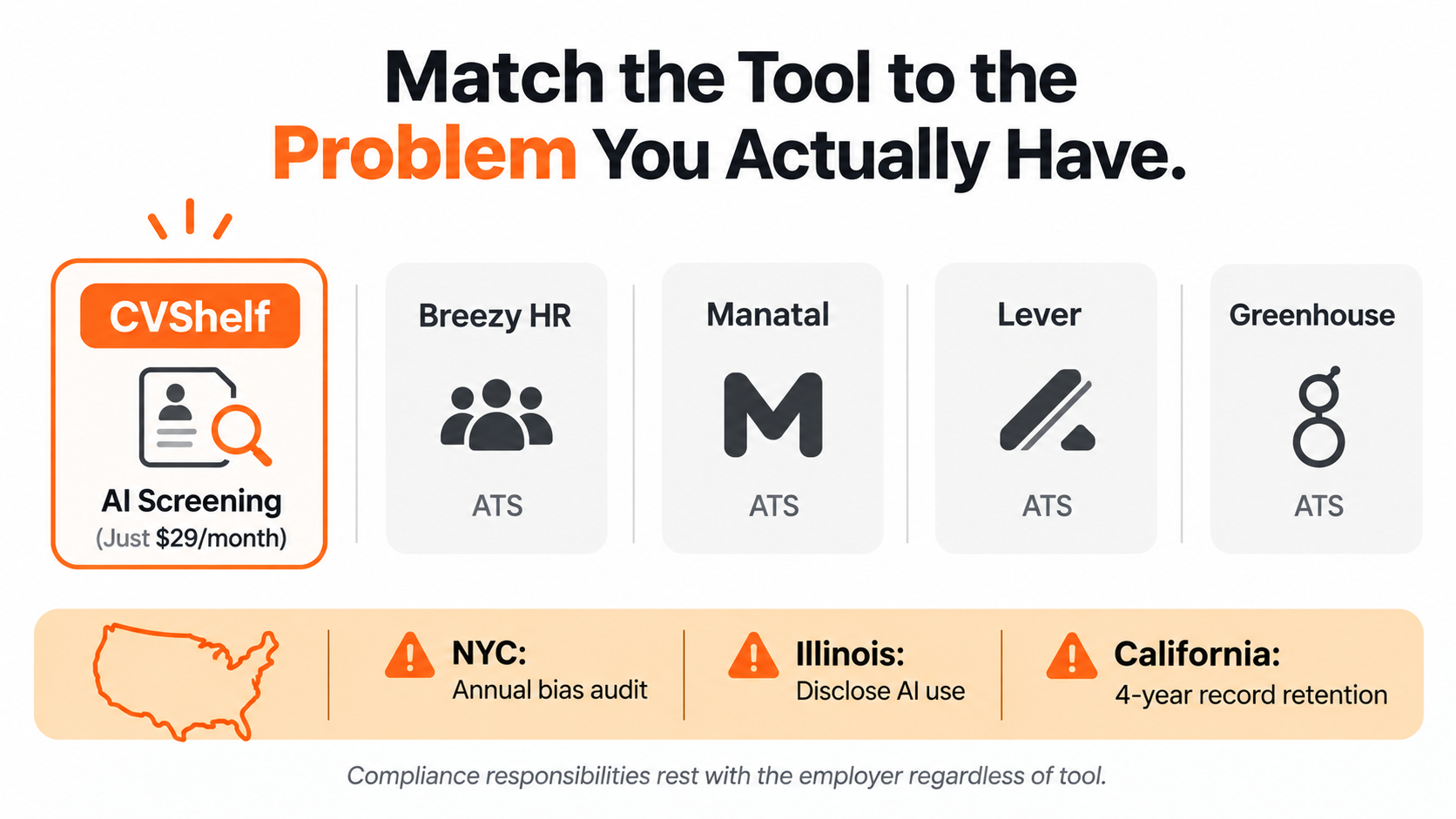
Resume Screening Software USA
This post is for founders and MDs at 10 to 100-person US agencies, digital marketing, creative, or integrated.
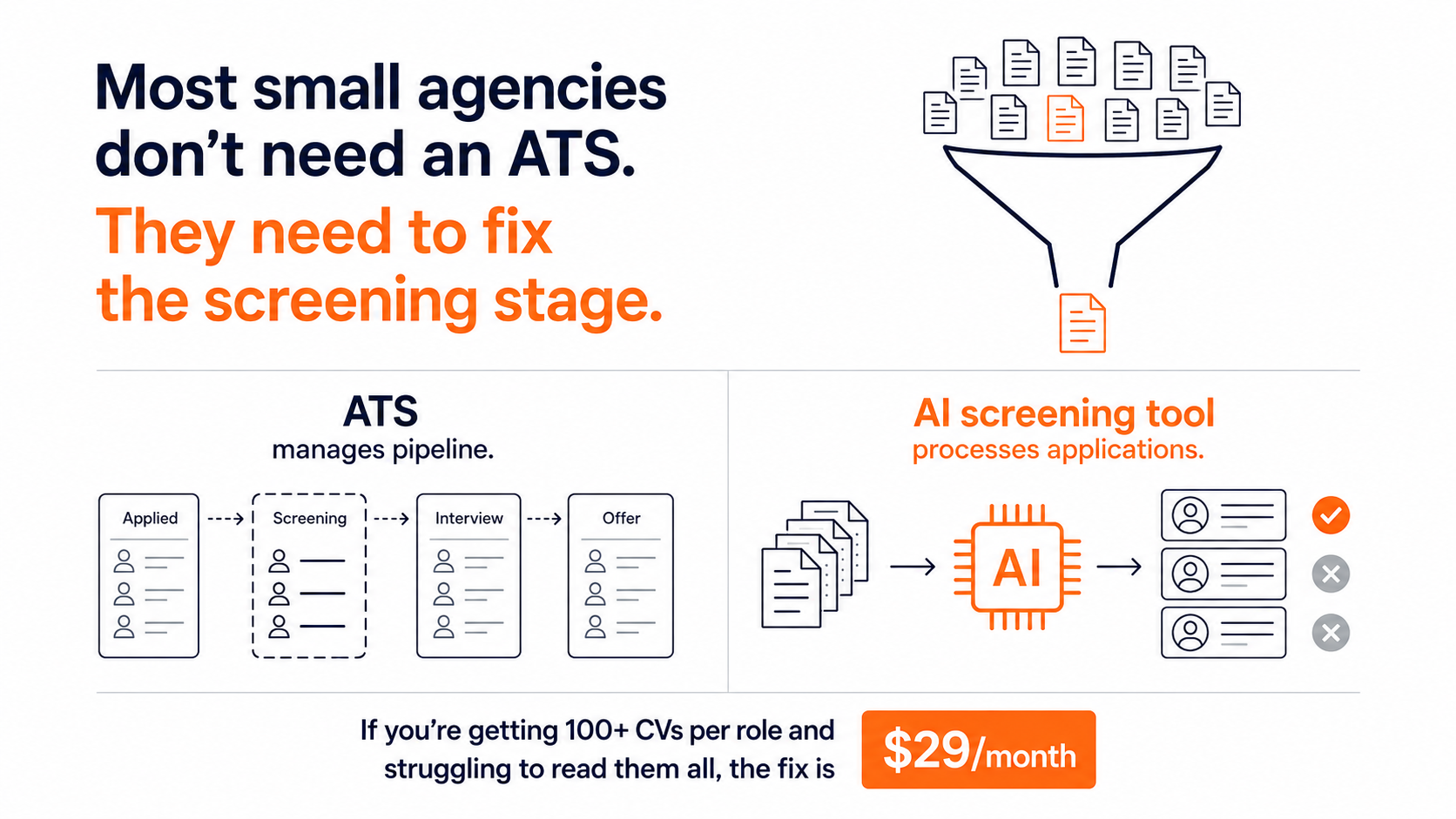
Screening Candidates Without An ATS
Screening candidates without an ATS is normal for agencies doing fewer than 15 to 20 hires per year.
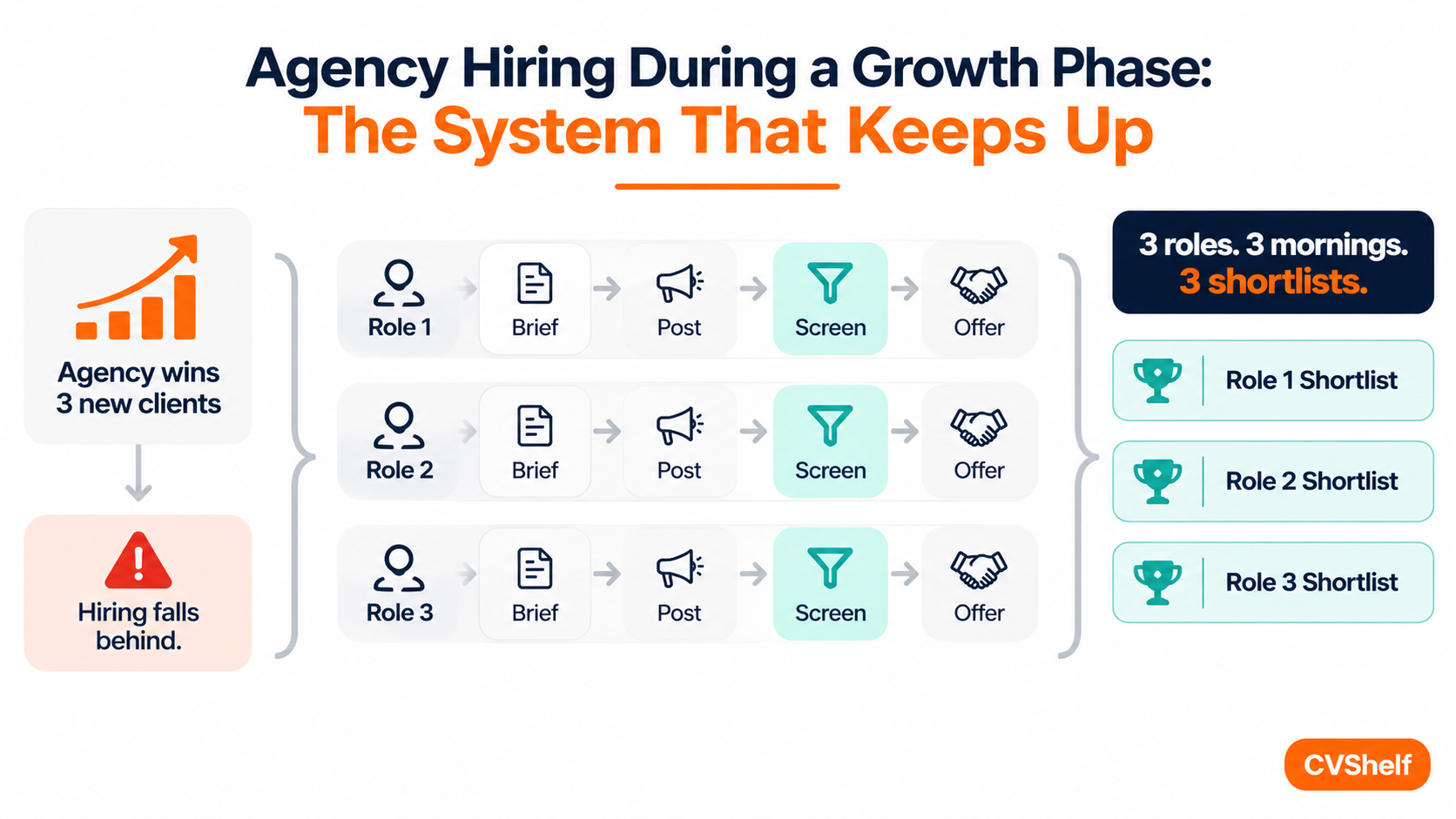
Agency Growing Pains Hiring
The hiring problems that hit a growing agency aren't random.