
Best Candidate Screening Tool for Marketing Agencies
Most agency hiring mistakes don't happen in the interview.
Every Agency Hiring Mistake Starts in the Same Place
The role opens. Applications arrive. Someone opens the folder, reads a handful, forms opinions, and builds a shortlist that mostly reflects which resumes happened to land at the top of the pile.
Nobody planned it that way. But when screening gets handled between client calls by someone who also has a budget deck due Friday, this is what happens.
The result isn't always a bad hire. Sometimes you get lucky. The problem is that luck is not a repeatable process, and when the hire doesn't work out, you have no way to know whether the screening was the issue.
What Agency Screening Actually Looks Like
Here's the honest version.
The job goes on LinkedIn. 180 applications arrive in five days. They land in a shared inbox or get forwarded to whoever is handling the hire that week. That person reads the first 30 or so carefully, skims the next 40, and stops reading somewhere around resume 80 because a client just emailed. The remaining 100 get a ten-second scroll or nothing at all.
A shortlist gets built from the 20 or so that got real attention. Some of those will be strong. Some got through because they came in early and got reviewed when the reader still had energy. Some strong candidates in the bottom half of the pile never got looked at.
No rubric. No scoring. No way to explain to a hiring manager why candidate A made the cut and candidate B didn't. Just gut feel and reading order.
This works fine for one or two hires at low volume. It breaks badly when the role is urgent, the pile is large, or the person doing the screening is already stretched.
What Good Screening Actually Requires
Four things. None of them are complicated.
Written criteria before you open the pile. Three to five non-negotiables defined before a single resume gets read. If you write them mid-review, they drift. You'll hold candidate 20 to a different standard than candidate 80 without noticing.
A scoring rubric. A simple 1-to-5 scale across the criteria. Not a complex formula. Just something that produces a number you can sort by and defend later.
Consistent application of both. Every candidate, same criteria, same scale. This is where manual screening fails under volume and fatigue.
Explainable decisions. If you can't say in one sentence why a candidate made the shortlist, they probably shouldn't be on it. This matters when you're presenting to a founder or hiring manager who will ask.
The problem is not knowing what good screening looks like. It's doing it consistently across 200 resumes when you have other work due.
Why AI Screening Tools Make Sense for Agencies Specifically
A full ATS is overkill for a team doing eight hires a year. The setup takes weeks. The pricing assumes you're a company with an HR department. Most of the features you'd pay for are irrelevant.
An AI screening tool is a different proposition. It reads every application against your job description, scores candidates on relevance, and returns a ranked list with an explanation per candidate. No ATS required. No recruiter experience required. The output is a shortlist you can actually act on.
For an agency founder or ops manager, this changes the screening stage from a week of scattered reading to a morning task.
How CVShelf Works, Step by Step
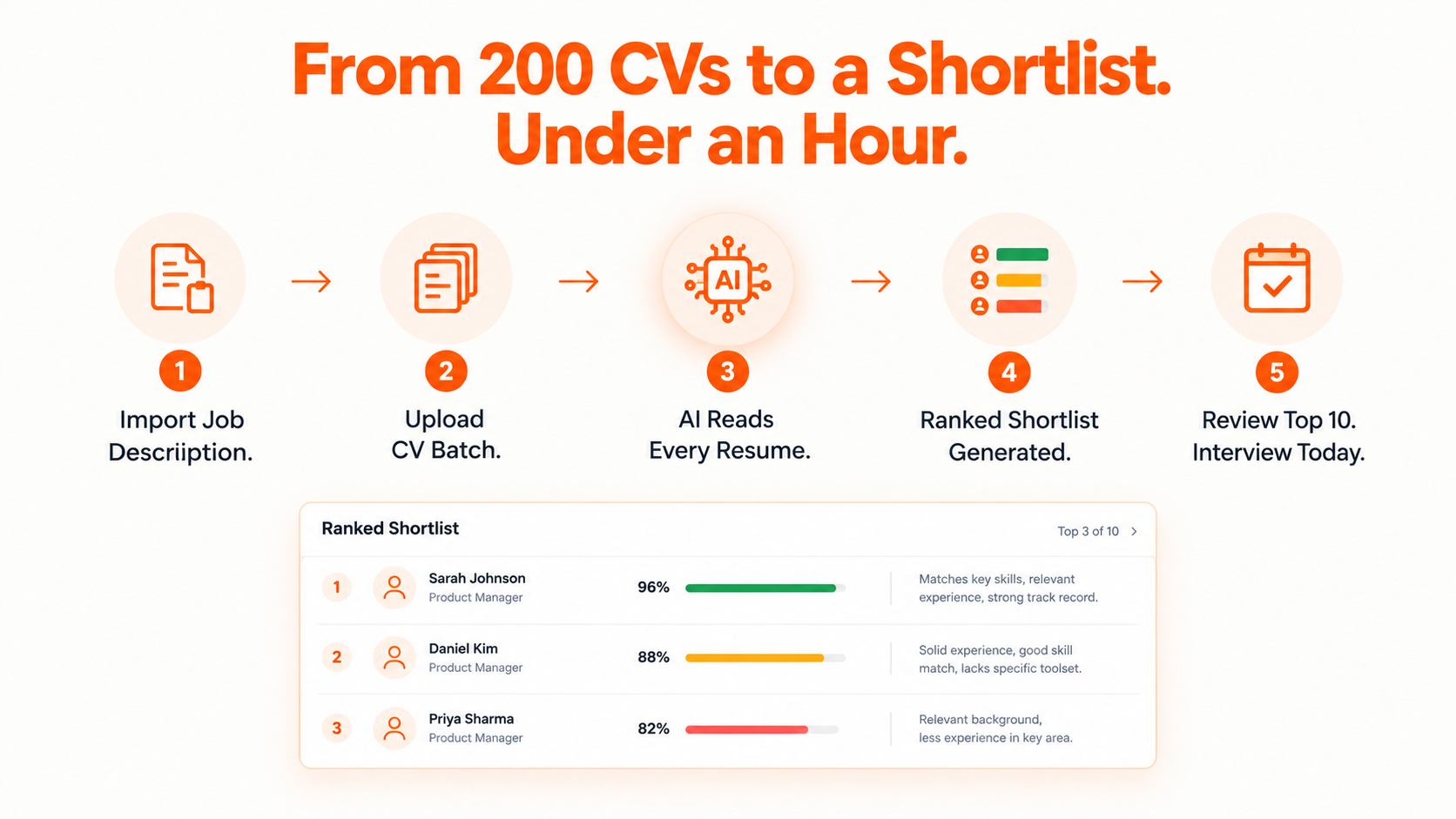
Step 1. Paste in your job description or pull it from LinkedIn directly. CVShelf reads it and uses it as the evaluation benchmark.
Step 2. Upload your resumes as a bulk batch. PDFs, Word docs, a zip file of everything. No manual entry.
Step 3. CVShelf processes every resume against the job criteria. Takes a few minutes for a batch of 200.
Step 4. You get a ranked list. Each candidate has a score and a short explanation: what the AI found strong, what it flagged as missing, why they ranked where they did.
Step 5. Review the top ten to fifteen. Apply your own judgment. Override where you have context the AI doesn't. That's your shortlist.
The whole thing takes under an hour. The 160 resumes you didn't read in detail got evaluated consistently against the same criteria as the ten you did.
Presenting the Shortlist in 10 Minutes
Once you have the ranked list with explanations, presenting to a hiring manager or founder is straightforward.
Top ten candidates, in order. One sentence per candidate explaining why they're on the list (CVShelf gives you this). A note on the three criteria you screened against. Your top pick called out explicitly.
That's a professional shortlist. It took an hour to produce instead of a week. The hiring manager can orient to each candidate immediately rather than reading everything from scratch. And when they ask why candidate six made the cut and candidate seven didn't, you have an answer.
CVShelf starts at $29 per month. No setup call. No implementation process.
Try CVShelf free at cvshelf.com. Screen your next batch of candidates today.
FAQs
Q:1 What is a candidate screening tool?
Software that evaluates job applications against a set of criteria and helps identify which candidates are worth interviewing. Basic tools use keyword matching. Better tools use AI to assess the quality and relevance of a candidate's experience, not just whether certain words appear. The output is typically a ranked list or scored set of candidates.
Q:2 Do agencies need a full ATS or just a screening tool?
For most agencies doing fewer than 20 hires per year, a screening tool covers the highest-friction part of the process without the cost and setup of a full ATS. A full ATS adds value when you're coordinating hiring across multiple people, tracking candidates through many stages, or running enough volume to justify the infrastructure. Start with screening. Add pipeline management only when manual tracking becomes the actual bottleneck.
Q:3 How does AI screening differ from keyword matching?
Keyword matching counts how often words from the job description appear in a resume. AI screening reads the resume for meaning: does this person's experience actually match what the role requires, at what level, and in what context? A candidate who writes "led a 12-person client services team" may not contain the exact keywords but should rank higher than one who lists every term in the job description without evidence behind any of them. AI screening catches the first candidate. Keyword matching often misses them.
Q:4 Can a non-recruiter use an AI screening tool effectively?
Yes, which is the main reason they're useful for agencies. You don't need recruitment experience to paste in a job description and upload a resume batch. The output, a ranked list with explanations, is designed to be read by someone making a hiring decision, not someone trained in candidate evaluation methodology. The AI does the methodology. You make the call.
Q:5 How many resumes can CVShelf process at once?
CVShelf handles bulk uploads, including large batches submitted as a zip file. For a typical agency AM or strategist role receiving 150 to 300 applications, the processing takes a few minutes. There's no one-resume-at-a-time limitation.
Keep Reading
More from AI Resume Screening.
How Much Does A Recruiter Cost Vs AI Tool
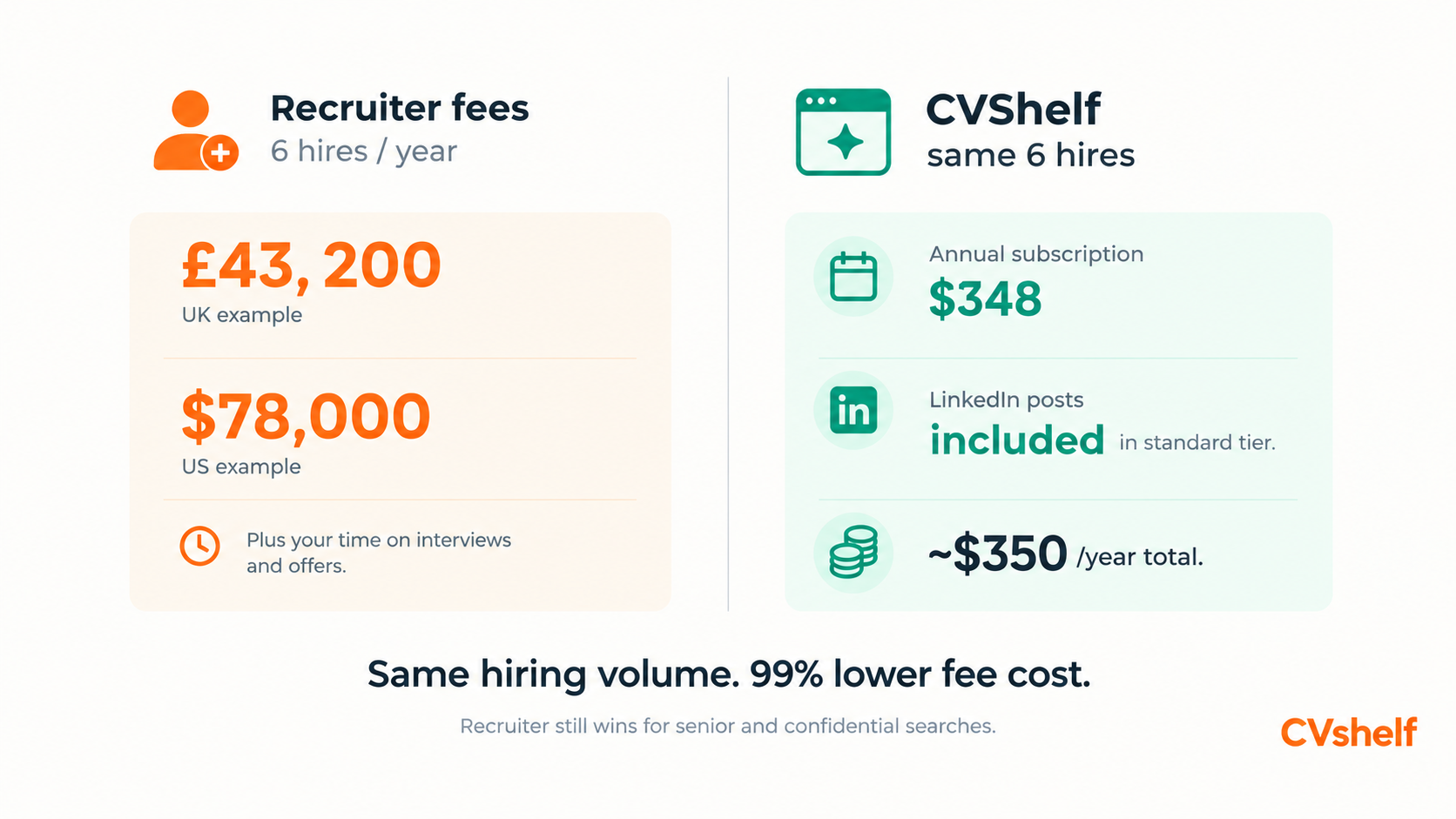
A contingency recruiter placing a mid-level account manager or strategist typically charges 15-25% of first-year salary.
Illinois AI Hiring Law Resume Screening
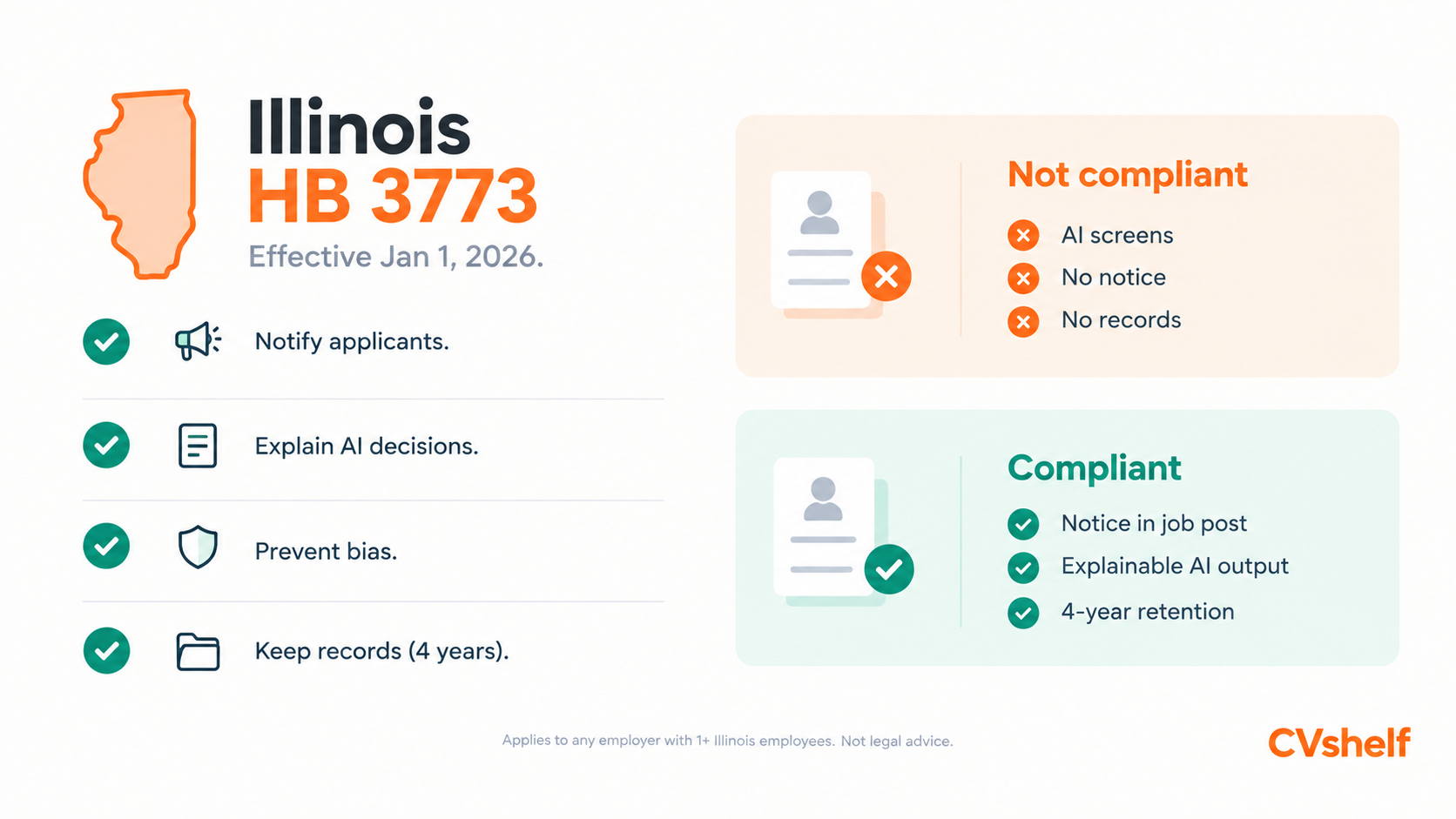
Illinois HB 3773, effective January 1, 2026, amended the Illinois Human Rights Act to require employers to notify applicants.
Reduce Time To Hire For Agencies
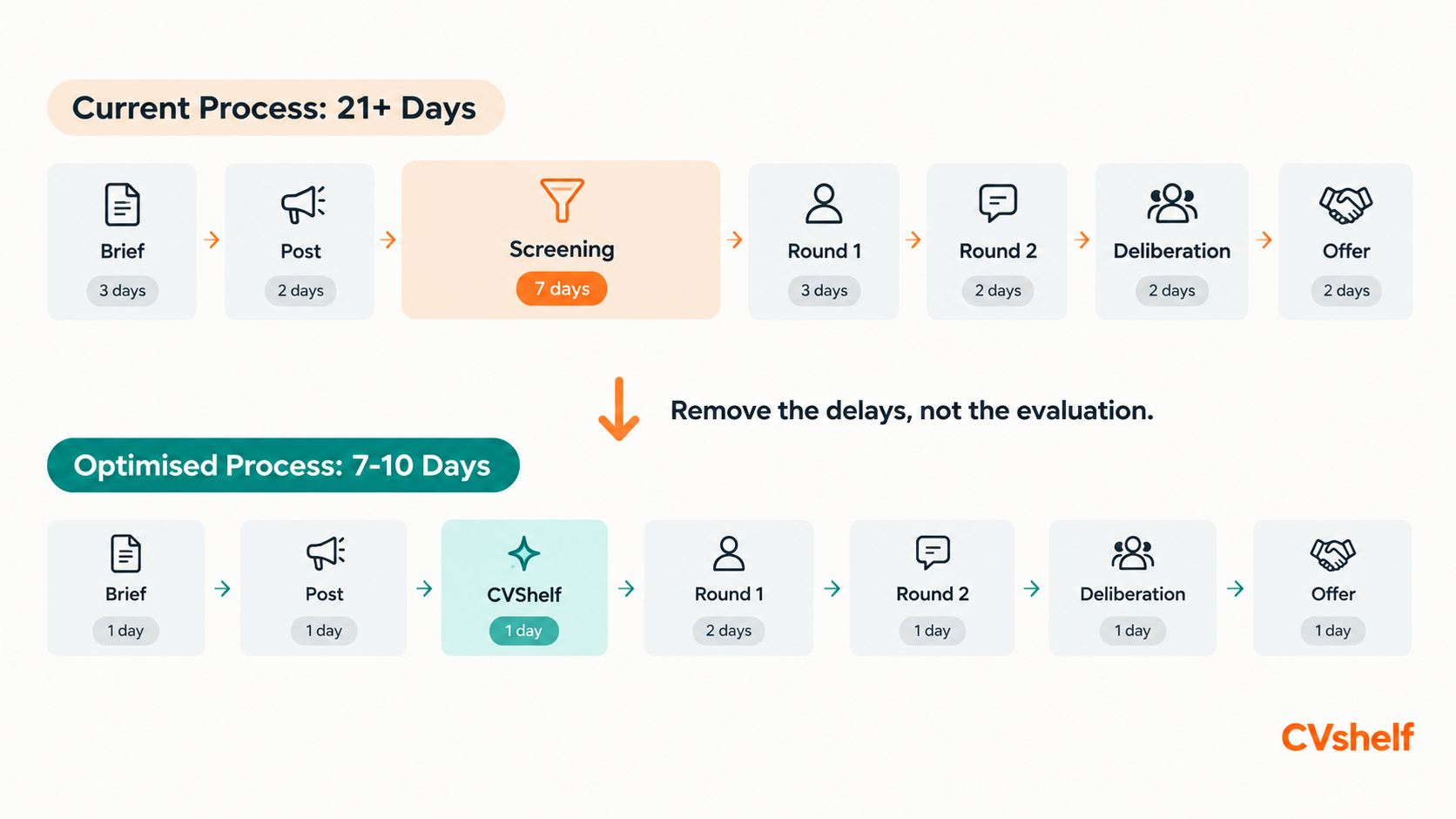
The average agency hiring process takes three to four weeks.