
CV Screening Tool For Small Agency
Most CV screening tools were built for companies with dedicated recruiters and continuous hiring pipelines.
The hiring software market is not short of options. What it is short of is options that actually work for a 40-person creative agency where the COO handles hiring alongside operations, client escalations, and whatever else landed on their desk that week.
Most CV screening tools assume a recruiter is on the other end. They're built around recruiter workflows, ATS integrations, candidate pipelines, multi-stage review queues. For a small agency where one person processes a hiring batch a few times a year, those features aren't assets. They're overhead that requires adoption work the team doesn't have time for.
The tools worth using at this size do one thing well: take a large pile of incoming CVs, apply the job criteria consistently, and return something a non-recruiter can act on the same morning.
The Real Problem at This Size
When a role opens at a small agency, the CV pile lands on whoever is available. That's typically the COO, an ops manager, or a department head, someone whose primary job is not hiring and who has competing priorities from the moment the applications arrive.
That person reads the first 30 to 40 carefully. Skims the next batch. Gets interrupted by client work. Comes back to the folder two days later with a slightly different mental model of what they're looking for. The shortlist they produce reflects reading order, energy levels, and whatever criteria drifted into their head over those two days, not a consistent evaluation of the full applicant pool.
This isn't a skills problem. It's a process problem. Manual screening at volume produces inconsistent results regardless of how capable the reviewer is, because the human brain degrades at repetitive cognitive tasks under time pressure. A CV screening tool removes that variable by applying the same criteria to every application, in the same way, regardless of where in the pile it falls.
The problem is choosing a tool that's actually built for the use case, not a scaled-down enterprise product, not a tool that requires a recruiter to configure, and not something that costs more per month than the hire is worth.
What Good Actually Looks Like
Four things, in this order.
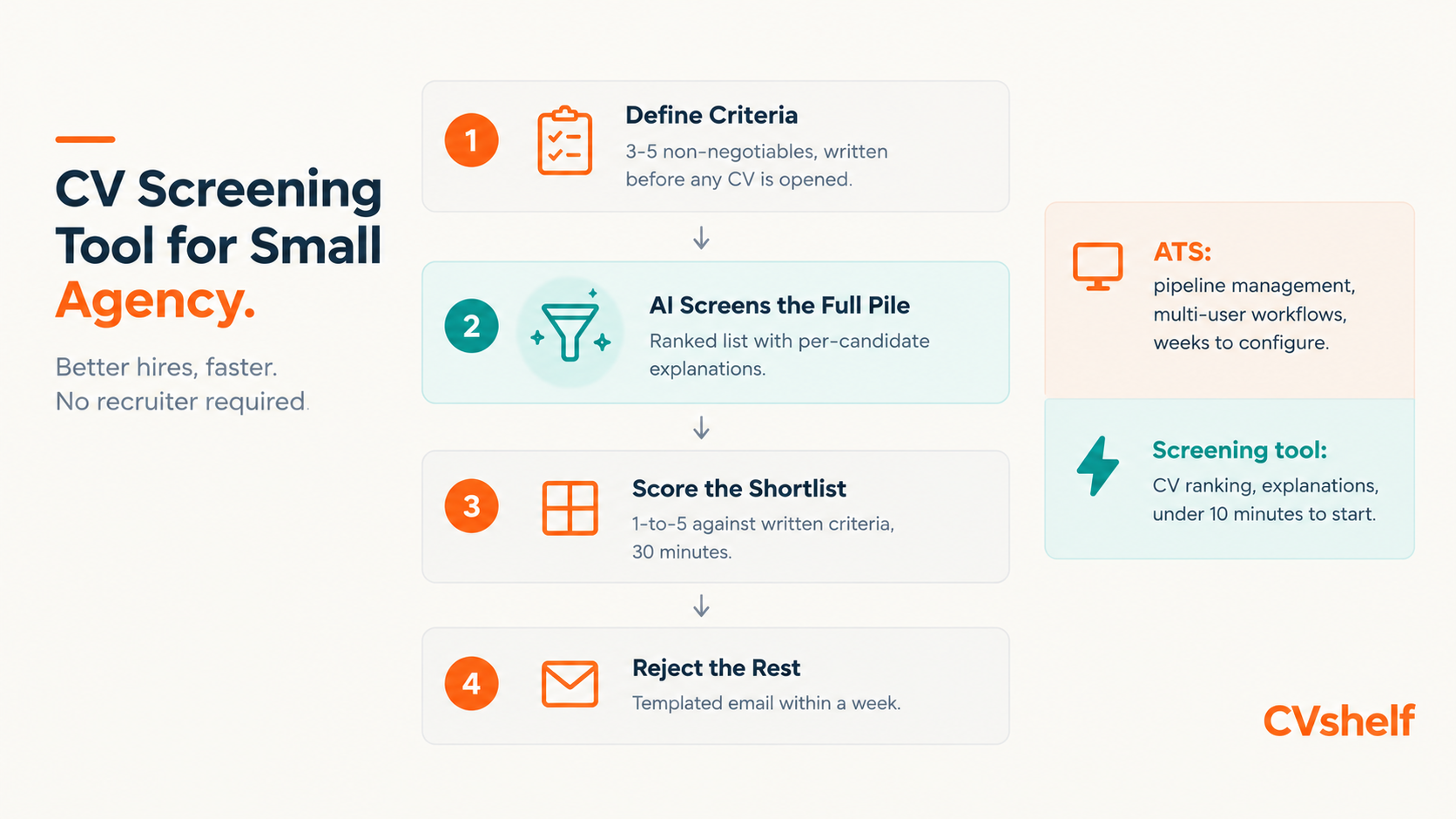
1. Define criteria before you touch the pile. Three to five non-negotiables, written down before a single CV is opened. Agency-side experience, required or not. Specific channel or skill knowledge if it's a real dealbreaker. Minimum years in a directly relevant role. This step takes 15 minutes and determines whether the screening output is useful. Vague criteria produce vague rankings. Specific criteria produce specific shortlists.
2. Run the full batch through AI screening. Upload the complete pile to a screening tool. Paste in the job description. Let the tool rank every application against the criteria and produce a shortlist with per-candidate reasoning. CVShelf does this: bulk upload, job description input, ranked output with an explanation per candidate covering what the AI found relevant and what it flagged as missing. The reviewer reads the top ten to fifteen with real attention rather than reading everything at varying levels of focus. A non-recruiter can work through the output in under an hour.
3. Score the shortlist before presenting it. For each candidate in the top ten, score them against the written criteria on a simple 1-to-5 scale. This takes 30 minutes and produces a shortlist that holds up under scrutiny from a hiring manager or MD who wasn't part of the screening. "The AI ranked them and I agreed" is not a defensible shortlist. "They scored 4.2 against five specific criteria" is.
4. Reject the rest promptly. Templated email, two sentences, sent within a week of the close date. The candidates who didn't make the shortlist are part of your professional network regardless of the outcome. Leaving them in silence for a month costs you employer brand with people who work in your industry.
The Most Common Mistake
Buying an ATS.
A full ATS, Breezy HR, Manatal, Workable, Greenhouse, is the right call when you're coordinating hiring across a team, running multiple roles simultaneously, and doing enough hires per year to justify standing infrastructure. For a 30-person agency doing eight hires annually with no dedicated recruiter, the overhead cancels out the value.
The pattern is consistent: ATS purchased, partially configured, used for two hires, abandoned. The agency goes back to the inbox, slightly poorer, with an unused subscription on the books.
The mistake is buying for a use case you don't have. You don't need pipeline management, interview scheduling automation, or multi-user hiring workflows. You need a tool that processes a large incoming pile, applies consistent criteria, and tells you who to call.
That's a CV screening tool, not an ATS. They are different products solving different problems. Conflating them is what leads to buying a £150/month platform to solve a £29/month problem.
FAQ
Q1. What's the simplest CV screening tool for a small agency with no recruiter?
CVShelf. Paste in the job description, upload the CVs as a bulk batch, get a ranked shortlist with per-candidate explanations. No ATS required, no configuration, no training. Setup for a first role takes under ten minutes. The output is a ranked list with reasoning the reviewer can agree with or push back on, which is the thing a non-recruiter needs to work from confidently.
Q2. What's the difference between a CV screening tool and an ATS?
An ATS is a database and workflow platform, it stores candidates, tracks them through pipeline stages, and handles communications. A CV screening tool evaluates incoming CVs against job criteria and ranks them. Most ATS platforms include basic screening, but it's keyword matching rather than relevance ranking, and it doesn't produce per-candidate explanations. A dedicated screening tool handles the evaluation problem better. The two can complement each other, but for low-volume hiring without a recruiter, the screening tool alone is usually sufficient.
Q3. How do I know if an AI screening tool will work for my agency's roles?
The quality of the output is almost entirely determined by the quality of the job description you provide. A vague JD produces a vague ranking. A specific JD, agency-side experience required, named channels, minimum years in a directly relevant role, produces a shortlist that matches what you're actually looking for. Test any tool with your real job descriptions before committing to it. If the first shortlist doesn't reflect the criteria you set, the issue is usually the JD, not the tool.
Screening CVs at agency scale doesn't require enterprise software. It requires written criteria, a tool that applies them consistently, and an hour to review the output.
Try CVShelf complimentary at cvshelf.com.
Keep Reading
More from AI Resume Screening.
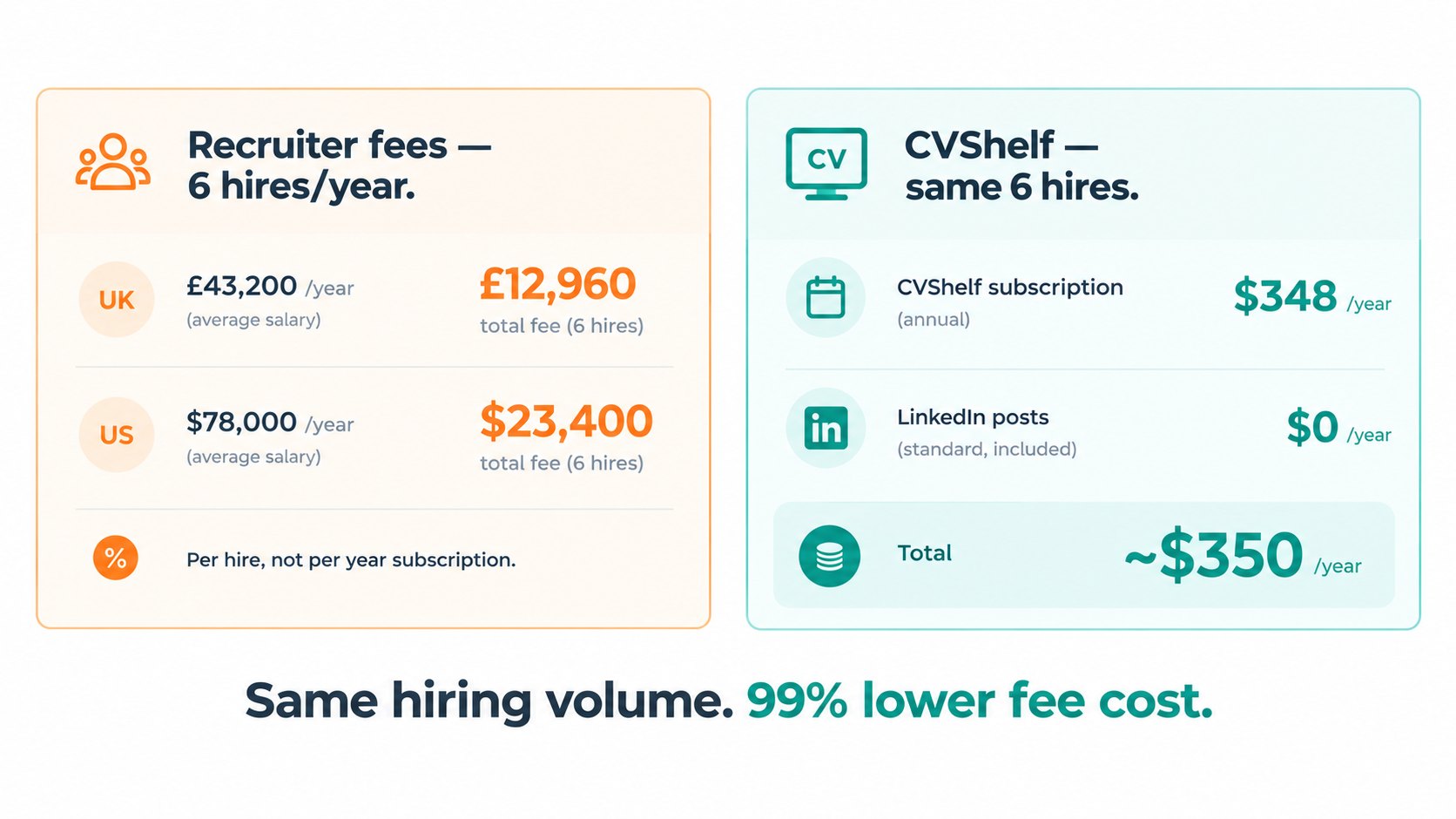
Agency Recruiter Fees Vs Software
A contingency recruiter placing a mid-level account manager.
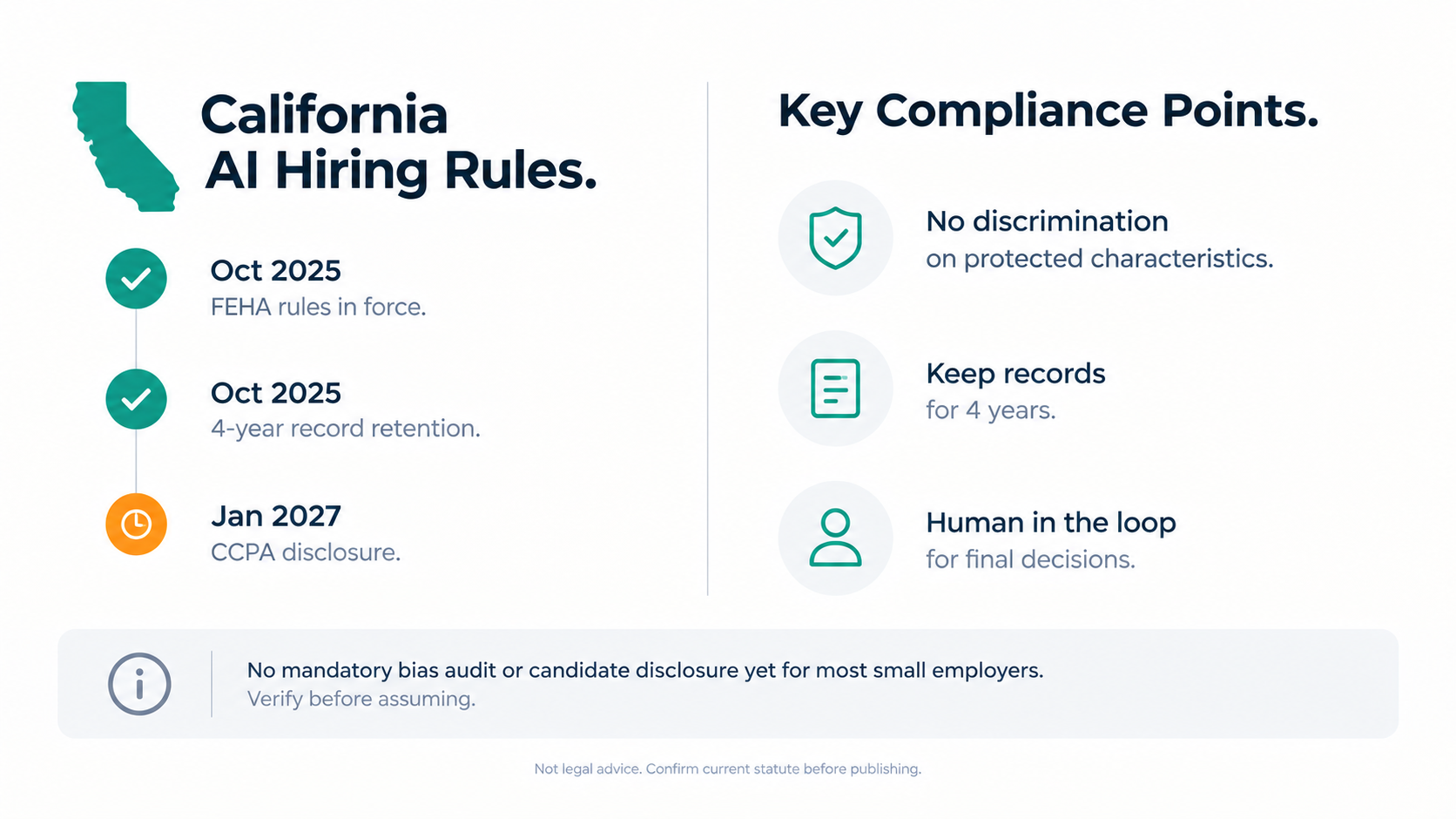
AI Resume Screening Disclosure Law California
California does not currently require employers to disclose to candidates that AI resume screening.
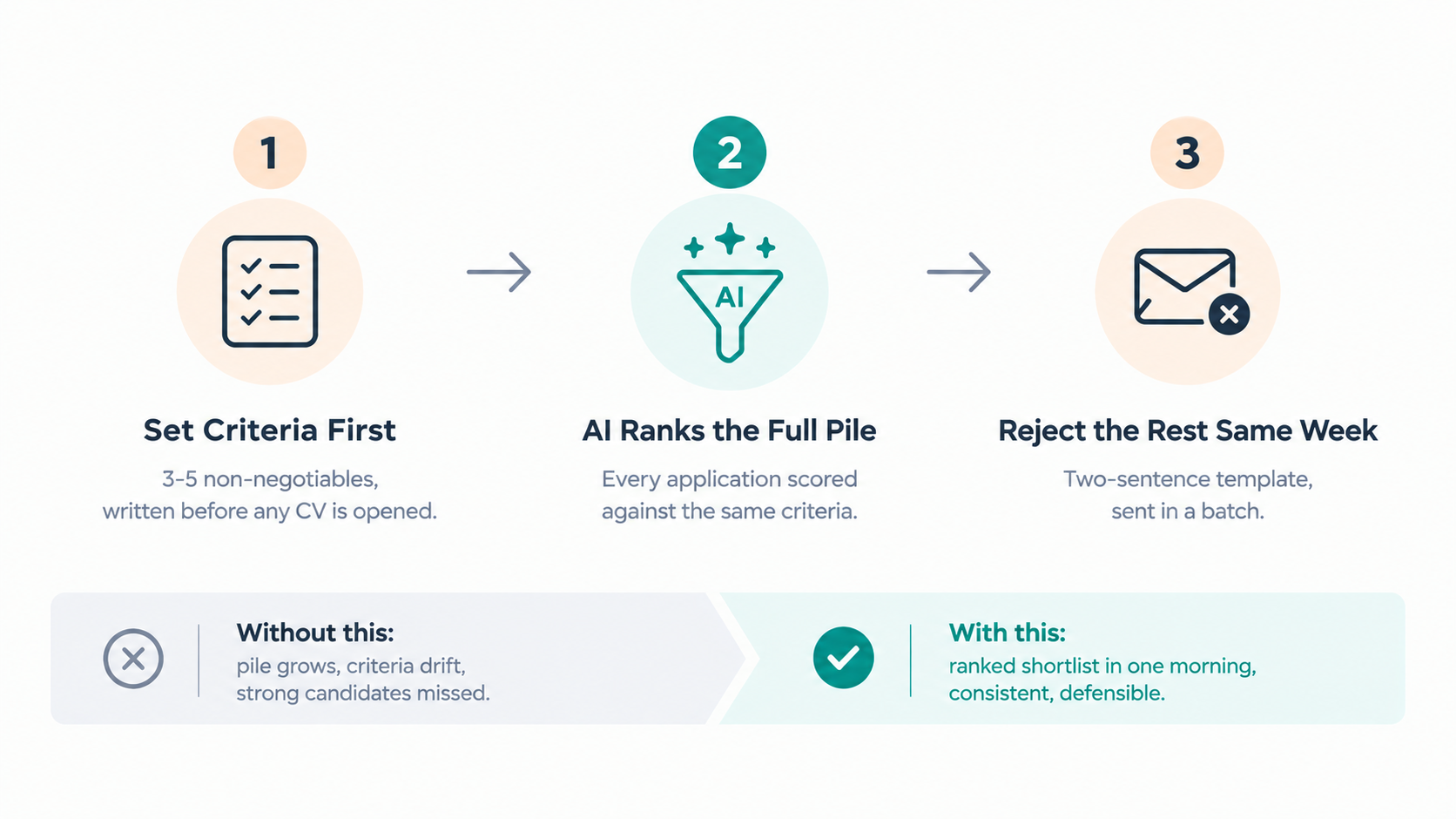
How To Screen Marketing Candidates Faster
Marketing roles at agencies generate large application piles and land on whoever has the most available time that week.