High Volume Recruiting: 6 Strategies That Actually Scale
Hiring 5 people and hiring 50 are not the same job. The process that works at low volume collapses under pressure:

Volume Hiring Is a Different Game
Most recruiting processes are designed for a steady cadence of 3 to 10 hires per quarter. One recruiter, a manageable pipeline, enough time to read every resume carefully and give each candidate a thoughtful evaluation.
Then the headcount plan doubles. Or a seasonal peak hits. Or you're scaling a new market and need 40 hires in 8 weeks.
Everything that worked before stops working. Screening takes 3 weeks instead of 3 days. Candidates drop out while waiting to hear back. Hiring managers start complaining that shortlists are inconsistent. The recruiter is buried and making faster, worse decisions just to keep up with the volume.
This is not a effort problem. It's a process problem. Standard recruiting workflows have a ceiling, and volume hiring hits that ceiling fast.
The teams that handle volume well build different systems. Here's what those systems look like.
The 3 Biggest Challenges in High Volume Recruiting
Before getting to solutions, it helps to be specific about where volume hiring actually breaks down.
The screening bottleneck. At 200 applications per role across 5 simultaneous open positions, you have 1,000 resumes to process. Even at 5 minutes per resume, that's 83 hours of reading before a single interview is booked. Most recruiting teams don't have 83 hours. They cut corners. They skim. They stop at resume 150 and never reach 151 through 1,000. Strong candidates in the second half of the pile disappear.
Candidate experience degradation. At volume, communication becomes the first casualty. Candidates apply and hear nothing for two weeks. Interview scheduling takes four email chains. Rejection emails either never arrive or arrive three months after the role is filled. In a market where candidates share experiences publicly and employer brand travels fast, this creates damage that outlasts the hiring campaign.
Inconsistency of evaluation. When four recruiters screen resumes for the same role over two weeks, the criteria drift. What one recruiter treats as a must-have, another treats as optional. Reading order affects scores. Friday afternoon reviews are less rigorous than Monday morning ones. The shortlist that emerges reflects when and who reviewed which resumes, not a consistent application of the hiring criteria.
All three problems are solvable. Not with more effort but with better structure.
6 Strategies for High Volume Recruiting That Actually Work
Strategy 1: Define Standardised Criteria Before the Role Goes Live
This sounds obvious. Most teams skip it anyway.
Before posting the job, write down your must-haves (non-negotiable qualifications, experience minimums, location or work authorisation requirements) and your ranked nice-to-haves. Make this a shared document that every reviewer, every AI screening tool, and every hiring manager can reference.
Criteria that are written down before screening begins stay consistent across reviewers and across time. Criteria held in someone's head drift within days.
For volume hiring, this step is not optional. It's the foundation everything else builds on.
Strategy 2: Automate First-Round Screening
Manual resume screening is the biggest time sink in volume hiring and the one most amenable to automation. AI screening tools like CVShelf process bulk uploads against your job description, rank every candidate by relevance, and return a shortlist with per-candidate explanations. A 500-resume batch that would take 40+ hours of manual review takes under 30 minutes.
This is not about removing human judgment from hiring. It's about applying human judgment where it creates value (the top of the ranked shortlist) rather than spreading it thinly across 500 applications where fatigue makes it unreliable.
Automated candidate screening using AI ranking also reduces the inconsistency problem. Every resume is evaluated against the same criteria with the same level of attention. Reading order and reviewer fatigue don't affect the output.
Strategy 3: Use Knockout Questions at the Application Stage
Knockout questions are 2 to 4 binary questions attached to the job application that filter candidates before they enter the screening queue. Does the candidate have the right to work in the UK? Do they have the specific certification this role requires? Are they available for the required shift pattern?
A candidate who answers no to a knockout question is out before a resume is read. For a role receiving 500 applications where 200 fail basic eligibility, knockout questions eliminate those 200 before they consume any reviewer time.
Keep knockout questions to genuine deal-breakers only. Overusing them filters out candidates who could have been right with minor adjustments, and it creates a poor application experience.
Strategy 4: Stagger Hiring Waves
Running 8 roles simultaneously with simultaneous application windows means 8 screening piles arriving at the same time. Staggering the opening and closing of application windows by 1 to 2 weeks per role distributes the screening load across time rather than concentrating it.
This works particularly well for roles that are largely identical (multiple positions for the same job title and location). You open wave one, screen, hire, then open wave two with a refined criteria set based on what you learned from wave one.
Staggering also gives you faster time-to-offer for the first wave, which improves candidate acceptance rates before the broader market has absorbed your strongest candidates.
Strategy 5: Centralise Candidate Communications
In a high volume campaign, candidate communication cannot depend on individual recruiter initiative. Every touchpoint needs to be automated and consistent: application confirmation, status updates at each stage, interview scheduling, offer or rejection delivery.
Set up automated triggers for each pipeline stage. When a candidate moves from "Applied" to "Screening," an acknowledgement goes out. When they move to "Interview," scheduling instructions go out automatically. When they're declined, a prompt and professional rejection email is sent.
This removes communication from the task list of individual recruiters (freeing capacity for higher-value work) and ensures every candidate gets the same experience regardless of which recruiter is managing the role.
Strategy 6: Measure Your Screening-to-Hire Ratio
The screening-to-hire ratio tells you how many screened candidates it takes to produce one hire. If you are screening 200 candidates to hire 1, either your sourcing is poorly targeted or your criteria are inconsistently applied during screening.
Tracking this metric across roles and recruiters surfaces problems quickly. A recruiter with a 150:1 ratio in a team where others are hitting 60:1 signals a criteria problem, a sourcing problem, or both. A role where the ratio spikes tells you the job description is attracting the wrong applicants.
In high volume hiring, this metric is as important as time-to-fill. Efficiency at the screening stage directly drives efficiency across the entire funnel.

Deep Dive: How CVShelf Handles Volume Screening
CVShelf is purpose-built for the screening bottleneck that stops most high volume recruiting operations. Here is how it works in practice for volume hiring.
Bulk upload. Upload hundreds of resumes at once: PDFs, Word documents, or a zip file. No manual entry. No one-at-a-time processing. The full pile goes in together.
Multi-role ranking. If you have 5 roles open simultaneously, you run 5 separate screening batches. Each batch uses the specific job description for that role. Candidates are ranked against the role they applied for, not a generic profile.
AI-generated explanations per candidate. Every ranking comes with a reason. You can see why candidate A ranked above candidate B and whether the AI's reasoning aligns with your actual criteria. Override where context warrants it.
LinkedIn job description import. Pull job descriptions directly from LinkedIn rather than re-entering them. Saves setup time when roles are already posted.
Pricing from $29/month. No enterprise contract, no implementation cost, no training required. A new role is set up and screening in under 10 minutes.
For a talent acquisition team running a volume hiring campaign across multiple locations or roles, the output is a ranked, explained shortlist per role, ready to review within 30 minutes of uploading resumes.
Track these per campaign, not just per role. Volume hiring produces enough data to see patterns quickly. A drop in offer acceptance rate across a wave signals a candidate experience problem. A spike in screening-to-hire ratio signals a sourcing or criteria problem. The numbers tell you where to fix before the next wave.
Ready to Scale Your Hiring?
High volume recruiting does not have to mean overwhelmed recruiters, inconsistent shortlists, and candidates who never hear back. With standardised criteria, automated screening, and the right tools at each stage, a volume hiring campaign becomes a repeatable process rather than a crisis to manage.
The biggest single lever is the screening stage. That's where most time goes and where AI tools deliver the most immediate impact.
Ready to scale your hiring without scaling your workload? Try CVShelf free at cvshelf.com. Bulk upload. Instant AI ranking. No complex setup.
FAQs
Q1: What is considered high volume recruiting? Generally, high volume recruiting refers to hiring 50 or more people within a short period (typically 30 to 90 days), or managing 10 or more open roles simultaneously. It's most common in retail, hospitality, BPO, tech scale-ups, and staffing agencies. The defining characteristic is that standard one-at-a-time recruiting workflows break down under the volume.
Q2: How do you screen 500 resumes quickly? Use a combination of knockout questions at the application stage (to filter ineligible candidates before they enter the queue) and AI screening tools to rank the remaining candidates. AI screening tools like CVShelf process 500 resumes against your job description in under 30 minutes and return a ranked shortlist with per-candidate explanations. Manual screening of 500 resumes takes 40 to 60 hours and produces less consistent results.
Q3: What is the best software for high volume resume screening? For teams focused specifically on the screening and ranking problem, CVShelf handles bulk uploads, ranks candidates by relevance against a job description, and generates explanations for each score. It starts at $29/month and works as a standalone screening tool alongside any existing ATS. For teams that also need sourcing and pipeline management in one platform, Workable or Manatal are worth evaluating.
Q4: How do you maintain quality in high volume hiring? Three things matter most: standardised written criteria applied before screening begins, consistent evaluation using AI ranking or structured scoring rubrics, and human review concentrated at the top of the ranked list rather than spread thinly across the full pile. Tracking quality of hire at 30 and 90 days per hiring cohort tells you whether your screening criteria are actually predictive.
Q5: How do you improve candidate experience during volume hiring? Automate every touchpoint that doesn't require human judgment: application confirmation, status updates at each pipeline stage, interview scheduling, and rejection communications. Candidates in a volume hiring campaign will forgive a slightly slower process if they receive consistent, timely communication. Silence is what drives negative reviews and public complaints.
Q6: How do you handle 1,000 job applications? Start with knockout questions to remove ineligible candidates immediately. Feed the remaining applications through an AI screening tool to produce a ranked shortlist. Concentrate human review on the top 20 to 30 ranked candidates. Document your decisions at each stage for compliance purposes. A 1,000-application pile should yield a defensible shortlist of 15 to 20 candidates within a few hours using this approach.
Keep Reading
More from AI Resume Screening.
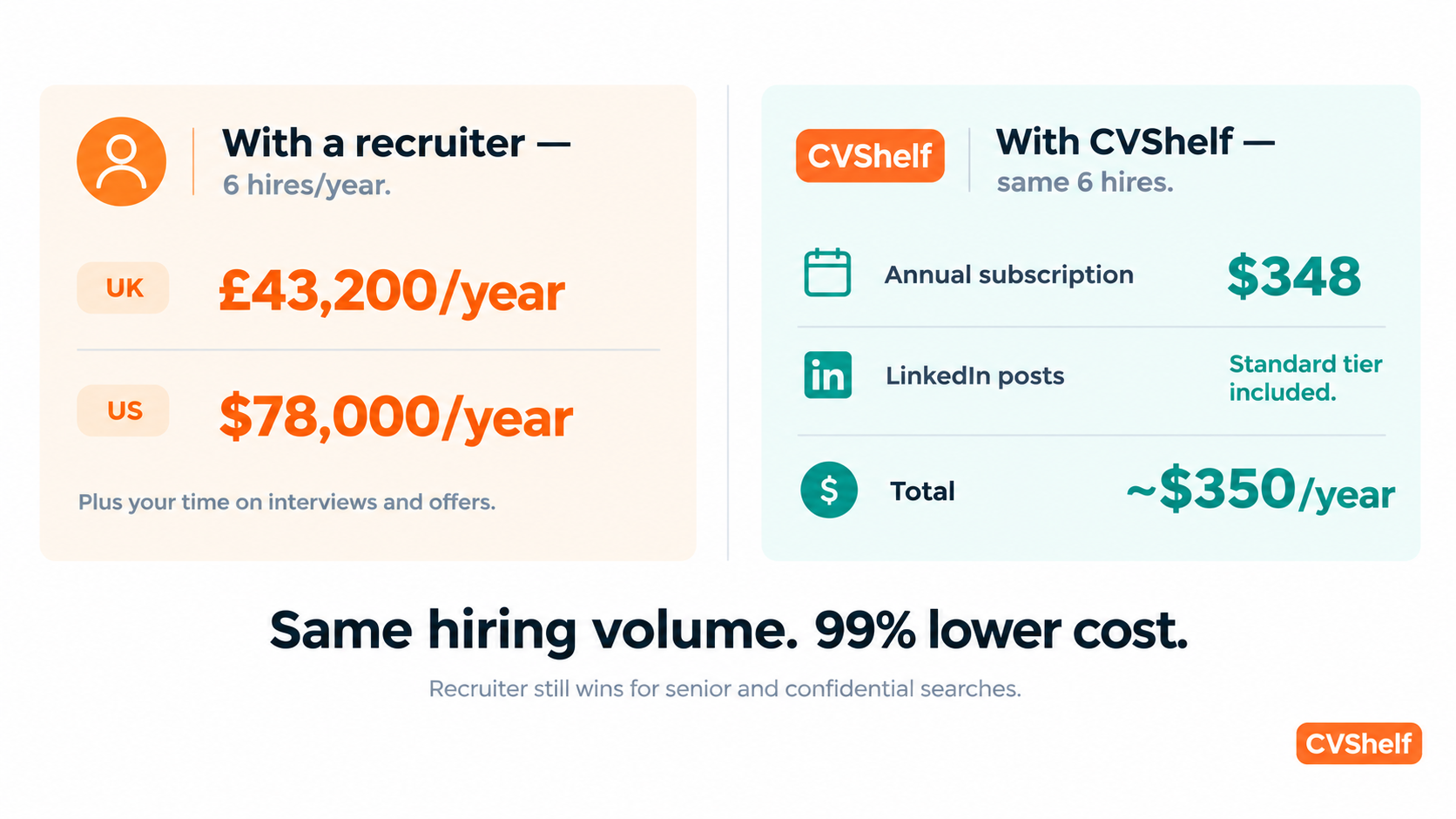
Agency Hiring Without Recruiter Fees
Contingency recruiters charge 15-25% of first-year salary for mid-level placements, that's $9,000 to $15,000 for a single account manager hire.
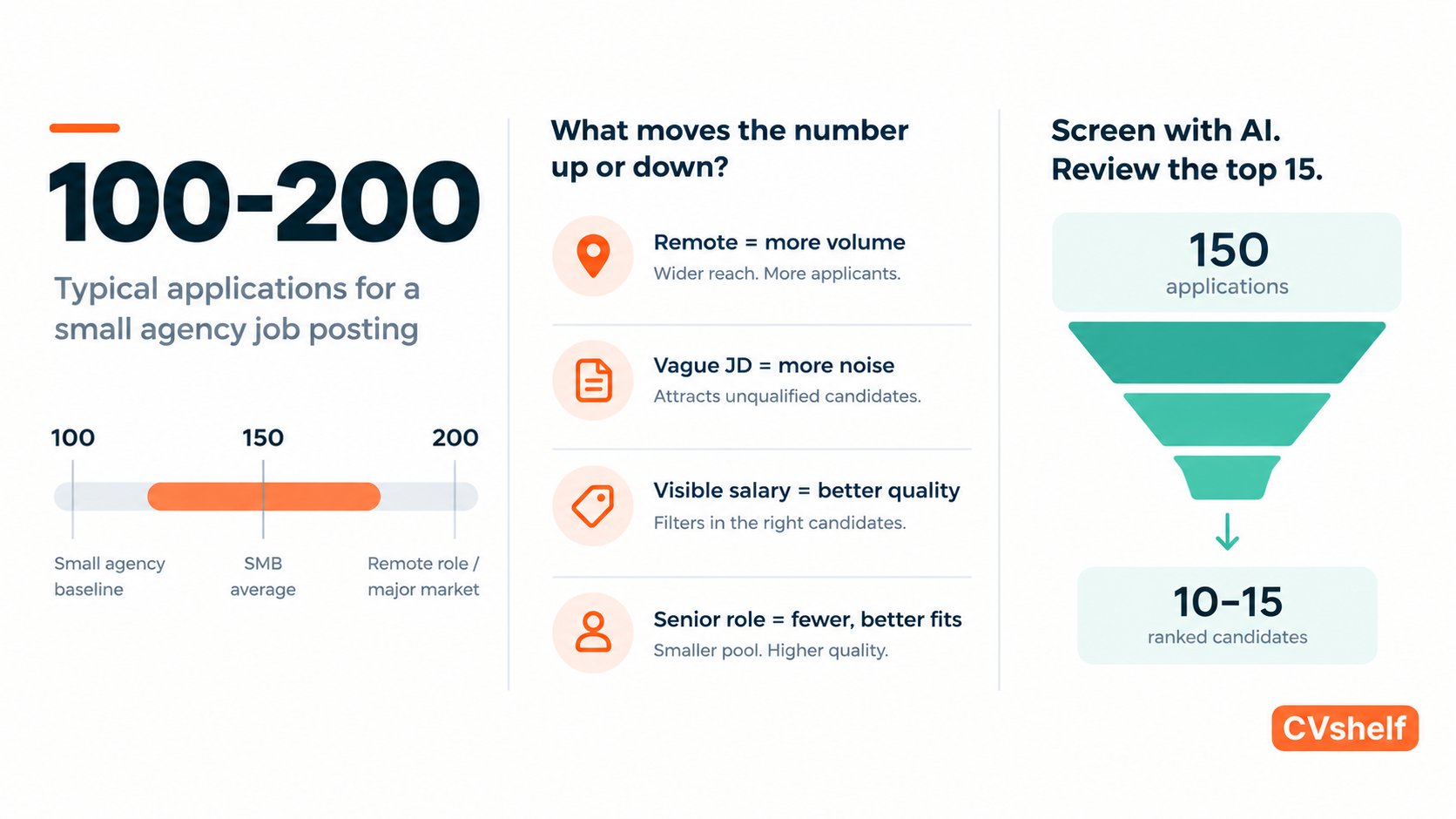
How Many Applicants For A Small Agency Job Posting
A small agency posting a mid-level role on LinkedIn or Indeed typically receives 100 to 200 applications within two weeks.
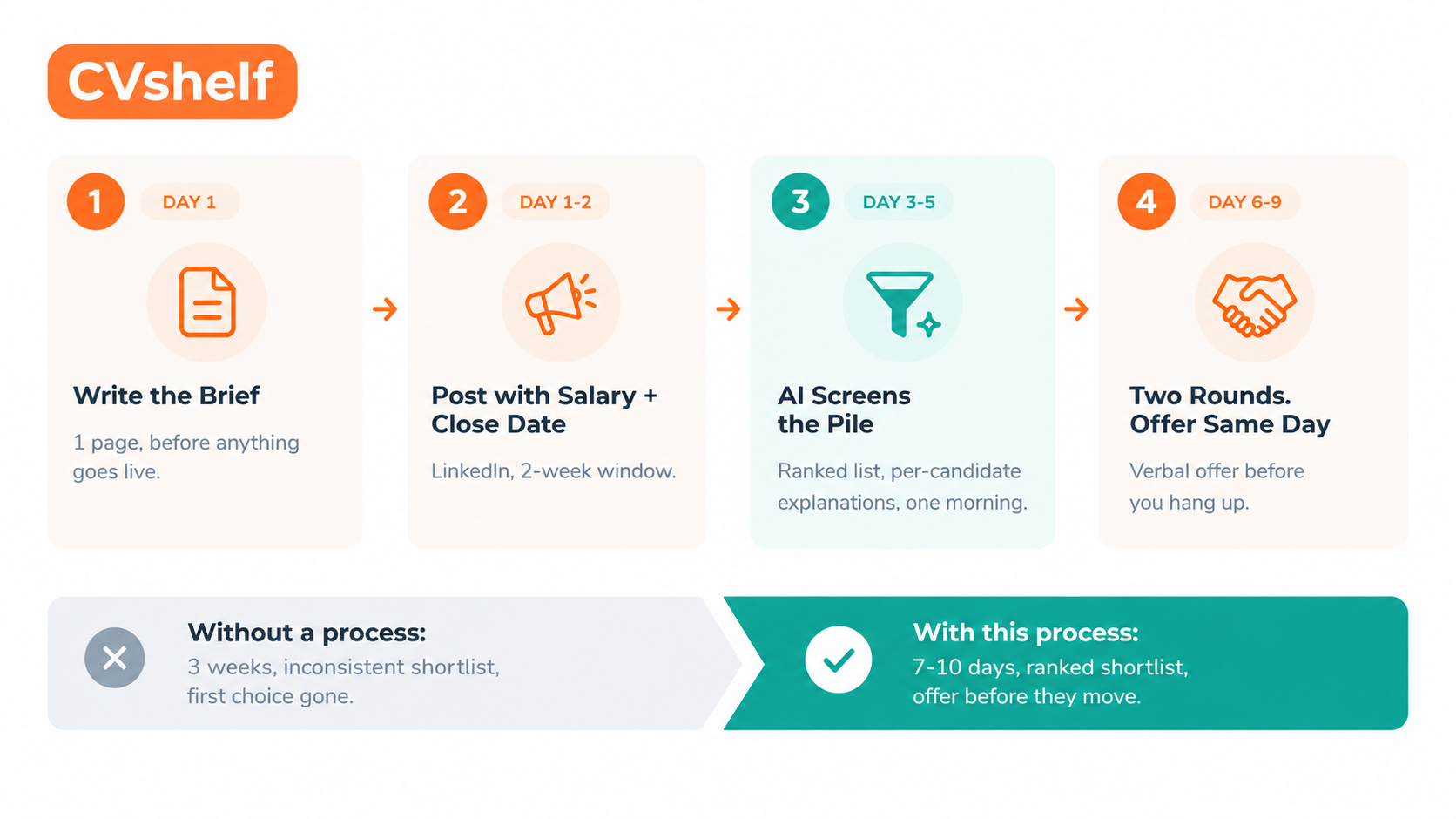
Hiring Without HR Department Small Business
Most small businesses handle hiring the same way: someone gets voluntold, reads a third of the CVs.