
How to Hire Fast After Landing a New Client
The moment you sign a new client, a countdown begins. You have days, not weeks, to staff the account before the kickoff call.

The Clock Starts the Moment You Sign
You close the deal on a Wednesday. The client's kickoff call is in three weeks. You need an account manager, maybe a strategist, possibly a project coordinator.
You post the job Thursday morning. By Friday you have 180 applications. You open the folder, scan a few resumes, get pulled into three client calls, and close your laptop. Monday comes. The folder still has 180 applications. Nothing has moved.
Two weeks later you're interviewing people with four days to go before the kickoff. You're offering the role to someone you met once. They accept. They start three days late because onboarding wasn't set up. The client notices the chaos.
This is not a story about bad luck. It's a story about a hiring process that was never built for the moment it needed to perform.
Why Agency Hiring Is Different
Corporate companies hire continuously. They have HR managers, ATS platforms, structured interview pipelines, and a steady intake of candidates. They hire slowly because they can afford to. Their revenue doesn't depend on whether one hire happens this week or next.
Agency hiring is nothing like that.
It's bursty. You go months without a critical hire and then you need two people in three weeks because you just landed a significant account. There's no warm pipeline of candidates already through the first stage. No HR team to hand the process to. It lands on the founder, the ops manager, or whoever has the least full calendar that week.
It's revenue-linked. Every day the role is unfilled is a day your new client is being serviced by a team that's either overstretched or not there yet. Slow hiring at a corporate company is an inefficiency. Slow hiring at an agency is a client retention risk.
It happens without infrastructure. No dedicated recruiter. No established process. No ATS you've kept warm. You're starting from scratch every time.
Understanding this is the first step. Your hiring process has to be designed for a sprint, not a steady jog.
What Slow Hiring Actually Costs You
The obvious cost is the team overload. Your existing account managers pick up the slack. They work longer hours. They get stretched across more accounts than they should be handling. Quality drops. Burnout creeps in.
The less obvious cost is the client relationship.
Clients hire agencies partly on the people they meet in the pitch. They expect those people, or people of the same calibre, to be working their account from day one. When the account is understaffed in the first month, they feel it. Response times slip. Strategy meetings get delayed. The relationship that was supposed to be building is already wobbling.
Early client churn is rarely about the work itself. It's about the experience of working with you. And that experience is shaped heavily by whether you had the right team in place from the start.
There's also the internal cost that never shows up in a report: the opportunity cost of a founder or MD spending three hours reading resumes instead of doing business development, client work, or managing existing accounts.
Slow hiring isn't just an operational problem. It's a revenue problem.
A 5-Step Rapid Hiring Framework for Agencies
Step 1: Define the Role in 30 Minutes
Do not write a comprehensive job description. Write a brief one. What does this person need to do in the first 90 days? What's the non-negotiable experience? What's the one quality that would make you confident they could own the account?
Set a 30-minute limit on this. The goal is clarity, not comprehensiveness. A focused brief produces better candidates than a long list of requirements that nobody fully meets.
Step 2: Post With Urgency Signals
Most job posts read like they were written six months ago and will stay live for six more. Write yours like it's urgent, because it is.
Include the start date. Say "immediate start available" if true. Mention that you're screening applications as they come in and will move fast on the right person. These signals attract candidates who are available and motivated, and they set accurate expectations.
Post to LinkedIn Jobs and Indeed. That's enough. Do not spend a week debating job boards.
Step 3: Screen at Volume With AI
This is where most agencies lose the race. Applications arrive and sit unread while the person who should be screening them is doing everything else.
AI screening tools process your full application pile against your job criteria, rank candidates by relevance, and produce a shortlist with explanations. You don't read 180 resumes. You review the top 10 the AI surfaced, with a note on each explaining why they ranked there.
CVShelf does this in minutes. Upload your resumes (or point it at your job post), set your criteria, get a ranked list. The same day the applications land, you know who to call. Not the same week. The same day.
Step 4: Interview Only the Top 5
Do not interview 12 people for an agency role that needs to be filled in two weeks. Interview 5. Run a 30-minute call with each. Decide within 48 hours.
The instinct to see more candidates before deciding is understandable but counterproductive at speed. You have a ranked shortlist from a structured screening process. The top 5 are the people worth your time. Trust the process and move.
Step 5: Make the Offer Fast
Good candidates at this level are usually in more than one process. Every day between the final interview and the offer is a day they might accept something else.
Make the verbal offer within 24 hours of the final interview. Send the written offer the same day. Do not wait for a committee sign-off that doesn't need to happen. You are the decision-maker. Decide.
How CVShelf Helps Agencies Hire Same-Day
CVShelf was built for exactly this scenario: a stack of applications, a tight timeline, and no dedicated recruiter to process them.
Here's the workflow:
You paste in your job description or pull it directly from LinkedIn. You upload your resumes in bulk. PDFs, Word documents, a zip file of everything, it all works. CVShelf reads every application, scores each candidate against your criteria, and returns a ranked list with a per-candidate explanation.
The explanation matters. You see why candidate A ranked above candidate B. You can override it when something the AI missed is relevant. You're not trusting a black box. You're reviewing a reasoned recommendation.
The output is a shortlist you can act on the same afternoon the applications landed. Not after a week of reading. The same afternoon.
CVShelf starts at $29 per month. No onboarding call. No implementation. You can be screening your first role within 10 minutes of signing up.
For agencies running multiple open roles, CVShelf handles them separately. Each job description gets its own ranked output. You're not mixing candidates across roles.
Hire Before the Kickoff Call
The agencies that retain clients longest are rarely the ones with the most sophisticated processes. They're the ones who show up fully staffed, fully prepared, and fully present from day one.
That starts with hiring fast.
Define the role in 30 minutes. Post with urgency. Let AI handle the screening volume. Interview the top 5. Make the offer fast.
CVShelf handles step three. The rest is up to you.
Try CVShelf free at cvshelf.com. Know who to interview the same day.
FAQs
Q1: How quickly can an agency realistically hire after winning a new client?
With a structured process, 7 to 14 days from job post to accepted offer is achievable for an account manager or strategist role. The bottleneck is almost always screening. With AI screening tools cutting the shortlisting phase from days to hours, the interview and offer stages can run in parallel rather than sequentially. The 3-week window between signing and kickoff is workable if the hiring process starts the same day the deal closes.
Q2: How do small agencies hire without an HR team?
The founder or ops manager handles it, which means the process needs to be fast and low-friction. The practical approach: a brief role definition, a focused job post on LinkedIn and Indeed, AI-powered screening to manage the application volume, and a short interview list of 4 to 6 candidates. The goal is to minimise the time a non-HR person spends on hiring without sacrificing shortlist quality.
Q3: What should a job post say to attract fast-moving candidates?
Include the start date, specify that you're hiring immediately, and say you'll be screening applications as they arrive. This filters for candidates who are available and motivated rather than passive browsers. Keep the job description focused: role objectives, non-negotiable experience, what the first 90 days looks like. A tight post outperforms a comprehensive one for urgent roles.
Q4: How many candidates should an agency interview for an account manager role?
For a time-sensitive hire, 4 to 6 is the right number. More than that and you're adding a week to the timeline for marginal additional signal. A well-structured AI screening process should produce a shortlist where the top 5 candidates are genuinely strong, making a larger interview slate unnecessary. If the top 5 all fall short, the issue is usually in the screening criteria, not the number of interviews.
Q5: Can AI screening tools actually understand agency roles like account manager or strategist?
Yes, provided the job description is specific enough. The more clearly you define what the role requires (client relationship management, campaign oversight, specific channel experience, team coordination) the more accurately an AI screening tool can rank candidates against those criteria. Vague job descriptions produce vague rankings. Specific ones produce shortlists you can act on.
Q6: What is the biggest hiring mistake agencies make when they win new business?
Starting too late. The hiring process should begin the day the contract is signed, not the week before the kickoff call. The second most common mistake is treating the screening phase as a task that requires dedicated focus time, when AI tools have made it something that can run in the background while you're doing everything else.
Keep Reading
More from AI Resume Screening.
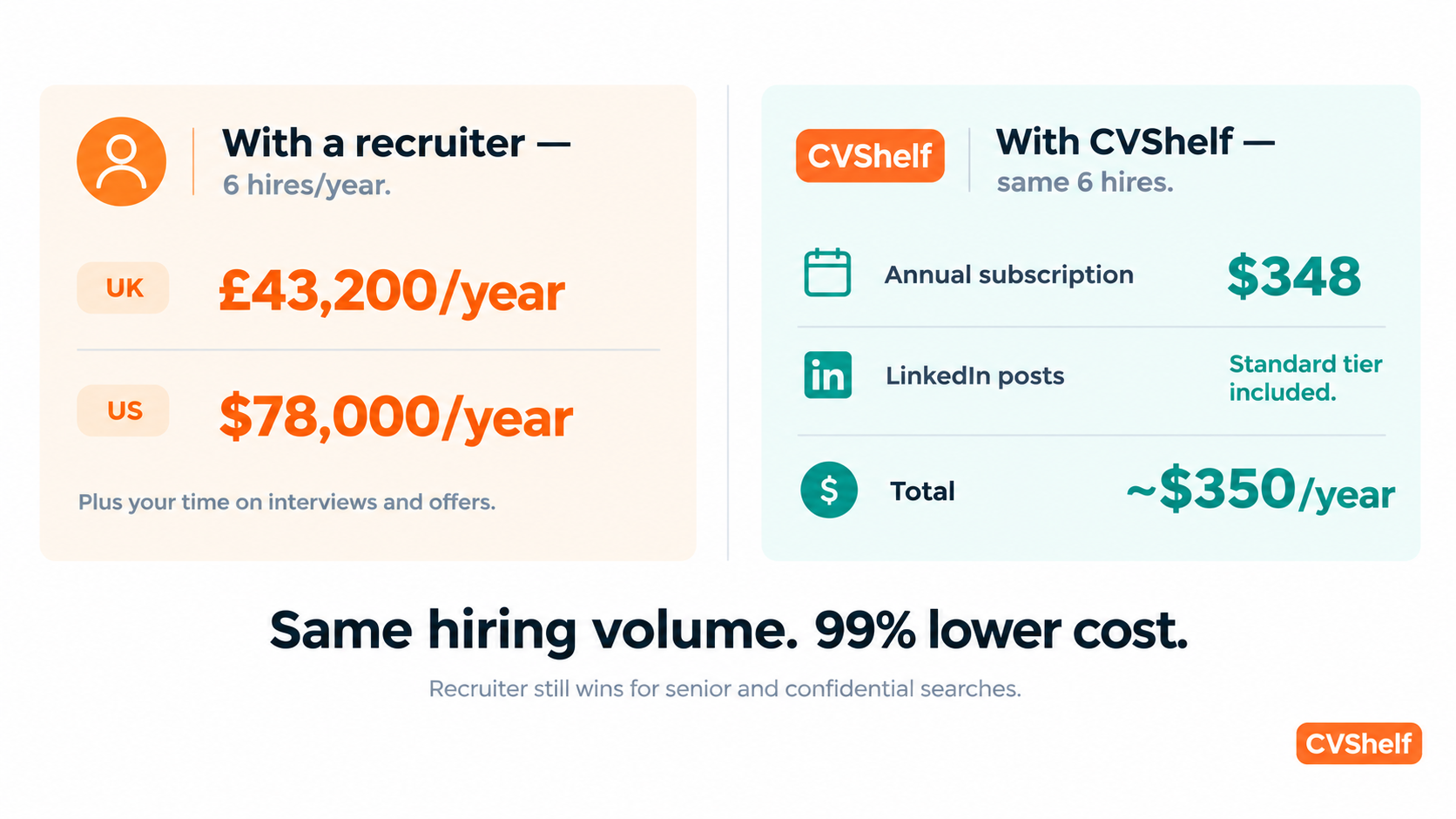
Agency Hiring Without Recruiter Fees
Contingency recruiters charge 15-25% of first-year salary for mid-level placements, that's $9,000 to $15,000 for a single account manager hire.
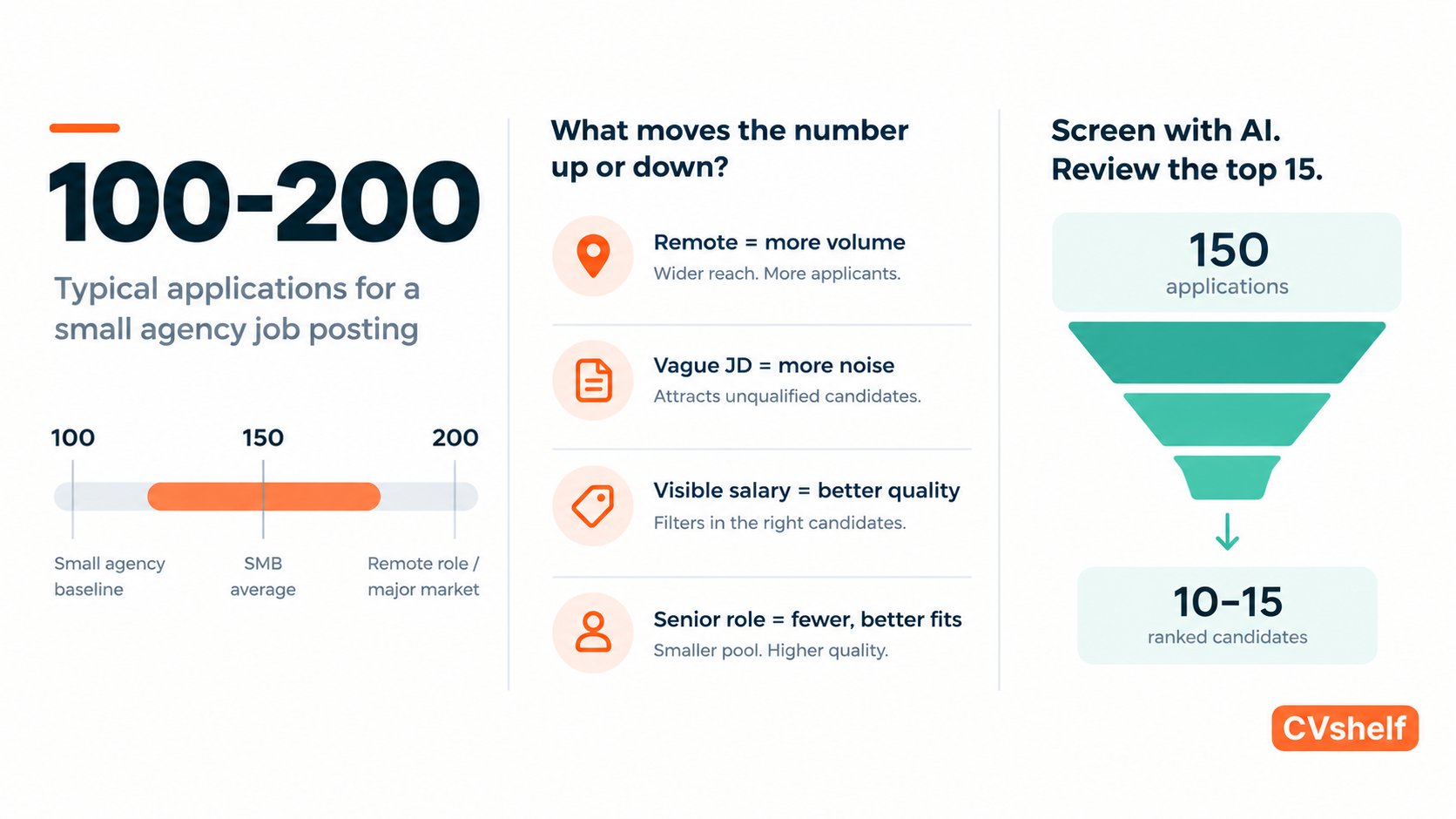
How Many Applicants For A Small Agency Job Posting
A small agency posting a mid-level role on LinkedIn or Indeed typically receives 100 to 200 applications within two weeks.
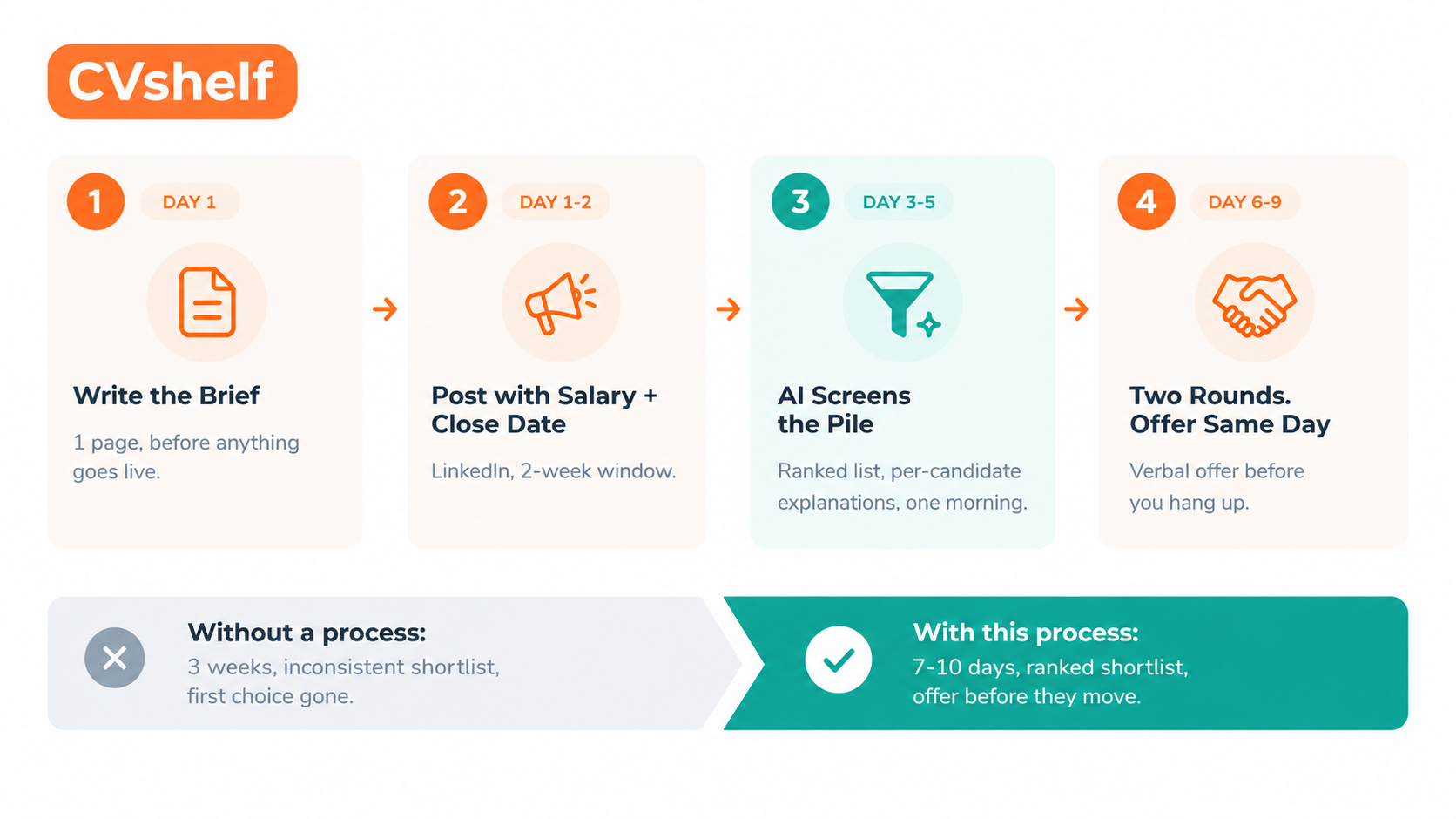
Hiring Without HR Department Small Business
Most small businesses handle hiring the same way: someone gets voluntold, reads a third of the CVs.