Hiring Process For Small Agency
Most small agencies don't have a hiring process.
The brief hit at 4 pm on a Wednesday. New client, significant scope, kicks off in three weeks. The creative director needs a senior account manager on the account from day one.
You post the role Thursday morning. By Monday, there are 160 applications.
You open the folder. Read six. Close the laptop.
Why This Keeps Happening
Small agencies don't have a hiring function. They have whoever isn't swamped when a role opens.
That person, usually the MD, the COO, or the ops manager, has no standing process to pick up. No rubric from last time. No criteria written down anywhere. No shortlist template. They're starting from scratch on a task that competes directly with billable and client-facing work for the same hours.
And because it only happens a handful of times each year, nobody builds the process between cycles. The next role opens and the same thing happens again.
The chaos isn't laziness. It's the absence of a repeatable system. And that's fixable in an afternoon.
What It Costs When the Process Breaks
The slow hire shows up in two places. One is visible. One is where the real damage happens.
The visible cost: a role stays open for three to four weeks while your team absorbs the extra load. Someone at 90% capacity hits 115%. Errors creep in at the margins. Deadlines get close.
The less visible cost is the new client relationship.
When you win a new account, the client has expectations set in the pitch. They expect a capable team on their business from day one. When the AM role is still open in week two of the engagement, the client starts feeling the understaffing before they can name it. Response times slow. Strategy conversations get delayed. The energy from the pitch stalls.
Early attrition almost never traces to a single missed deliverable. It traces to the first 60 days of a relationship and whether the client felt properly looked after. An understaffed account in that window is a retention risk that nobody will write in the post-mortem.
There's also the candidate side. Good account managers and strategists are in multiple processes simultaneously. The agency that reaches the offer stage in week three is competing for whoever is still available. That's a different pool from week one.
A Better Way to Handle It
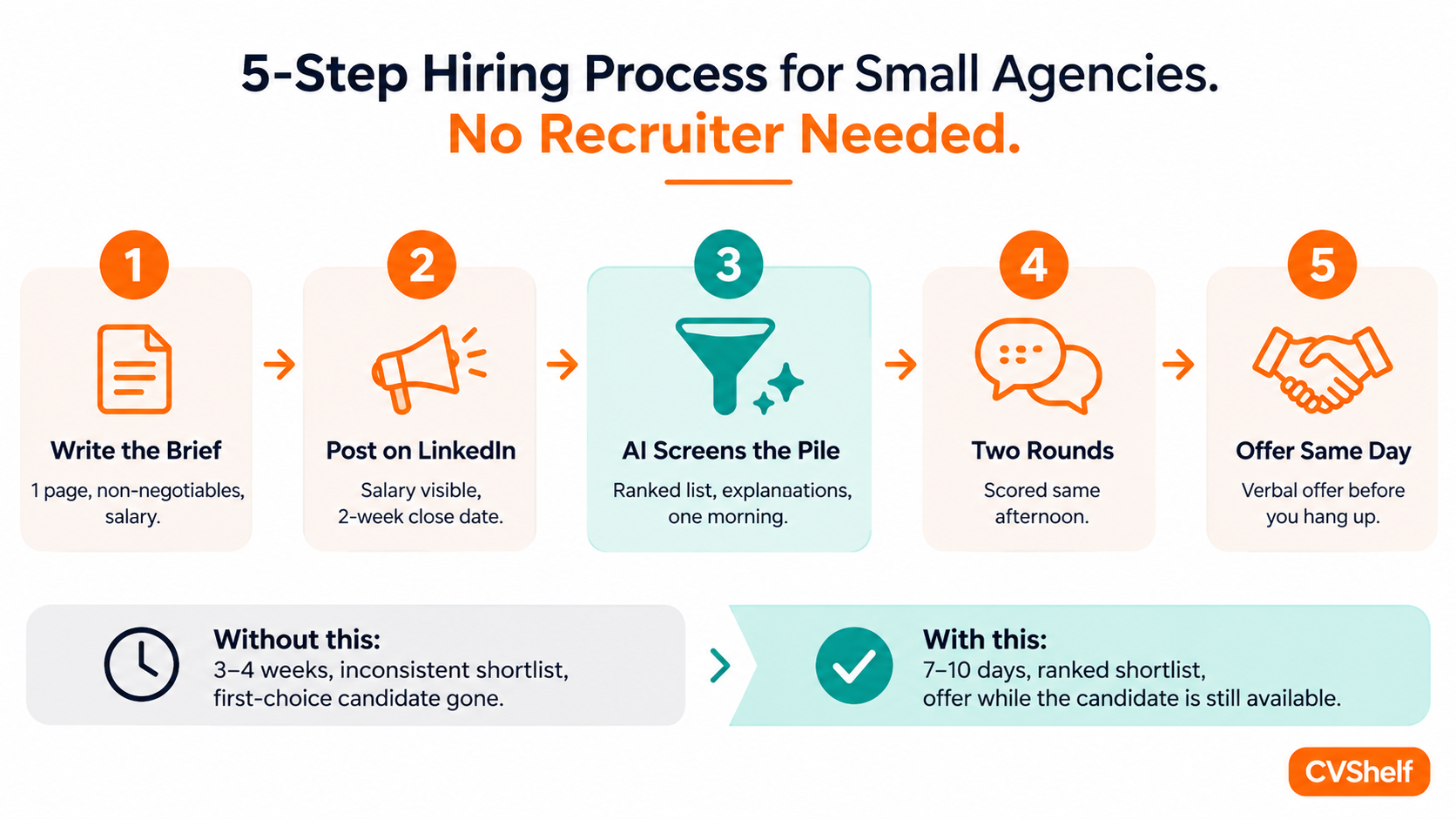
Five steps. Build them once. Use them every hire.
1. Write the brief the day the role opens. One page. What does this person do in their first 90 days? What are three genuine non-negotiables, agency experience required or not, specific channel knowledge if it's a real dealbreaker, minimum years in a relevant role? What's the salary? This brief becomes the job description, the screening criteria, and the reference point for everyone involved.
2. Post on LinkedIn with a visible salary and a close date. Keep the JD under 350 words. Include the salary. Candidates who can't see a range either skip the listing or find out late and withdraw. Set a close date two weeks out so the pile lands as one batch.
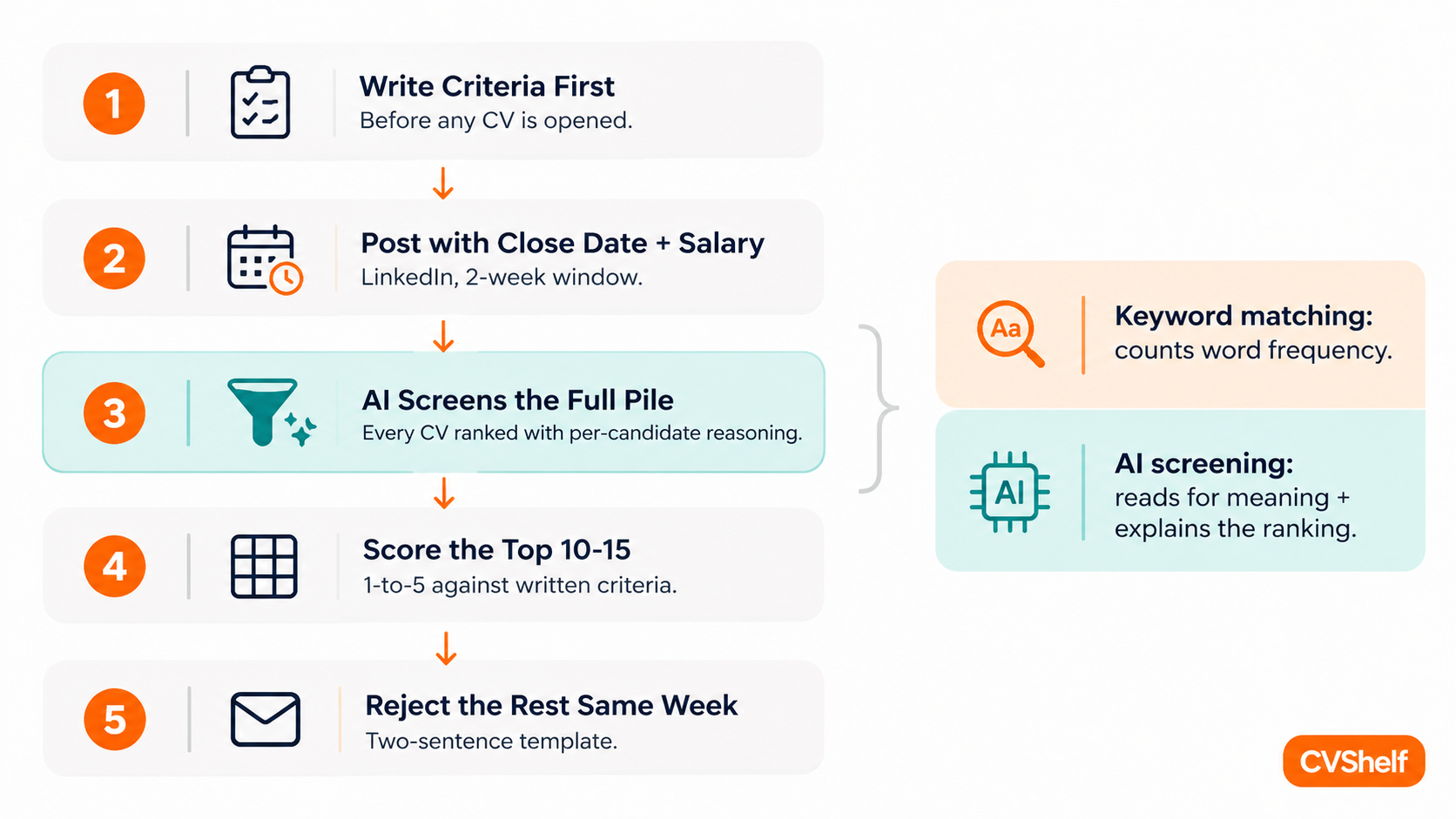
3. Screen with AI. When the close date hits, upload every CV, paste in the job description, and get a ranked list with per-candidate explanations. Each note covers what the AI found relevant and what it flagged. You review the top ten to fifteen with real attention. The rest are handled. This step takes one focused morning instead of a week of interrupted reading.
4. Two interview rounds. A 30-minute first call to check basics and fit. A 60-minute second with a practical element, a real client scenario, a brief, something that shows how they think. Score both rounds against the written criteria the same afternoon.
5. Offer on the day of the final interview. Agree on salary, start date, and key terms internally before the final conversation. If it goes well, make the verbal offer before you hang up. Written offer the same day.
That sequence runs in seven to ten days. The three-week process is almost entirely made of delays between these steps, not the steps themselves.
Where CVShelf Removes the Bottleneck
Step three is where the week goes. CVShelf is built to collapse it.
Paste in the job description or pull it from LinkedIn. Upload the CV pile as a bulk batch. CVShelf reads every application against the criteria, ranks by relevance, and returns a shortlist with a short explanation per candidate.
The explanation is what makes it usable without a recruiting background. You're not interpreting a score. You're reading a reasoned recommendation and deciding whether you agree. A founder or ops manager with no hiring experience can work through the top fifteen candidates in under an hour and produce a shortlist they can defend.
For agencies that want to understand how this fits into a broader approach to AI CV screening built for marketing agency workflows, the full breakdown is worth reading before setting up the first role.
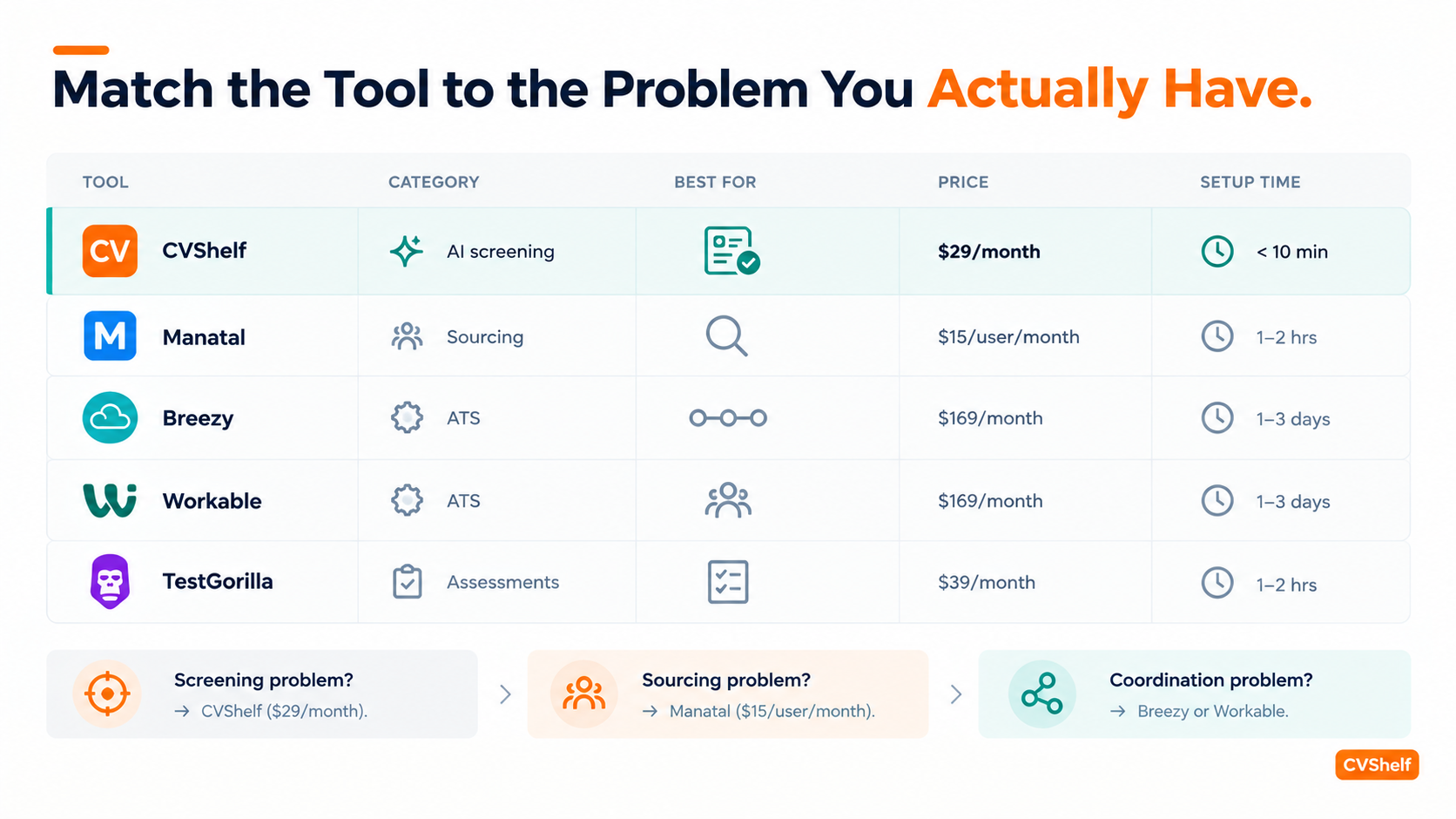
CVShelf starts at $29/month. No setup required.
FAQs
Q1. How long should a small agency hiring process take?
Seven to ten days from job post to accepted offer is consistently achievable for mid-level account management and strategist roles. Most agencies take three to four weeks because the screening stage runs across multiple interrupted sessions rather than one focused morning, and because interview scheduling and offer timing add days that don't need to be there. Fix those two steps and the timeline compresses without touching evaluation quality.
Q2. What's the minimum a small agency needs to run a proper hiring process?
A written brief, a job post with salary and close date, an AI screening tool for the application pile, two interview rounds with consistent scoring, and a same-day offer policy. No ATS required. No dedicated recruiter. The whole setup takes an afternoon to build and works every time a role opens.
Q3. Should a small agency hire an in-house recruiter?
For fewer than 15 to 20 hires per year, an in-house recruiter is hard to justify on volume. A contingency recruiter makes sense for senior or hard-to-fill roles where the candidate pool is small and passive. For mid-level marketing and account management roles that generate strong inbound volume on LinkedIn, the fee typically covers work that AI screening tools handle at a fraction of the cost.
A small agency hiring process doesn't have to be complicated. Five steps, built once, used for every hire.
Try CVShelf complimentary at cvshelf.com.
Keep Reading
More from AI Resume Screening.
AI CV Screening For Marketing Agencies
AI CV screening for marketing agencies solves a specific problem.
AI Hiring Tool USA Small Business
This post is for COOs and ops managers at 10 to 100-person US businesses.
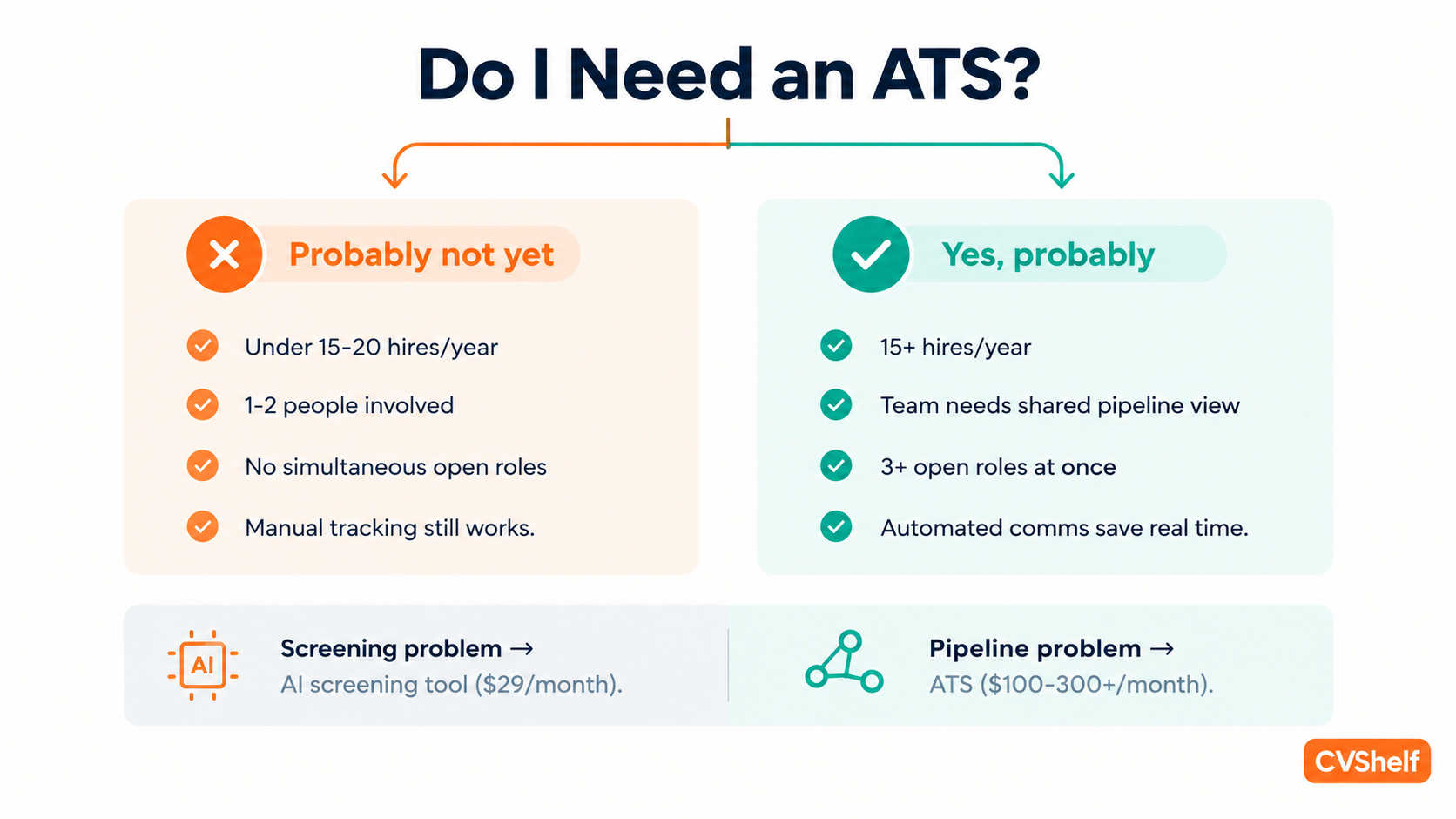
Do I Need An ATS As A Small Agency
Most small agencies under 100 people don't need a full ATS.