
How to Hire Without an HR Team
At most agencies under 100 people, hiring is not a department. It's a task that appears on someone's plate when a role opens, competes with client work and operations for attention, and disappears the moment the contract is signed.
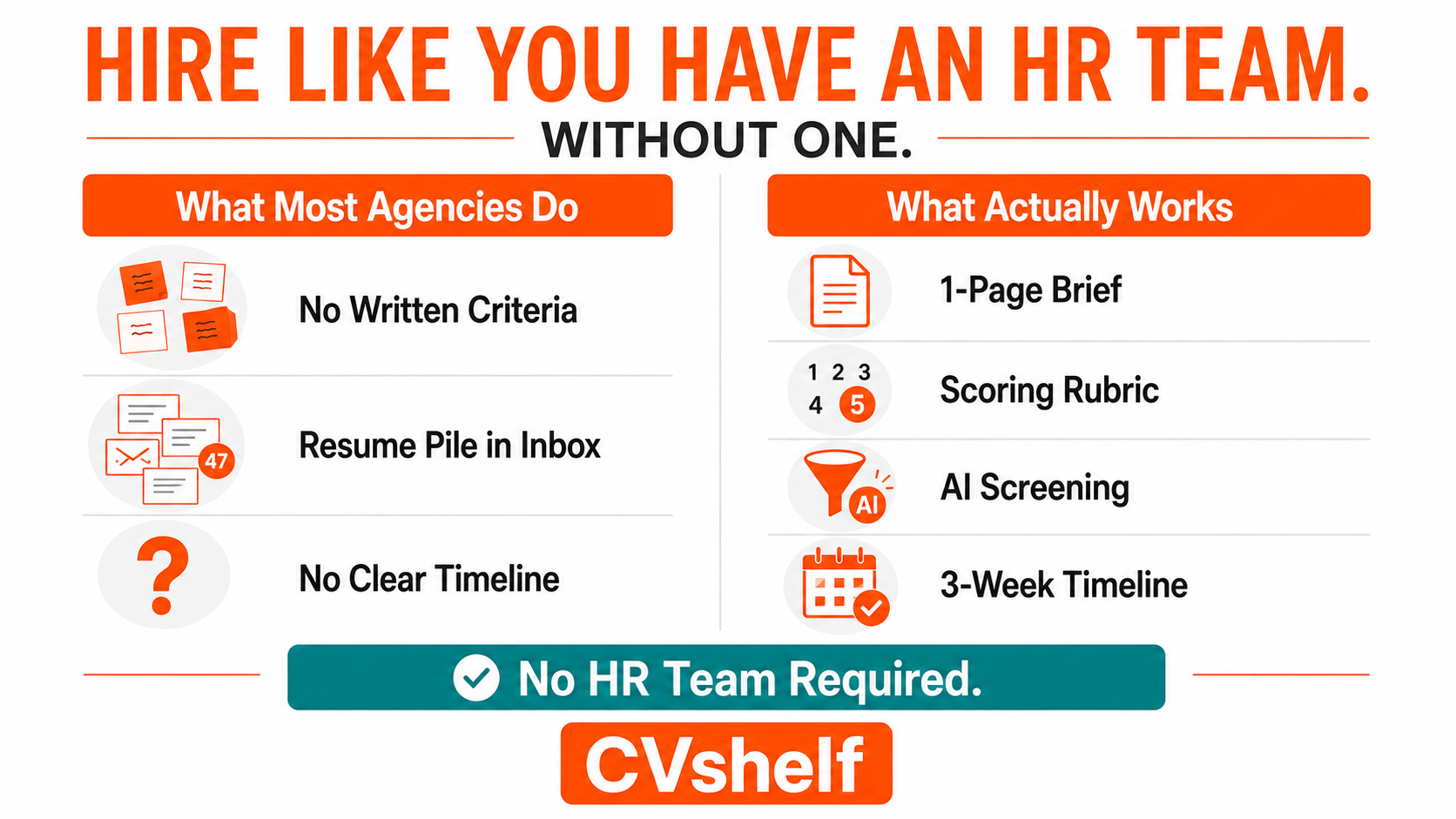
HR Is Not a Department at Most Agencies. It's a Task.
At a 40-person agency, the question of who handles hiring has a predictable answer: whoever is least overwhelmed that week. Sometimes it's the founder. Sometimes it's the operations manager. Sometimes it's a senior account director who got voluntold.
This is not a criticism. It's how agencies work. You build a lean team, everyone covers multiple functions, and hiring is one of those functions that can't quite justify a dedicated headcount until you're significantly bigger. At 10, 30, 60 people, you're doing it yourself.
The problem is that hiring without any process in place produces predictably bad outcomes: slow shortlists, inconsistent decisions, poor candidate experience, and a significant drain on the time of whoever got stuck with it. A founder spending 15 hours screening resumes for an account manager is a founder not doing business development, not managing existing clients, and not thinking about the business.
The fix is not hiring an HR manager. For most agencies at this size, that's the wrong hire. The fix is building a repeatable, minimal process that anyone with reasonable judgment can run in a few hours per role without needing an HR background.
What No HR Process Actually Costs You
The cost of ad hoc hiring is easy to underestimate because most of it is invisible.
Inconsistent decisions. When there's no written criteria, hiring decisions reflect the preferences of whoever reviewed the resumes on the day they had time. Two people reviewing the same pile will produce different shortlists. Neither is wrong. Both are arbitrary. And the candidate who got through to interview stage on Tuesday might not have made it if the same pile was reviewed on Friday after a difficult client call.
Slower hires. Without a process, every hire starts from zero. What channel to post on, what to include in the job description, how to evaluate candidates, who makes the final call. These decisions get made from scratch each time. A documented process, even a lightweight one, cuts the setup time on every future hire.
Poor candidate experience. Candidates applying to agencies that have no hiring process often hear nothing for weeks. Screening takes longer than it should. Scheduling is disorganised. Offer timelines are vague. In a market where a strong account manager has multiple options, your process is part of what they're evaluating. A slow or chaotic one signals operational immaturity.
Founder time drain. The opportunity cost is the most expensive part and the least visible. Three hours of a founder's time spent reading resumes is three hours not spent on a client relationship, a growth conversation, or the actual work. Multiply that across several hires per year and the total is meaningful.
What You Actually Need to Hire Without an HR Team
This is a short list. Do not overcomplicate it.
A 1-page hiring brief. Before a role opens, write down: what this person needs to do in the first 90 days, the three to five non-negotiable requirements, the salary range, and the decision-making timeline. One page. No more. This brief gets shared with anyone involved in the hire so everyone is evaluating against the same criteria.
A simple scoring rubric. Three to five criteria pulled from the brief, each scored 1 to 5. This does not need to be sophisticated. It needs to be consistent. When two people review candidates using the same rubric, their shortlists converge. Without it, they diverge.
One sourcing channel. For most agency roles, LinkedIn Jobs covers the market. Add Indeed if the role is more operational and you want broader volume. Do not post to six job boards. One or two is enough. More channels add management overhead without proportional candidate quality improvement.
One screening tool. This is where most of the time goes and where the right tool makes the biggest difference. More on this below.
That's the infrastructure. Four components. No ATS, no complex workflow, no HR background required to run it.
How to Run a Full Hire, Start to Offer
Week one: brief and post. Write the 1-page brief. Use it to write the job description. Keep the JD tight: the role's purpose, what the first 90 days look like, the non-negotiables, and the application instructions. Post to LinkedIn. Set a closing date two weeks out.
Week two: screen. Applications come in. Use your screening tool to rank the full pile against the job criteria. Review the top 10 to 15 with the scoring rubric. Identify 5 to 8 people worth a conversation. Send templated rejections to everyone else. Do this in one sitting. Do not let it stretch across multiple days.
Early week three: first interviews. Run 30-minute calls with your shortlist. Use the same 5 to 6 questions for every candidate. Score them on the rubric after each call while it's fresh.
Mid week three: final decision. Review scores. Pick your candidate. Make the verbal offer within 24 hours of the decision. Send the written offer the same day. Do not introduce unnecessary delays between deciding and offering.
End week three: close. Candidate accepts, contract goes out, start date confirmed. The whole process took three weeks and required no specialist HR knowledge.
This is not a stripped-down process. It's a complete one. The shortcuts are in not overcomplicating each stage, not in skipping stages that matter.
Where AI Screening Fits
The stage that consumes the most time and produces the most inconsistency is screening. It's also the stage most amenable to automation.
AI screening tools read every application against your job description, score each candidate by relevance, and return a ranked shortlist with explanations. You review the top of the list with your full attention. The bottom 80% of the pile never requires your time.
This is not a tool for HR professionals. It's a tool for exactly the person this post is written for: someone who needs to process a large application pile quickly, without screening expertise, and without spending a week on it.
CVShelf is set up specifically for this use case. Paste in your job description. Upload your resumes as a bulk batch. Get a ranked list with a per-candidate explanation in minutes. No training required. No ATS integration needed. No configuration process that takes days.
The explanation layer matters for non-HR users specifically. If you're a founder or ops manager reviewing candidates without a recruitment background, seeing why the AI ranked someone highly or lowly helps you apply your own judgment to the list. You're not just accepting a score. You're reviewing a reasoned recommendation and overriding where your knowledge of the role adds something the AI doesn't have.
CVShelf starts at $29 per month. Setup takes under 10 minutes for a first role.
You Don't Need an HR Team. You Need a Process.
The agencies that hire well without dedicated HR functions share one characteristic: they run the same process every time. Not a complex process. A consistent one.
A 1-page brief. A scoring rubric. One sourcing channel. One screening tool. A three-week timeline with clear milestones.
That's it. Build it once. Run it every hire. Improve it when something breaks.
CVShelf handles the screening step. The rest is a few hours of your time and a document you wrote once.
Try CVShelf free at cvshelf.com. Hire faster without the overhead.
FAQs
Do small agencies need an ATS? Not until hiring volume justifies the overhead. For agencies doing fewer than 20 hires per year, an ATS creates more process than it saves. The setup, maintenance, and workflow management cost more recruiter time than the tool saves. A lighter stack — AI screening tool plus a shared tracking spreadsheet or your email — is sufficient and significantly cheaper. Revisit an ATS when the volume of simultaneous open roles makes coordination genuinely difficult without one.
How do you maintain consistency in hiring without a dedicated recruiter? Written criteria applied before screening starts. A scoring rubric used by everyone involved in the process. A 1-page brief shared with every interviewer so they're evaluating against the same standard. Consistency comes from documentation, not from having a specialist in the room. The documentation does not need to be lengthy. It needs to exist and be used.
How long should a hiring process take for an agency account manager role? Three weeks from job post to offer is achievable and appropriate for most mid-level agency roles. Week one: post. Week two: screen and shortlist. Week three: interview, decide, offer. Processes that stretch to five or six weeks do so because of delays in screening and decision-making, not because the steps themselves require that time. The screening delay is where AI tools make the biggest difference.
What is the best way to write a job description without an HR background? Write it around the role's first 90 days rather than an exhaustive list of requirements. What does success look like at 30, 60, and 90 days? What is the one thing this person must be able to do from day one? What experience makes that credible? Answer those questions and you have a job description. Keep it under 400 words. Longer JDs attract more applications without improving quality and take longer to write.
How do you handle candidate rejections without an HR team? A single templated email, personalised only with the candidate's name and the role title, sent within a week of making your decision. It does not need to include feedback unless you want to provide it. A clean, timely response is better employer branding than a detailed but delayed one. Most email clients support templates. Gmail, Outlook, and Apple Mail all have native template or canned response functionality.
What hiring mistakes do agency founders make most often? Starting too late (the role should open the day the business case is clear, not the week before you need someone), interviewing too many people (more than 6 to 8 first-round interviews adds time without proportional signal), delaying offers (good candidates accept elsewhere while you deliberate), and hiring on instinct without written criteria (produces decisions that are hard to defend and hard to learn from).
Keep Reading
More from AI Resume Screening.
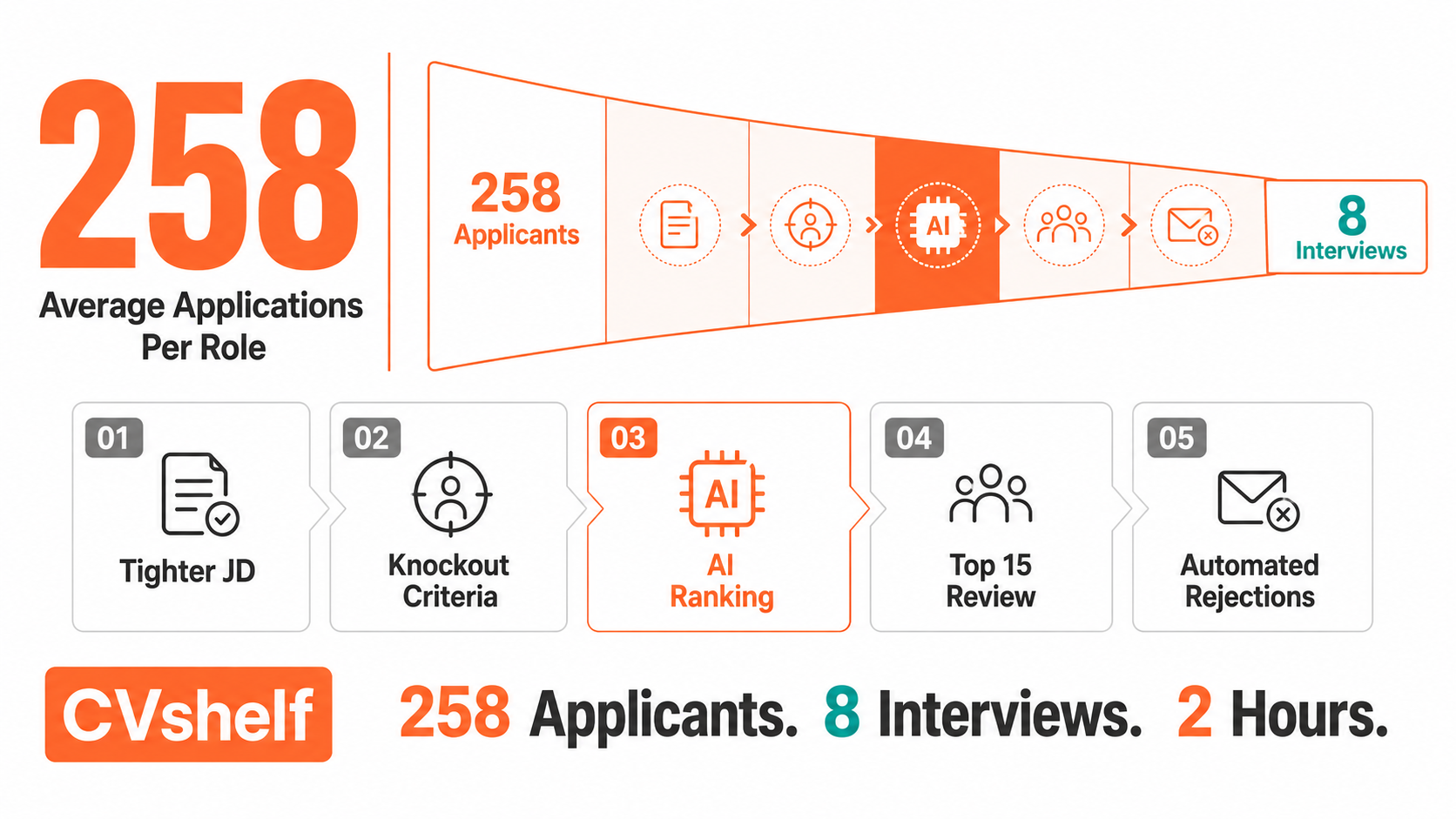
Too Many Applicants for Your Marketing Role? Here's What to Do
The average job post now attracts around 258 applicants. For an account manager or strategist role at a marketing agency, that number can climb higher.
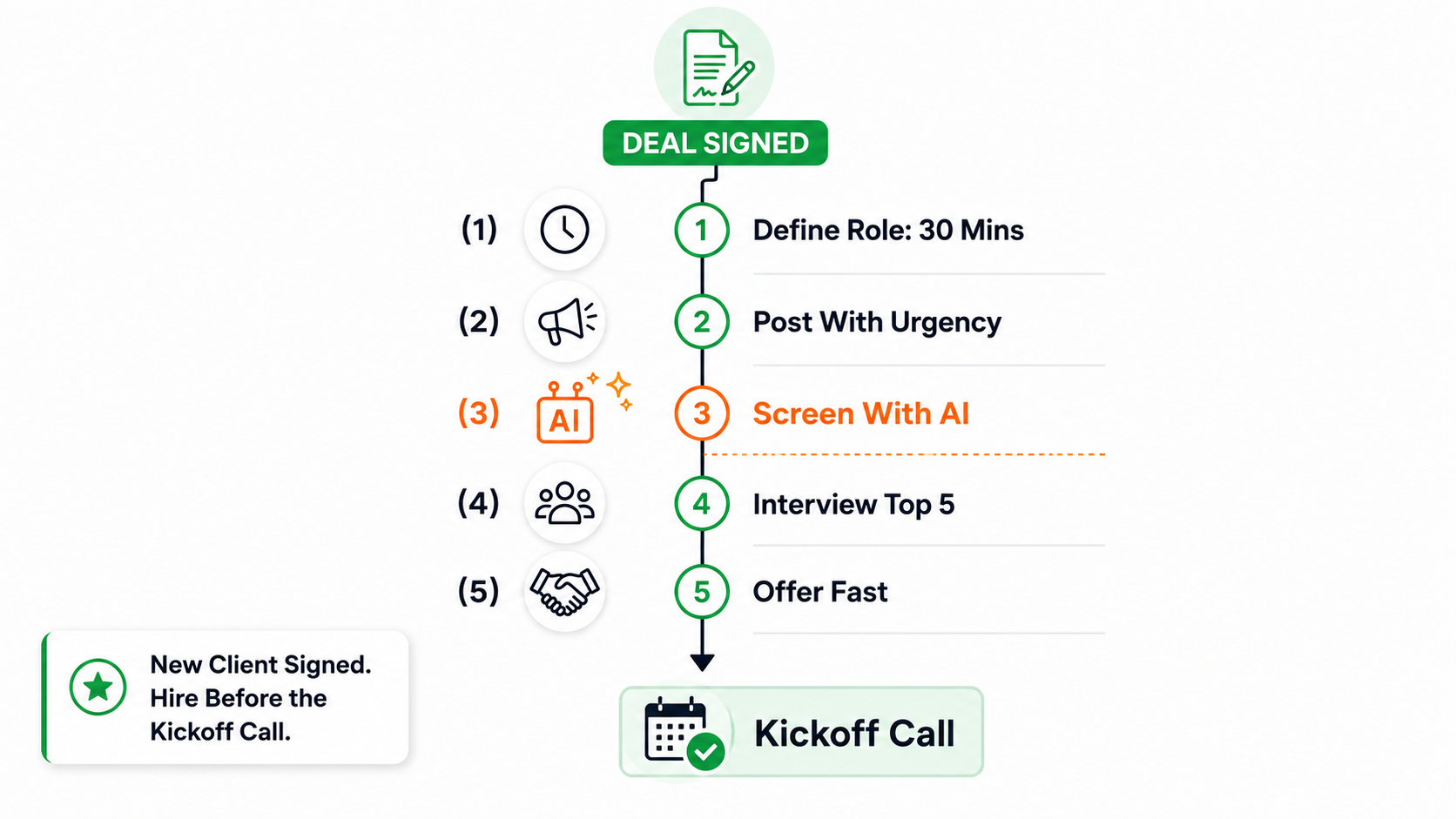
How to Hire Fast After Landing a New Client
The moment you sign a new client, a countdown begins. You have days, not weeks, to staff the account before the kickoff call.
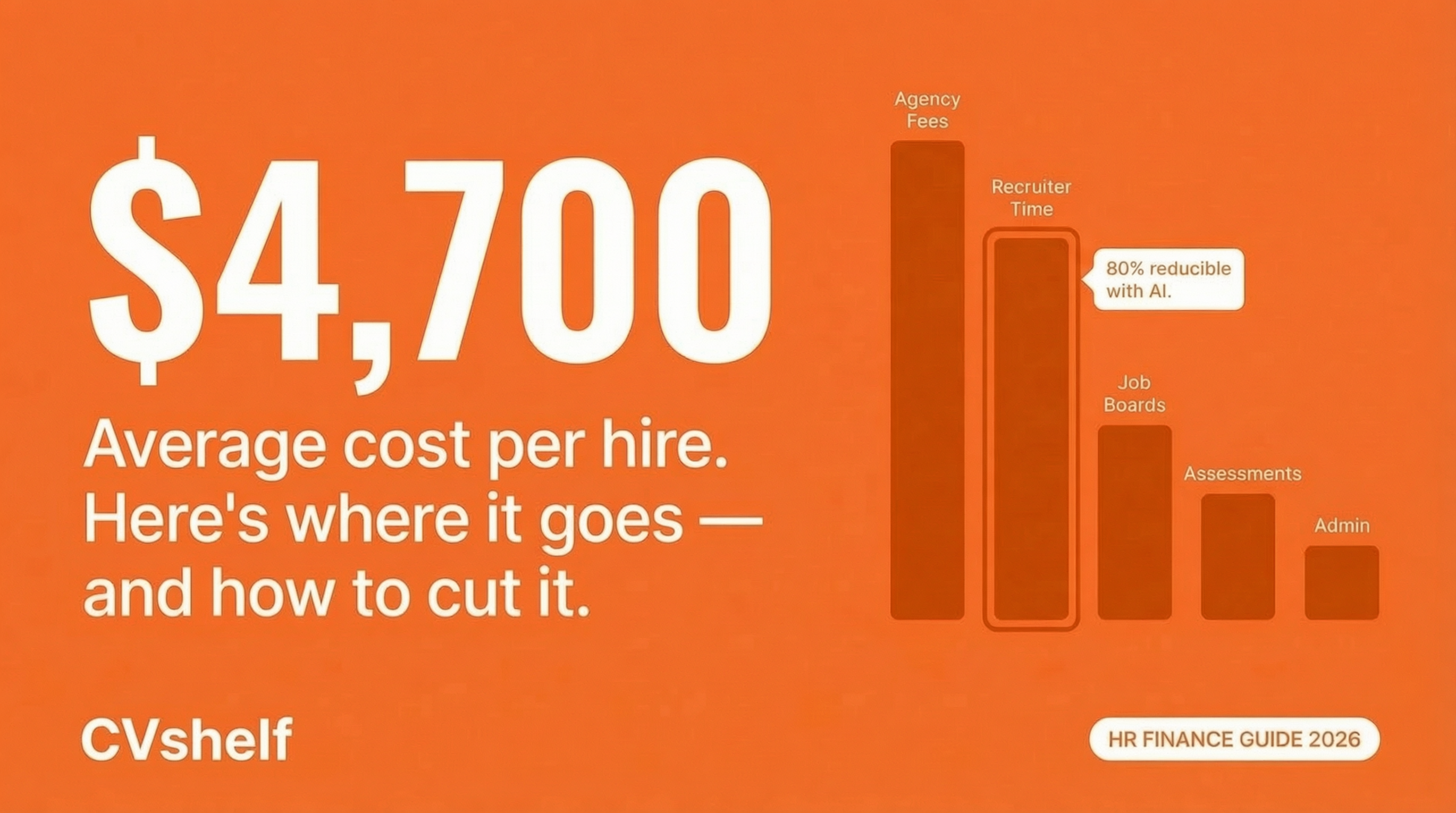
Cost Per Hire: How to Calculate and Reduce It
The average cost per hire in the US is $4,700, according to SHRM. Most HR teams accept that number without interrogating it.