Resume Screening Software for Marketing Agencies
Most resume screening software was designed for companies with dedicated HR teams, IT departments, and continuous hiring pipelines.
Most COOs at agencies between 10 and 100 people have the same experience with hiring software. You buy something that looked good in the demo. It takes two weeks to configure. Your team doesn't use it consistently. You end up back in your inbox, reading CVs manually, wondering what you're paying for.
The problem is not that the tools are bad. It's that they're built for a company with a dedicated recruiter whose full-time job is running the hiring pipeline. You don't have that. You have yourself, maybe an ops coordinator, and a hiring process that fires up four or six times a year and then goes quiet again.
What you need is different.
The Real Problem at This Size
When an agency role opens, the application pile lands on whoever is least swamped that week. That's almost never a recruiter. It's a COO, an ops manager, a studio manager, or sometimes just the MD.
That person is not trained in resume screening. They don't have a scoring rubric. They read the first 30 or 40 applications with real attention, skim the next batch, and stop somewhere in the middle when a client issue pulls them away. The shortlist gets built from whatever they remembered most clearly, which tends to mean candidates who applied early, wrote well, or happened to list a recognisable employer name.
This isn't incompetence. It's what happens when you ask a non-specialist to process a specialist task at volume, on a deadline, alongside everything else.
The downstream effects are real. Strong candidates buried in the middle of the pile don't get found. The shortlist you send to the hiring manager is thinner than it should be. Occasionally, the hire doesn't work out and nobody can explain exactly why because the screening rationale was never written down.
And because it only happens a few times a year, nobody fixes the process. They just live with it.
What Good Actually Looks Like
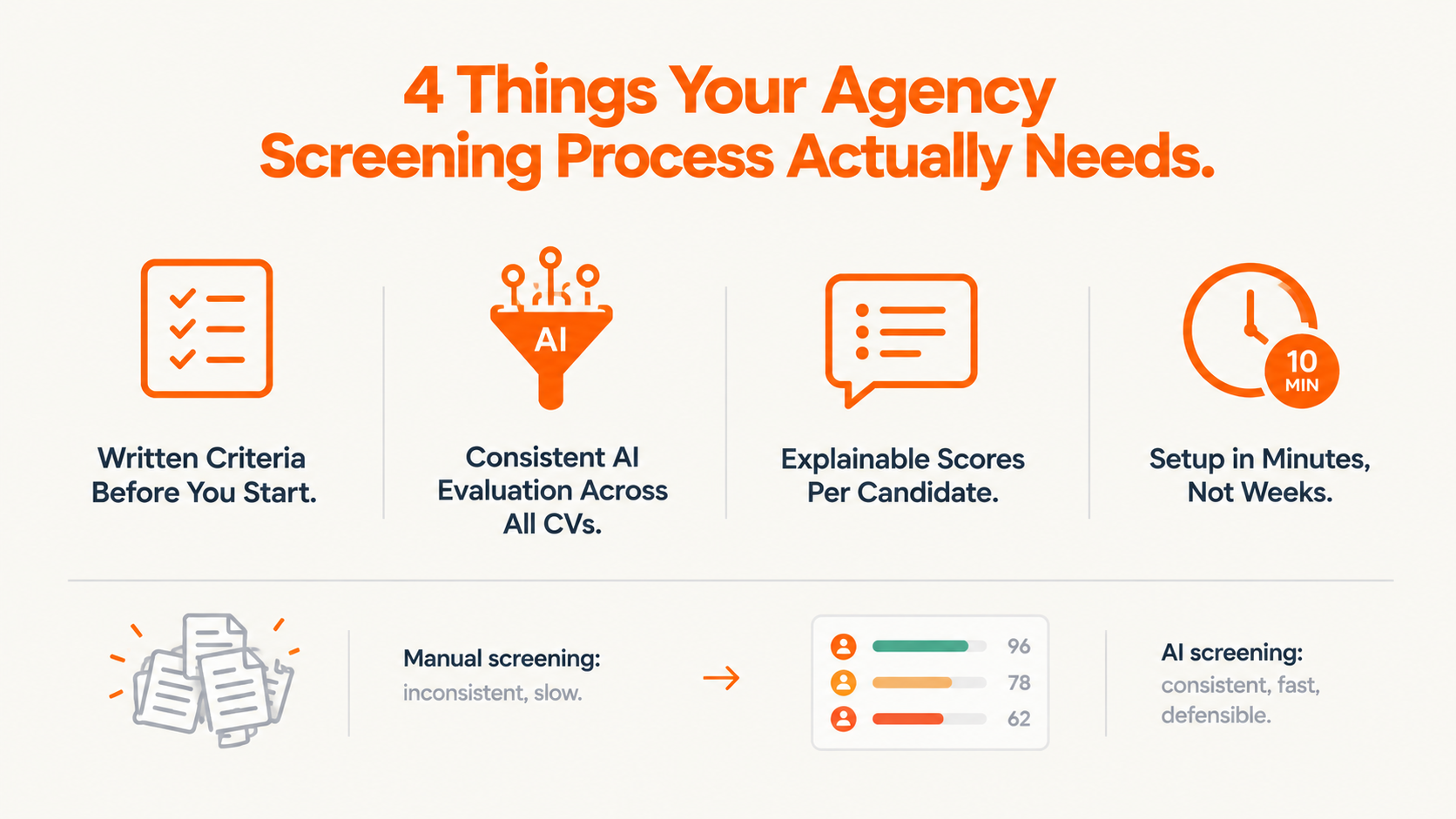
There are four things a workable screening process needs at agency scale. None of them are complicated.
1. Written criteria before you start. Three to five non-negotiables, defined before a single resume is opened. Agency experience required or not. Minimum years in a directly relevant role. Specific channel or skill knowledge if it's genuinely a dealbreaker. Writing these down takes 15 minutes and prevents the criteria drift that produces inconsistent shortlists.
2. Consistent evaluation across every application. This is where manual screening fails at volume. Candidate 150 does not get the same attention as candidate 15. An AI screening tool applies the same criteria to all 150 with no fatigue and no drift. CVShelf takes a job description, runs it against a bulk upload of resumes, and returns a ranked list with a short explanation per candidate. You review the top ten to fifteen with real focus. The AI handled the mechanical read-through. You handle the judgment calls.
3. Explainability. The ranked list is useful. The explanation is what makes it usable. A COO who didn't do the screening personally needs to be able to defend the shortlist to a hiring manager without saying "the software picked them." CVShelf's per-candidate explanations tell you what the AI found, what it flagged, and why the ranking landed where it did. That's a shortlist you can own and present.
4. A setup time measured in minutes, not weeks. Paste in the job description. Upload the resumes. That's the configuration. No implementation consultant, no training session, no workflow to build from scratch.
The Most Common Mistake
Buying a full ATS.
Not because full ATS platforms are bad — for a company doing 50+ hires a year with a dedicated recruiter, they're the right tool. For an agency doing eight hires a year with no dedicated recruiter, a full ATS is expensive overhead with features you'll never use and a setup process that assumes resources you don't have.
The pattern is predictable: the tool gets bought, partially configured, used inconsistently for a few months, and then quietly abandoned. The agency goes back to manual screening, but now they're paying $200+ a month for software nobody opens.
Start with the problem, not the category. The problem is that screening a large application pile manually is slow, inconsistent, and doesn't produce good shortlists. An AI screening tool fixes that specific problem. Buy for the problem you have, not the one you might have in three years.
FAQ
Q1. Is there resume screening software that doesn't require an ATS setup?
Yes. CVShelf is designed specifically for this. You paste in a job description, upload a batch of resumes, and get a ranked shortlist with explanations. No ATS, no integrations, no implementation process. It works as a standalone tool and takes under ten minutes to run a first screening.
Q2. What's the difference between resume parsing and resume screening?
Parsing extracts information from resumes and structures it into fields (name, job title, dates, skills). Screening evaluates that information against the job requirements and ranks candidates by fit. Most ATS platforms do the first part but handle the second part poorly, using keyword matching rather than relevance ranking. A dedicated screening tool like CVShelf combines both and adds an explanation layer so you can see the reasoning, not just the score.
Q3. How do I know if AI screening software will work for my type of role?
The quality of the output depends almost entirely on the quality of the job description you input. A vague JD ("account manager with marketing experience") produces a vague ranking. A specific one ("agency-side AM, minimum 3 years in performance marketing, client-facing, based in London or hybrid") produces a sharp shortlist. If your current JDs are tight and role-specific, AI screening tools will work well for you immediately. If they're broad, tighten the JD first.
Hiring at agency scale doesn't need enterprise HR software. It needs a process that a non-recruiter can run in a morning, tools that don't require an implementation project, and a shortlist that holds up when a hiring manager pushes back on it.
CVShelf handles the screening layer. Try it complimentary at cvshelf.com.
Keep Reading
More from AI Resume Screening.

AI Hiring Compliance USA 2026
Several US states now have live requirements around AI tools used in hiring, covering disclosure, bias auditing, and recordkeeping.
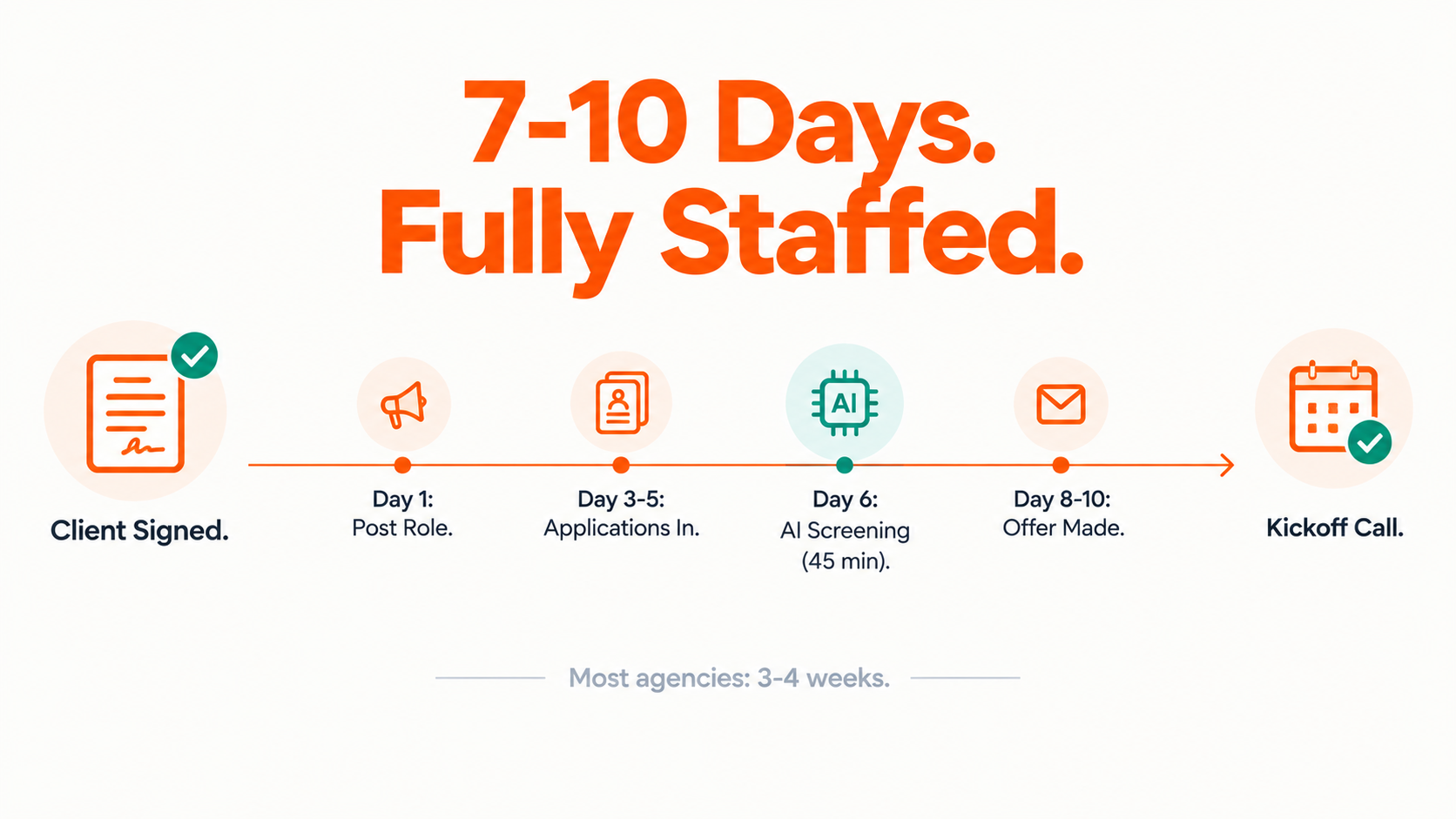
How to hire fast after landing a new client
The moment a client signs, a countdown starts.
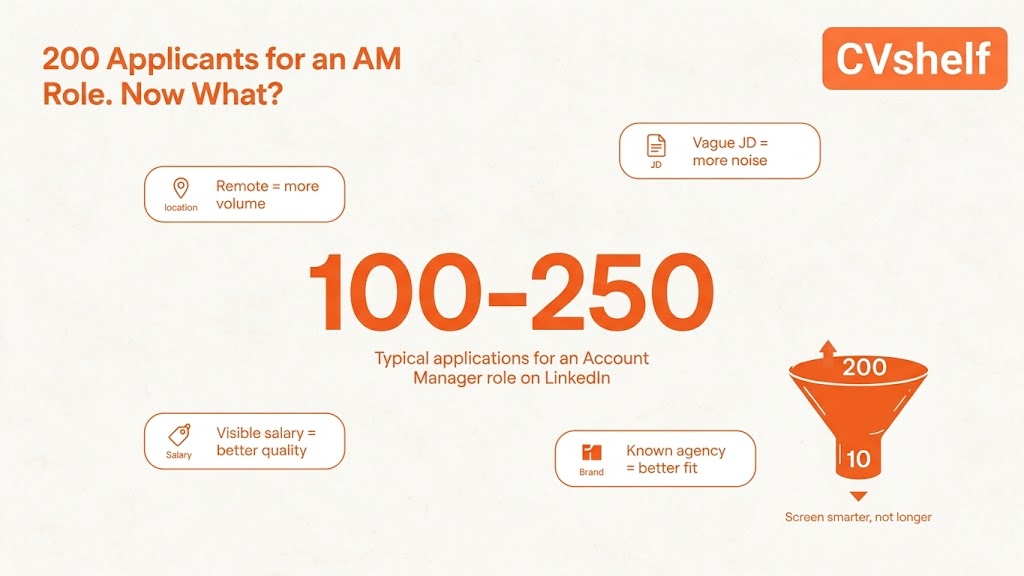
How Many Applicants Is Normal for an Account Manager Role?
A mid-level Account Manager role posted on LinkedIn typically receives 100 to 250 applications within two weeks.