The AI Hiring Tool Built for Marketing Agencies, Not Enterprise
Most AI hiring tools were built for companies with dedicated recruiters, IT budgets, and months to spend on configuration.
Marketing agencies hire differently from corporates. The trigger is usually winning new business, not a headcount plan. The person doing the screening is usually the MD, COO, or whoever had the lightest calendar that week. And the cost of a slow hire isn't just an empty desk — it's a client relationship at risk.
Most AI hiring tools weren't designed for that context. They were designed for HR teams that run continuous hiring pipelines, maintain ATS workflows, and have an implementation budget. If that's not you, most of what those tools offer is overhead you'll never use.
Here's what's actually useful.
The Real Problem for a 10 to 100-Person Agency
When a mid-market corporate gets [VERIFY: application volume stat] applications for a role, they have a recruiter whose entire job is to process them. When your agency gets the same pile, it lands on you or your ops manager alongside the other 40 things happening that week.
The problem isn't finding candidates. Post on LinkedIn and you'll get applications. The problem is that processing 150 to 200 of them properly takes [VERIFY: manual screening hours stat] of focused attention, which nobody at a 40-person agency has sitting idle.
So the pile gets skimmed. The first 30 get real attention. The next 50 get a scroll. The rest don't get read. The shortlist reflects reading order and energy levels, not candidate quality.
Add a tight timeline (you need someone before the client kickoff call, not in three weeks) and the stakes go up further. Strong account managers and strategists aren't sitting around waiting. They accept the fastest reasonable offer.
A generic AI hiring tool that requires setup time, recruiter training, or a workflow that assumes you have dedicated HR staff doesn't solve this. It adds friction on top of a problem that's already costing you.
What Good Actually Looks Like
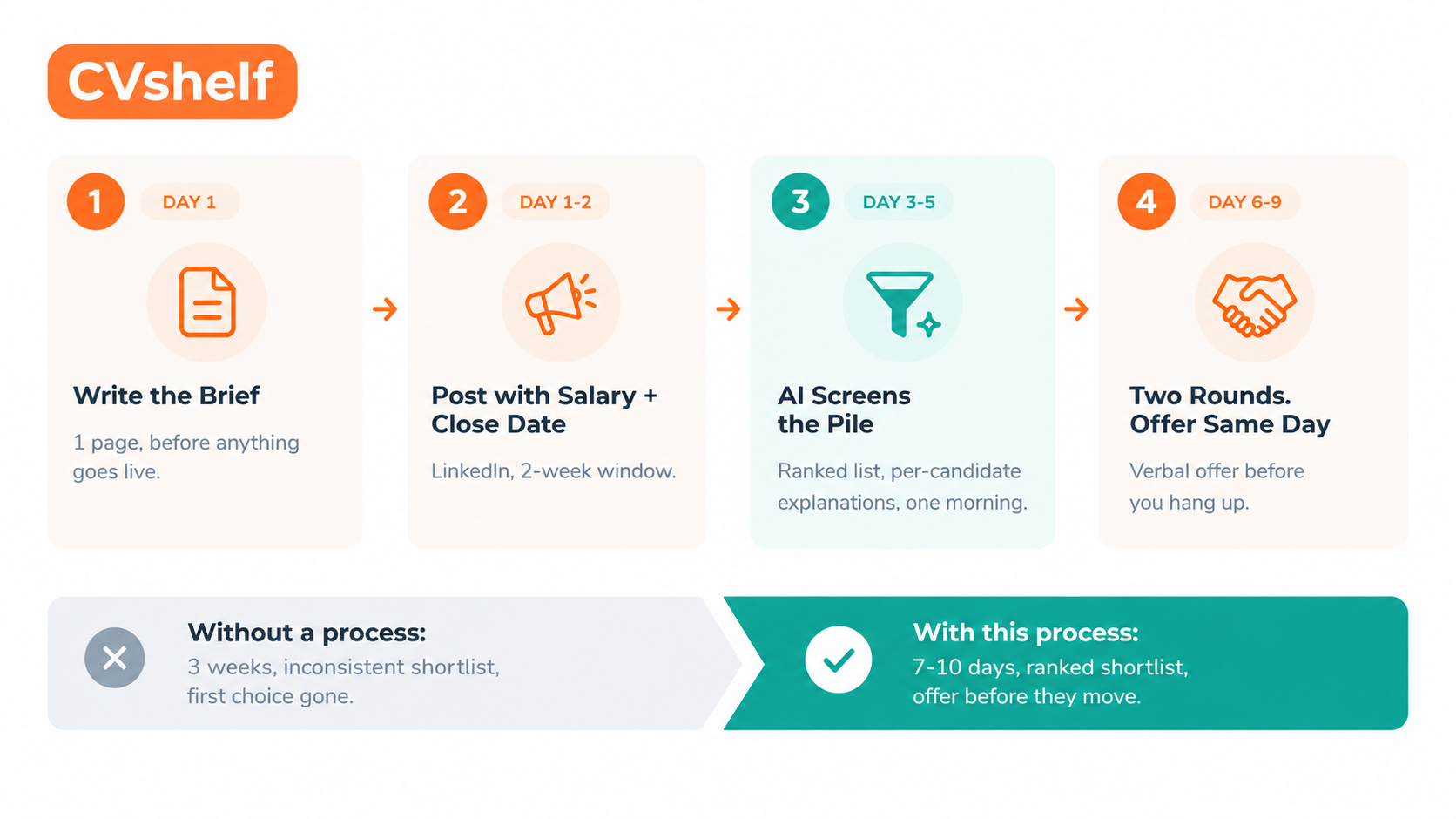
For an agency hire, the process that works is short and structured.
Write a 1-page role brief before the job goes live. What does this person need to do in the first 90 days? What are the two or three non-negotiables? This brief becomes the AI screening criteria.
Post on LinkedIn. Set a closing date. Don't leave it open indefinitely.
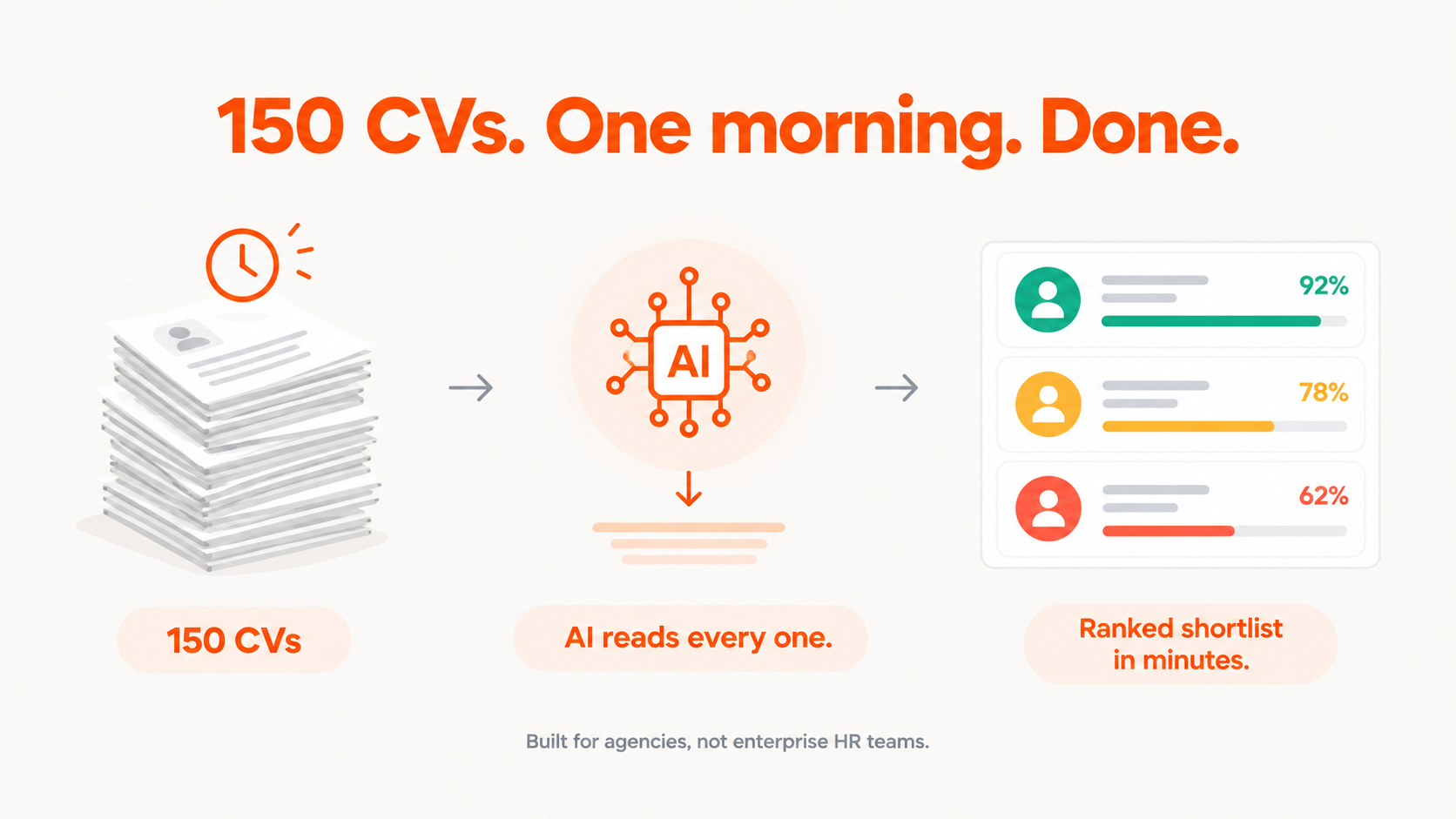
When applications arrive, run them through an AI screening tool. Paste in the job description, upload the full batch, get a ranked list with an explanation per candidate. Tools like CVShelf handle this step: you upload the pile, the AI reads every application against your job criteria, and you get a shortlist in minutes rather than days. Each candidate comes with a note on why they ranked where they did, which matters when you're not a trained recruiter and need to defend the list to whoever is co-signing the hire.
Review the top ten to fifteen with your actual attention. These have already been filtered. You're not reading 200 resumes. You're making judgment calls on ten.
Run two interview rounds. Offer fast. The agencies that lose good candidates almost always lose them between the final interview and the offer, not at the shortlisting stage.
The whole process can run in seven to ten days if the screening stage doesn't stall. That's the part AI fixes.
The Most Common Mistake Agencies Make
Treating the hire like a corporate process.
Four interview rounds for an account manager role. A panel interview that requires five calendars to align. A week between the final conversation and the offer while someone "checks with the team."
None of that adds information you don't already have after two good interviews. It just adds time. And in a candidate market where a strong AM has other options, time is what you don't have.
The second mistake is using the wrong tool. An ATS built for a 500-person company with a recruitment team has features you'll never touch, a setup process you'll never finish, and pricing that assumes a volume of hires that justifies the overhead. A lightweight AI screening tool that works on day one and costs under $100 a month fits the actual problem.
FAQs
Q1: Is there an AI tool that can screen CVs without me needing to be an HR expert?
Yes. CVShelf is specifically designed for this. You paste in the job description, upload your CVs in bulk, and get a ranked list with a short explanation per candidate. No training required, no recruiter background needed. You're reviewing a recommendation, not doing the screening from scratch.
Q2: What's the difference between a proper AI screening tool and the AI my ATS claims to have?
Most ATS "AI" is keyword matching. It finds resumes where words from the job description appear. That's fine for filtering obvious mismatches but it doesn't tell you which candidate actually fits the role best, or why. A dedicated AI screening tool reads the resume for meaning: whether the experience maps to the role, at what level, in what context. The output is a ranked list with reasoning, not a pass/fail filter.
Q3: Can I use an AI hiring tool if I only hire three or four people a year?
Yes, and the case for it is stronger than it sounds. The problem with low-volume hiring is that you have no established process. Each hire starts from scratch, takes longer than it should, and relies on whoever happens to have time. An AI screening tool takes most of the manual work out of the one stage that eats the most time, even at low volume. CVShelf starts at $29 per month with no long-term commitment, which is a reasonable cost for a process that takes an hour instead of a week.
Agency hiring doesn't have a staffing problem. It has a process problem. The applications are there. The candidates are there. The gap is a screening stage that wasn't built to handle volume, under time pressure, without a recruiter.
That's a solvable problem. Try CVShelf complimentary at cvshelf.com.
Keep Reading
More from AI Resume Screening.
Agency Hiring Without Recruiter Fees
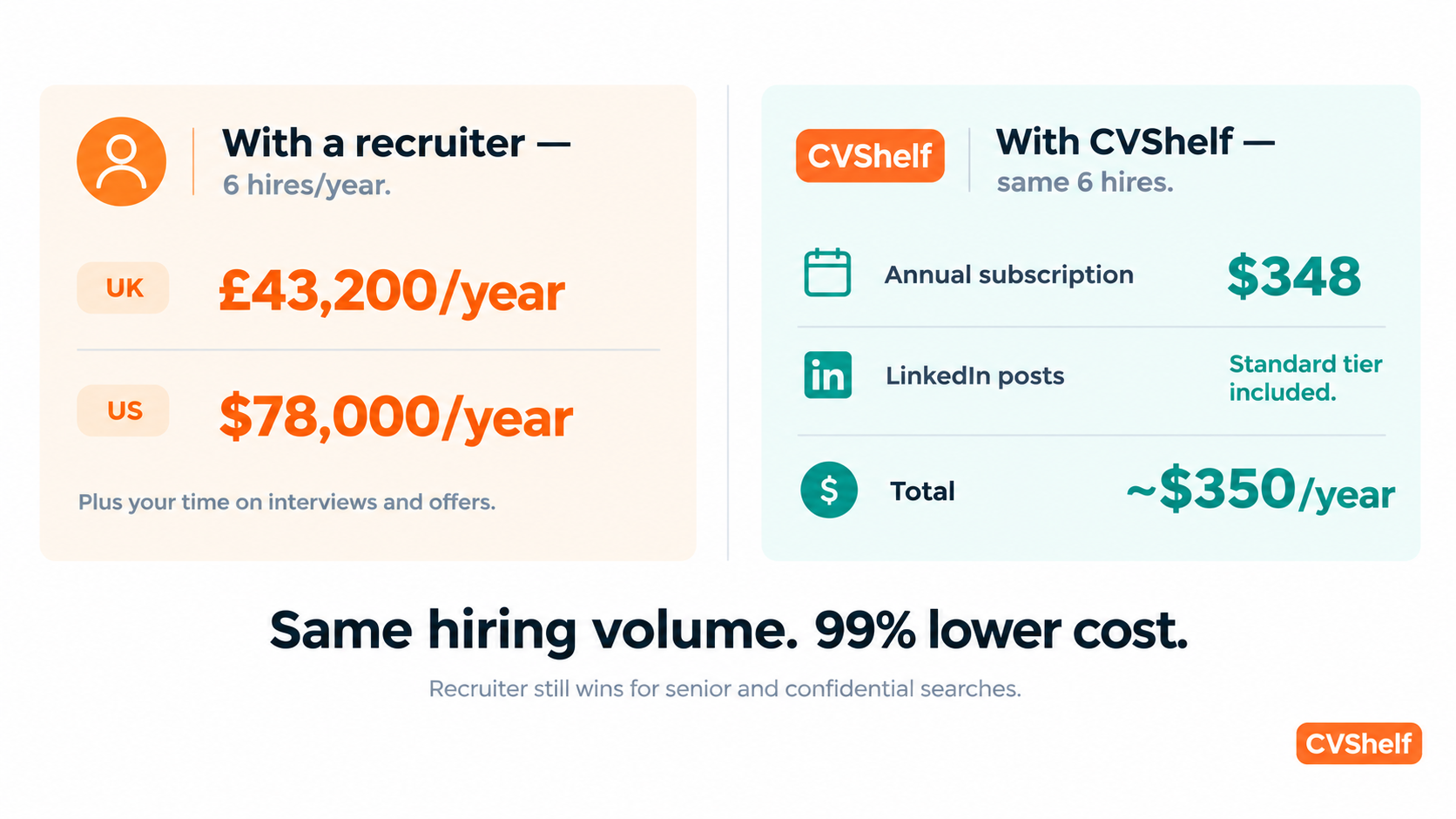
Contingency recruiters charge 15-25% of first-year salary for mid-level placements, that's $9,000 to $15,000 for a single account manager hire.
How Many Applicants For A Small Agency Job Posting
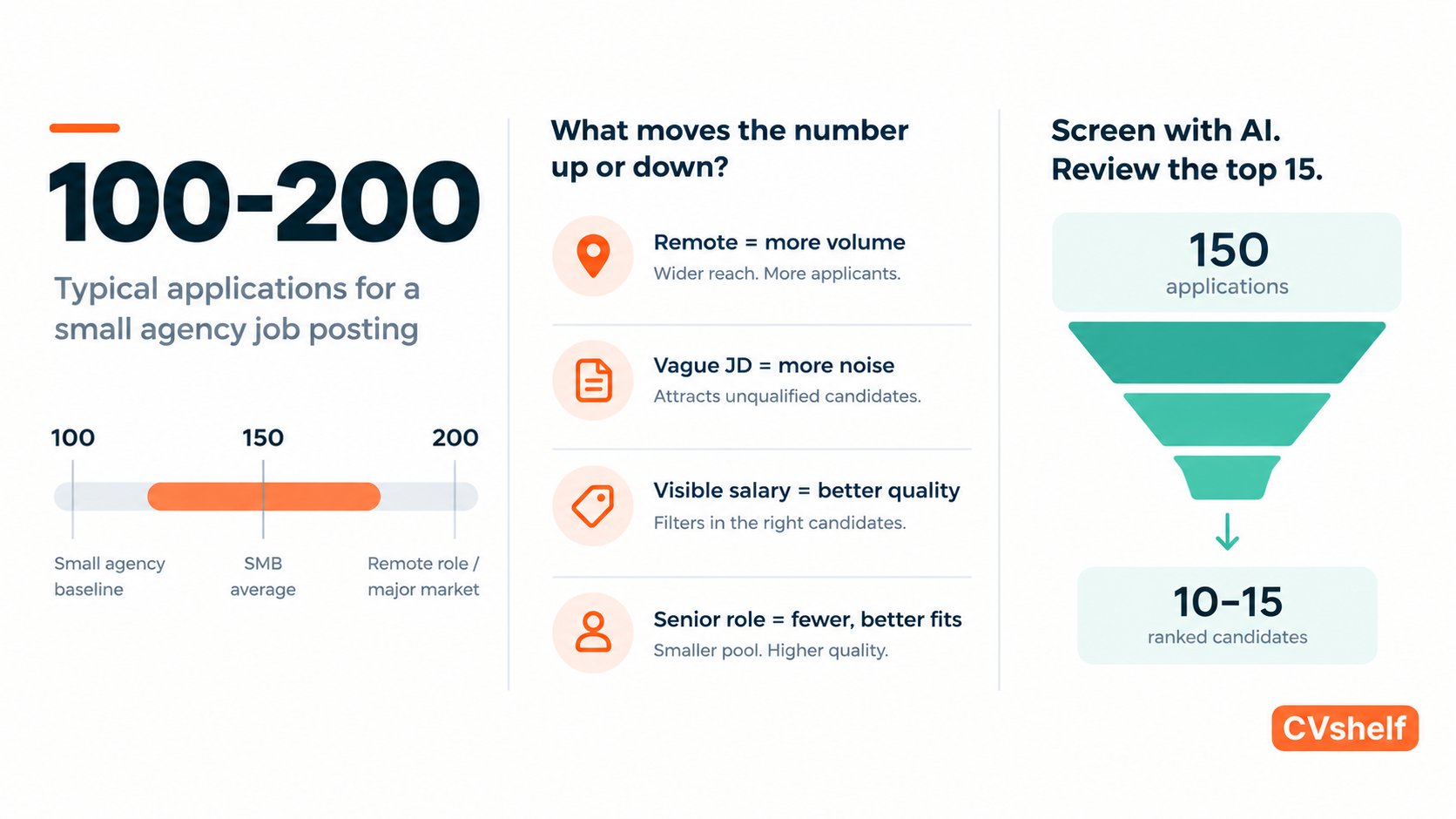
A small agency posting a mid-level role on LinkedIn or Indeed typically receives 100 to 200 applications within two weeks.
Hiring Without HR Department Small Business
Most small businesses handle hiring the same way: someone gets voluntold, reads a third of the CVs.