
Candidate Screening Tool For Agencies
Most candidate screening tools were built for companies with dedicated recruiters and established hiring pipelines.
The application pile arrives. 170 CVs for an account manager role, all sitting in a shared inbox or a folder that nobody has formally been assigned to process. The person who ends up handling it is the ops manager, the studio director, or whoever the MD delegated it to on a Tuesday morning alongside three other things.
That person reads the first 40 carefully. Skims the next 50. Stops somewhere around number 100 when a client issue interrupts. The shortlist gets built from whoever they remembered most clearly, which turns out to be the people who applied early and formatted their CVs well.
Nobody writes this down as a process failure. It just happens, four or five times a year, at almost every agency in this size range.
The Real Problem at This Size
The screening problem at a small agency is not the same as the screening problem at a corporate with an in-house TA team.
A corporate recruiter does this every day. They have muscle memory for what a good candidate looks like, a rubric they apply consistently, and nothing else on their plate while they're reviewing. The screening outcome is more reliable not because the candidates are better but because the reviewer is fresh, focused, and doing the same task repeatedly.
At a 40-person agency, the person screening is doing it once per quarter, without training, between client calls. The criteria in their head shift as they read. Candidate 20 gets assessed differently from candidate 80 because the mental model of the role has changed by then. The shortlist is inconsistent not because the reviewer lacks judgment but because the process doesn't support consistent judgment at volume.
That's the actual problem. A candidate screening tool for agencies needs to address that specific gap, not replicate enterprise recruiting infrastructure.
What Good Actually Looks Like
Four things. In this order.
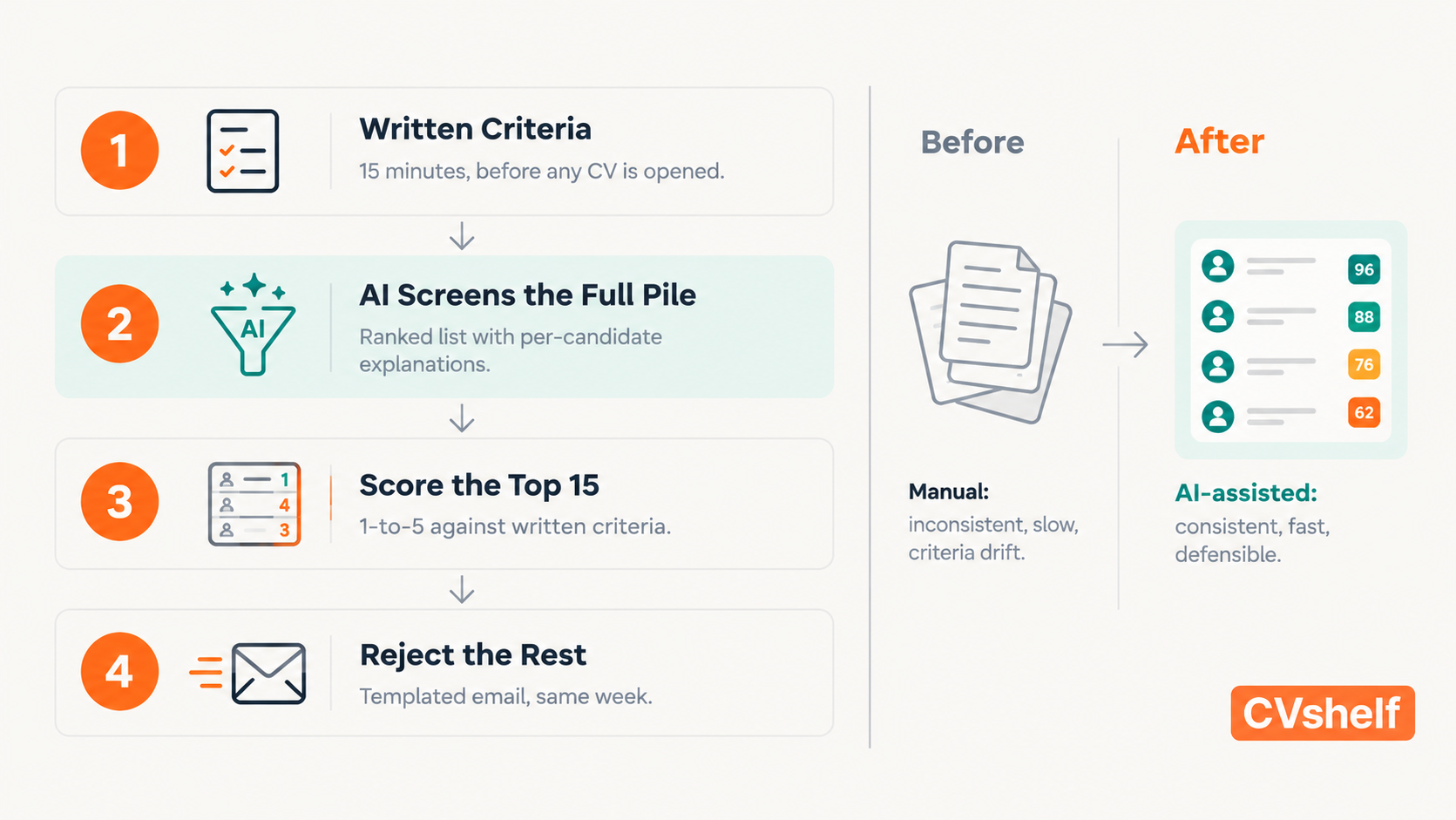
1. Written criteria before you open any applications. Three to five non-negotiables, defined before the first CV is read. Agency or studio-side experience, required or not. A specific channel or skill set if it's a genuine dealbreaker. Minimum years in a directly relevant role. Takes 15 minutes. Prevents the criteria drift that makes shortlists inconsistent.
2. AI screening to rank the full batch. Once criteria are written, run the whole pile through a screening tool rather than reading manually. CVShelf takes a job description, processes a bulk upload of resumes, PDFs, Word files, a zip of everything, and returns a ranked list with a per-candidate explanation. Each note covers what the AI found relevant, what it flagged as missing, and why the ranking landed where it did. You review the top ten to fifteen. The tool handled the mechanical read-through against consistent criteria. Your attention goes to the candidates who actually deserve it.
The explanation layer is what makes this workable for someone without a recruitment background. Reading a reasoned note and deciding whether you agree is a different task from interpreting a score or reading 170 CVs from scratch. It's one a studio director or ops manager can do confidently, in a single sitting, without specialist training.
3. A scoring pass on the top candidates. After reviewing the AI's top ten to fifteen, score each one against your written criteria on a simple 1-to-5 scale. Takes 30 minutes. Produces a shortlist you can defend to a hiring manager or MD without saying "I thought they seemed strong."
4. Templated rejections sent the same week. Everyone outside the shortlist gets a response. A two-sentence template takes ten minutes to write and sends in a batch. Candidates who applied to your agency are part of your professional network. Leaving them in silence for three weeks costs you employer brand with people who work in your industry.
The Most Common Mistake
Buying a full ATS.
For an agency doing eight to twelve hires per year with no dedicated recruiter, a full ATS generates overhead that cancels out what it saves. Configuration takes days. Adoption requires getting multiple people with different schedules into a new workflow. The features you'd actually use, posting a job, collecting applications, screening them, represent a fraction of what you're paying for.
The pattern is reliable: tool bought, partially configured, used twice, abandoned. The agency goes back to the inbox but now has a subscription sitting on the books.
Start with the problem. The problem is that screening a large application pile manually is slow, inconsistent, and doesn't produce good shortlists. A lightweight AI screening tool fixes that specific problem without the infrastructure investment of a full ATS. Add pipeline management tools only when coordination across the hiring team, not screening itself, becomes the actual bottleneck.
FAQ
Q1. Is there a candidate screening tool that doesn't need an ATS to work?
Yes. CVShelf runs as a standalone tool: paste in the job description, upload the resumes, get a ranked shortlist with explanations. No ATS required, no integrations, no configuration process. It works in under ten minutes for a first role and doesn't require a recruiter background to use effectively.
Q2. What's the difference between AI screening and keyword matching?
Keyword matching counts how often words from the job description appear in a resume and scores candidates based on frequency. AI screening reads the resume for meaning, whether the experience maps to what the role actually requires, at what level, and in what context. A candidate who writes "led a 10-person client services team for three years" may not contain every keyword but should rank higher than one who lists every term in the JD without evidence behind any of them. AI screening catches the first candidate. Keyword matching often misses them.
Q3. How many candidates should I screen before building a shortlist?
Screen the full pile, not a sample. The strongest candidate in a 200-application batch is as likely to be at position 140 as position 10. Manual screening produces a shortlist based on reading order. AI screening produces a shortlist based on criteria. The difference in shortlist quality, and therefore in hire quality, is significant. Running the full batch through CVShelf takes the same amount of time regardless of pile size. The ten minutes of setup doesn't change whether you have 50 or 250 applications.
Candidate screening at an agency doesn't need enterprise tools. It needs written criteria, a tool that applies them consistently, and one person with 45 minutes to review the output.
CVShelf handles the middle step. Try it complimentary at cvshelf.com.
Keep Reading
More from AI Resume Screening.
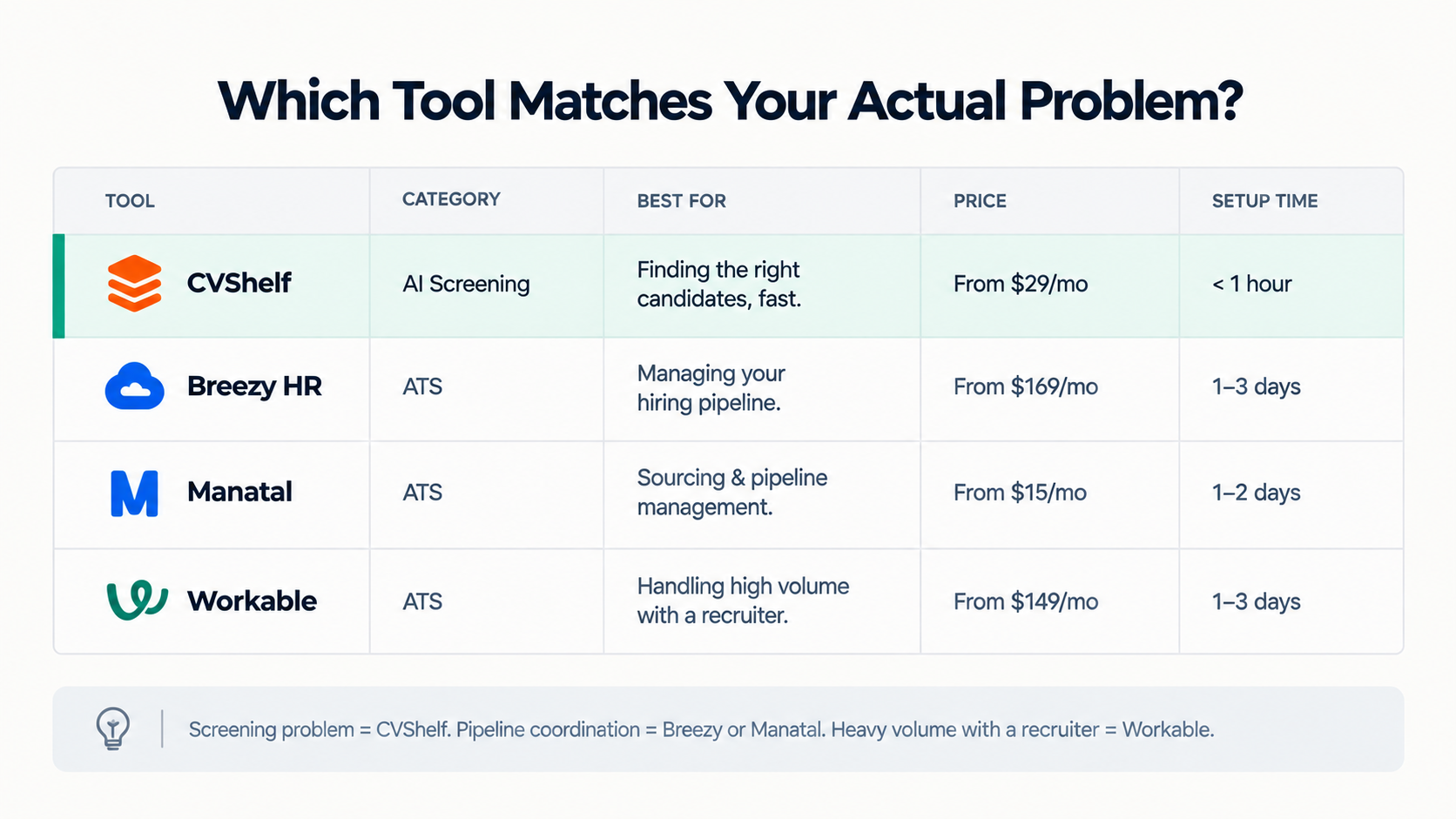
Best ATS For Small Marketing Agency
This post is for founders and MDs at 10 to 100 person marketing or creative agencies.
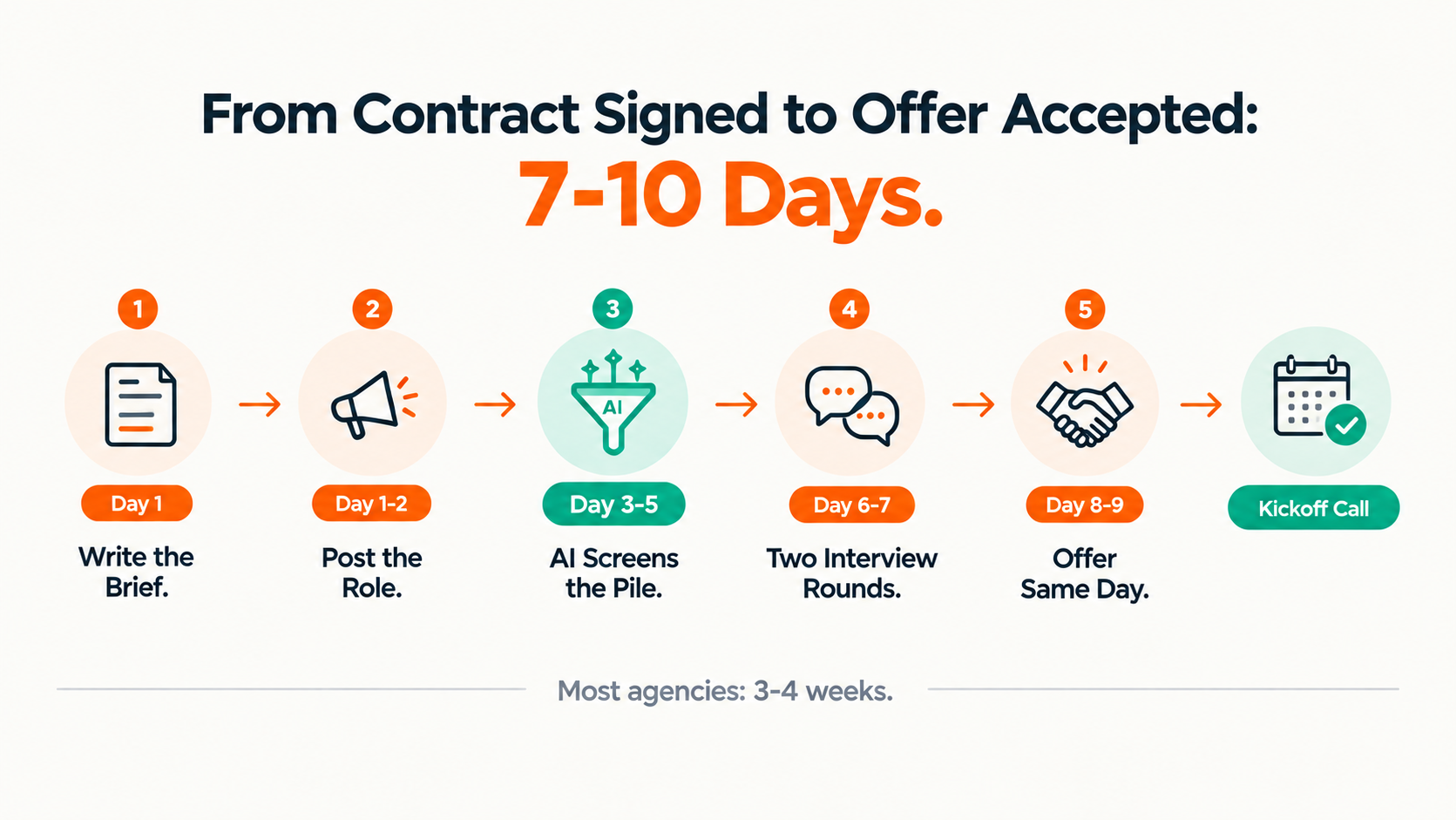
Is AI Resume Screening Legal In The UK?
AI resume screening is legal in the UK.
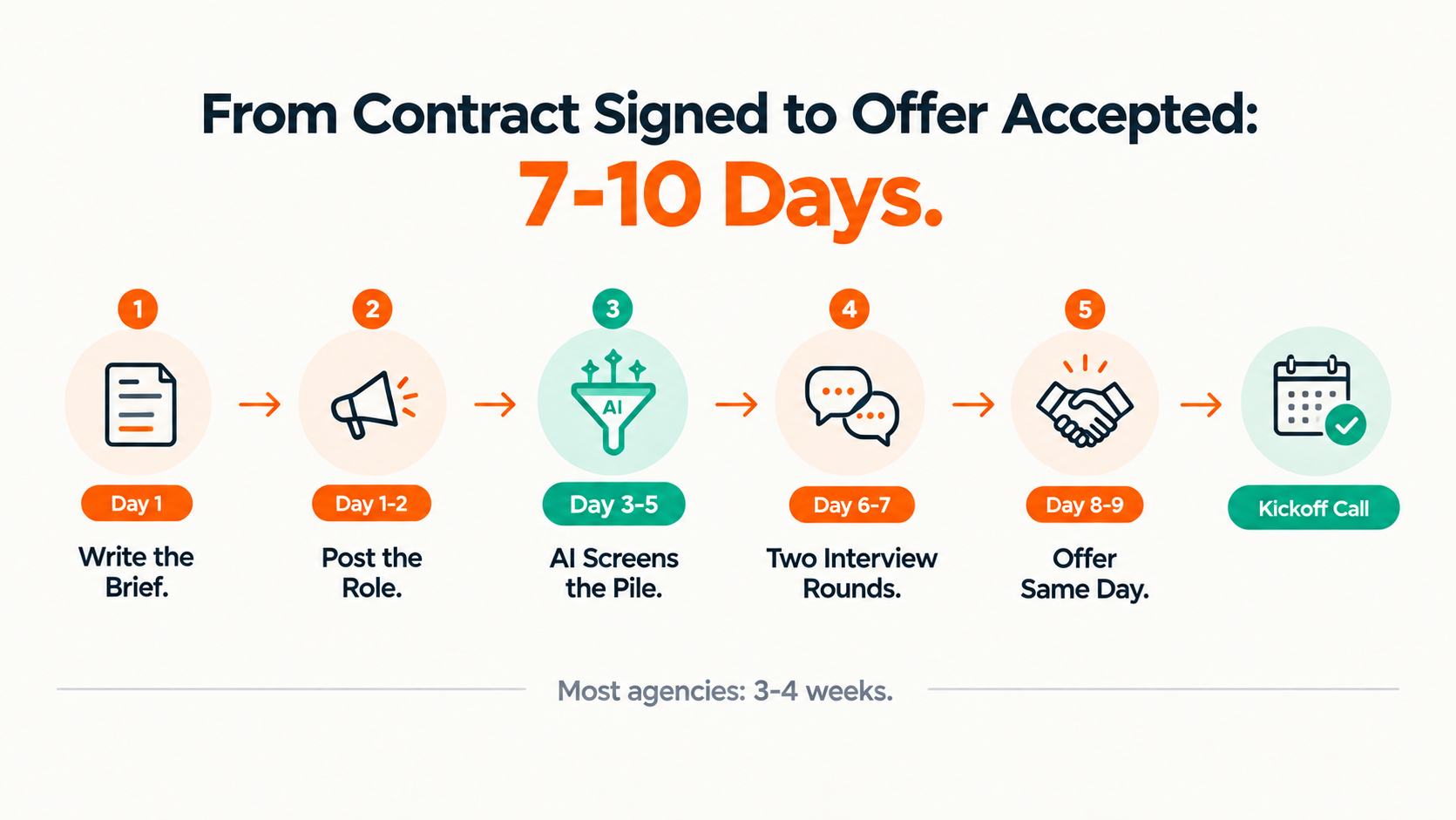
How To Hire An Account Manager Quickly
Account manager is the role agencies hire most urgently, usually right after a client win and usually without enough time to do it properly.