
Resume Screening Software USA
This post is for founders and MDs at 10 to 100-person US agencies, digital marketing, creative, or integrated.
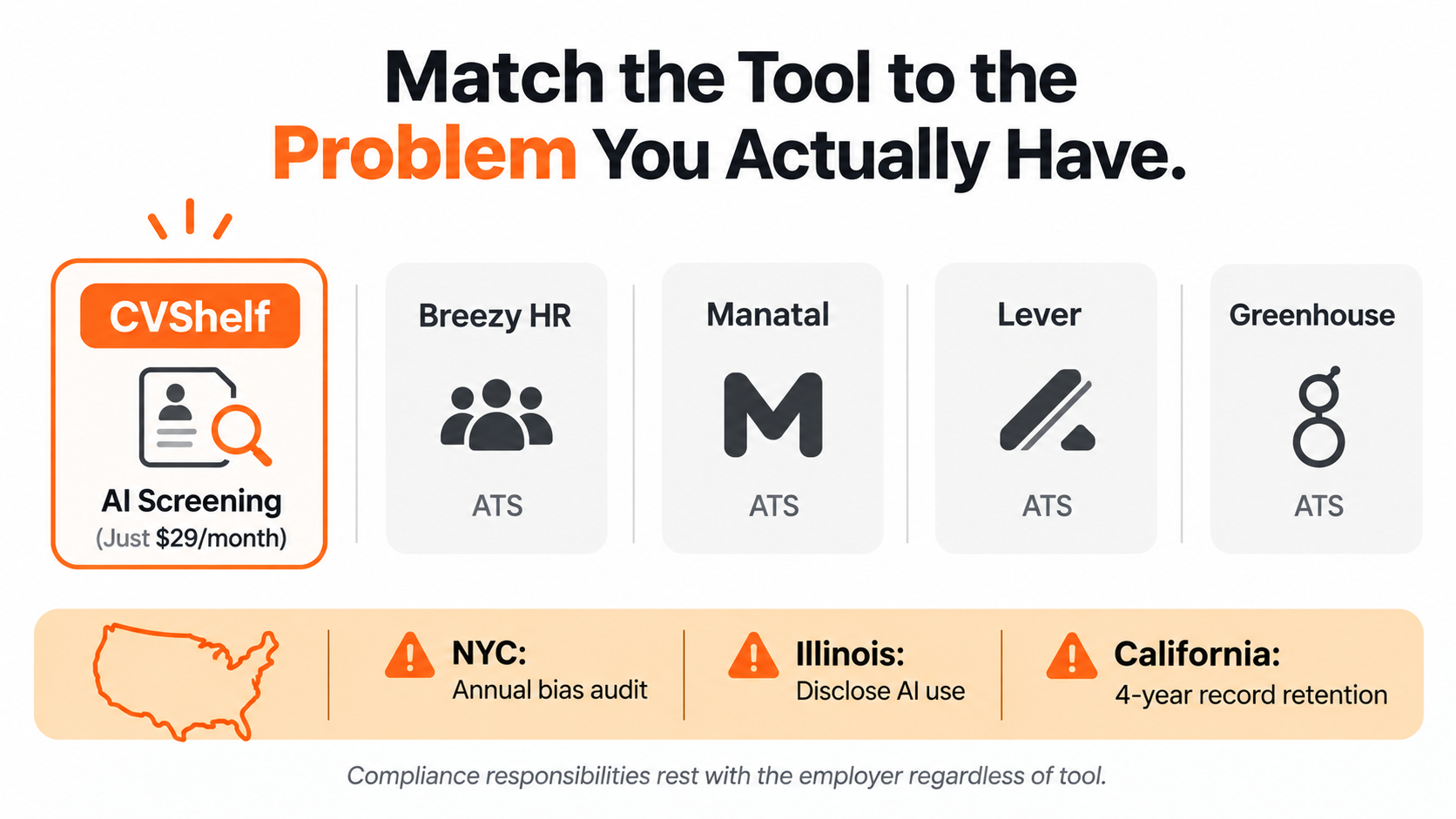
If you run a small US agency and you're looking at resume screening software, this post is for you.
You're not a corporate with a TA team. Hiring happens four to ten times a year, usually when a client account expands or someone resigns at a bad time. The person processing the applications is you, a COO, or an ops manager, not a specialist with a screening methodology. And US-based hiring has its own compliance layer to keep in mind: state-level AI hiring disclosure laws in Illinois and New York City, plus California's FEHA amendments effective October 2025.
What follows is a direct comparison. Where the alternatives are the better call, I'll say so.
Where the Alternatives Win
iCIMS is built for enterprise, large teams, high volumes, full ATS infrastructure. If your agency has grown to the point where you have a dedicated talent function and need serious compliance reporting, candidate sourcing integrations, and analytics, iCIMS is a mature platform. For a 50-person agency doing eight hires a year, it's overkill by a wide margin. Setup takes months and the pricing reflects a different buyer entirely.
Workable is the most commonly recommended mid-market option for US companies. The Standard plan runs $299/month and includes job posting to major boards, ATS pipeline management, and reporting. It's worth considering when two or more people are coordinating hiring decisions and you need shared pipeline visibility. For a solo decision-maker processing inbound applications four times a year, the feature set exceeds the problem.
Greenhouse sits in a similar bracket to Workable, structured hiring workflows, interview kits, compliance tooling, multi-user coordination. Purpose-built for teams with a dedicated recruiter. Not the right fit for a 30-person agency where the ops manager handles hiring alongside three other responsibilities.
Manatal is the most cost-effective option if you want ATS features plus proactive sourcing, pulling candidates from LinkedIn and aggregating job board applications into a single view. At $15/user/month, it's well-priced for teams that need both inbound processing and outbound sourcing. If your roles generate thin inbound volume and you're actively hunting for candidates, Manatal is worth evaluating seriously. CVShelf doesn't do sourcing.
US compliance note: Before deploying any AI resume screening tool for US hires, confirm the vendor's compliance documentation. If you hire in New York City, NYC Local Law 144 requires an annual independent bias audit and advance candidate notice before the tool is used. If you hire in Illinois, disclosure to applicants is required under HB 3773 (effective January 1, 2026). California's FEHA amendments require four-year record retention and anti-discrimination safeguards for AI-assisted hiring. These obligations fall on you as the employer regardless of which tool you use.
Where CVShelf Is the Better Fit
CVShelf solves one problem precisely: a large inbound application pile, processed quickly and consistently, by someone without a recruiting background.
Post on LinkedIn. 150 applications arrive. The COO has two client calls and a board deck due. CVShelf takes the job description, reads every application against it, and returns a ranked list with a per-candidate explanation, what the AI found relevant, what it flagged as missing, why the ranking landed where it did.
That explanation layer is what makes it usable without HR expertise. You're not interpreting a score. You're reading a reasoned recommendation and deciding whether you agree. A founder or ops manager works through the top fifteen candidates in under an hour and produces a shortlist they can defend.
Pricing: $29/month, flat rate. No per-seat pricing, no implementation fee, no sales call before you can start. Setup for a first role takes under ten minutes.
The right use case: US agency, 4-12 hires per year, strong inbound LinkedIn volume, one or two people running the process without a dedicated recruiter.
For agencies that want to understand how resume screening fits into a complete hiring workflow, the guide to candidate ranking tools built for agency hiring covers how to evaluate the options and what to look for.
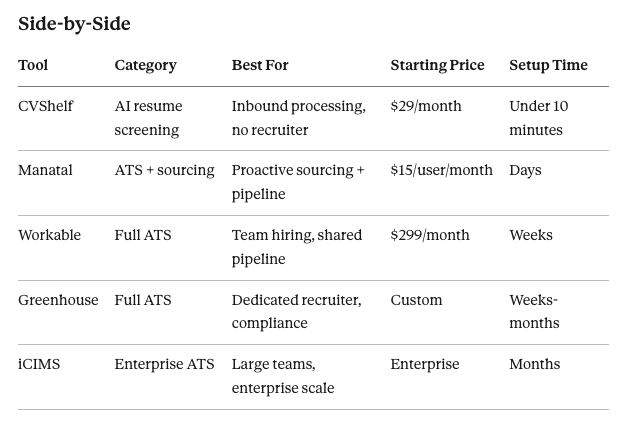
The pattern is clear: more features, more cost, more setup. CVShelf does less than all of them. It also starts in ten minutes, costs $29/month, and solves the specific problem most small US agencies actually have.
FAQ
Q1. What resume screening software works for a small US agency without HR?
CVShelf for inbound screening, paste in the job description, upload the pile, get a ranked shortlist with explanations. Manatal if proactive sourcing is also part of the problem. Workable or Greenhouse when you need team-based pipeline coordination and have a dedicated recruiter. Most small agencies need the first option and tend to overbuy the others.
Q2. Is resume screening software compliant with US hiring laws?
The tool itself must meet the compliance requirements of each jurisdiction you hire in. NYC Local Law 144 requires annual bias audits and candidate notice. Illinois HB 3773 requires disclosure to applicants. California FEHA requires four-year record retention and anti-discrimination safeguards. Compliance responsibilities sit with the employer regardless of which software is used, confirm any tool's compliance documentation before deploying.
Q3. How much does resume screening software cost for a small business?
CVShelf starts at $29/month with no per-seat pricing. Manatal starts at $15/user/month. Workable Standard is $299/month. Greenhouse and iCIMS are enterprise-priced. For a small US agency doing fewer than 15 hires per year, the $29/month tier covers the actual problem without the overhead of a full ATS.
Match the tool to the problem you actually have. CVShelf for inbound screening. Something more comprehensive when sourcing and team coordination are the bottlenecks.
Try CVShelf complimentary at cvshelf.com.
Keep Reading
More from AI Resume Screening.
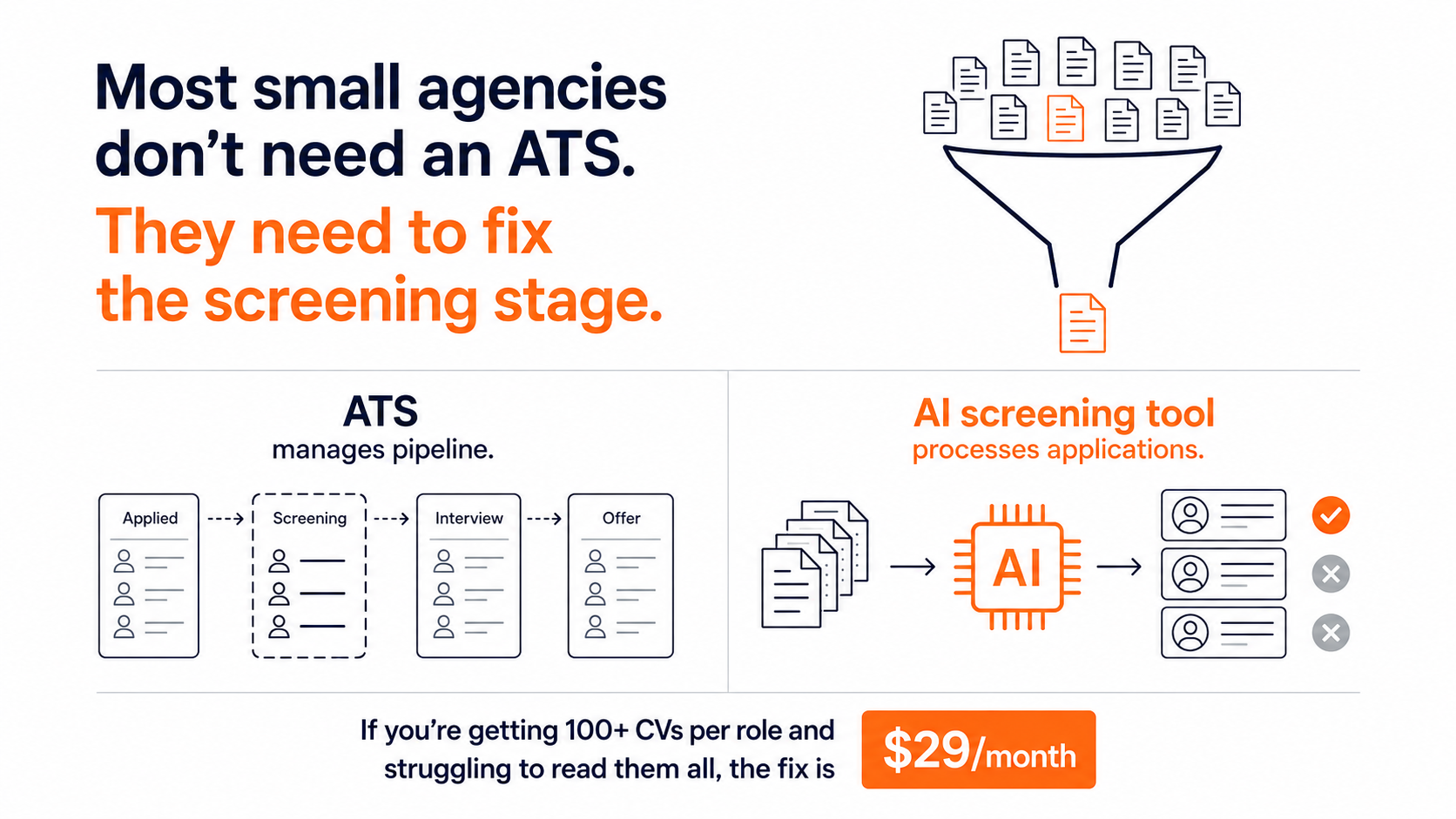
Screening Candidates Without An ATS
Screening candidates without an ATS is normal for agencies doing fewer than 15 to 20 hires per year.
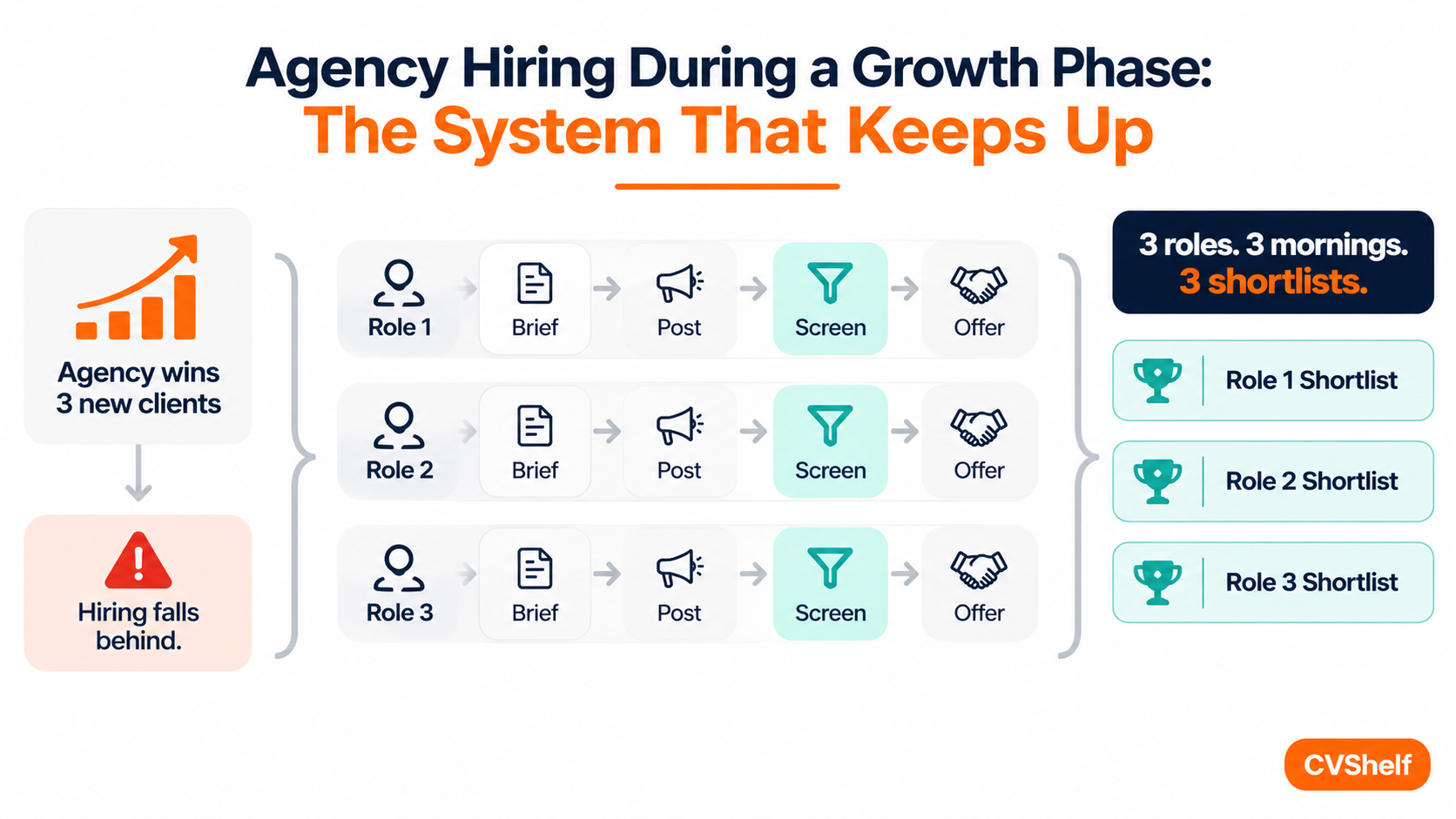
Agency Growing Pains Hiring
The hiring problems that hit a growing agency aren't random.
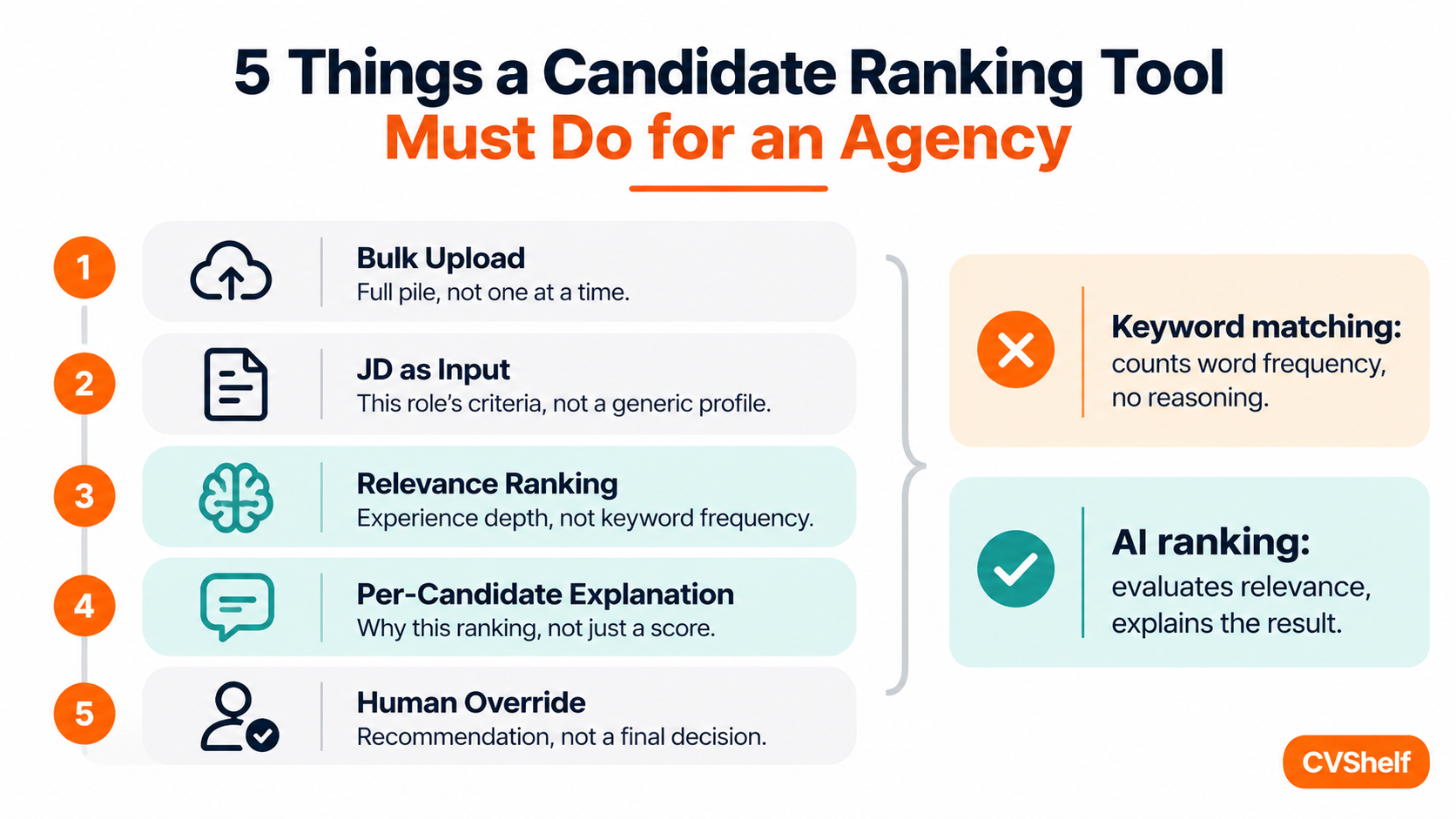
Candidate Ranking Tool For Agencies
A candidate ranking tool for agencies needs to do something most ATS screening features don't.