
How to Reduce Time to Hire at Your Marketing Agency
The average marketing agency takes three to four weeks to make a hire. The best candidates accept offers in week two.
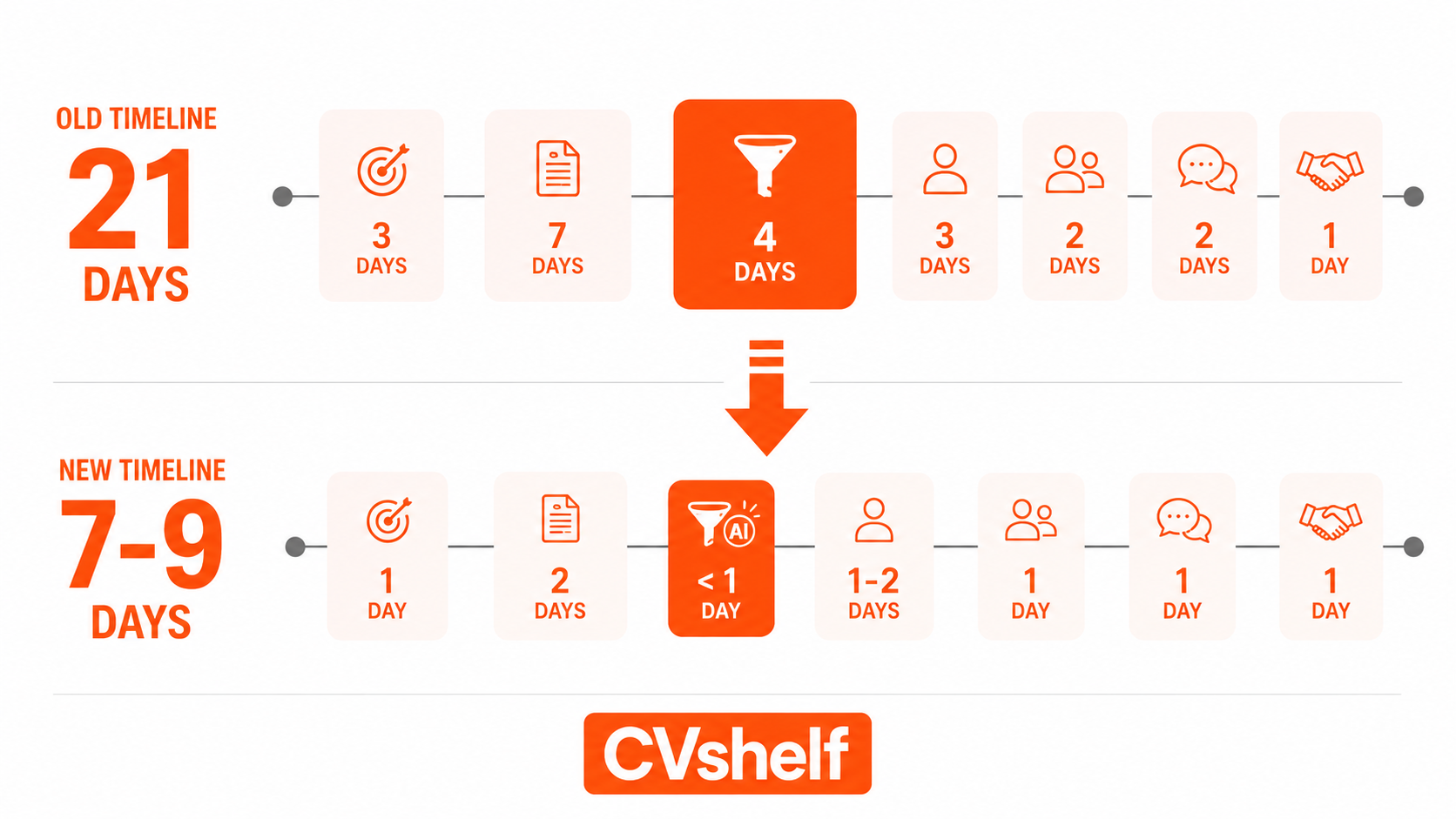
The Best Candidates Are Gone by Week Two
Most marketing agencies run a three to four week hiring process. Post the job, collect applications for a week, screen for a week, interview over another week, deliberate, make the offer.
The problem: strong account managers, strategists, and project managers at mid-level are typically in two or three processes simultaneously. They accept offers on the timeline of the fastest mover, not the most thorough one.
By the time your agency gets to the offer stage at day 21, your first-choice candidate has already signed with someone else. You're offering to whoever is still in your process. That's a different pool.
This is not about lowering standards to hire faster. It's about removing the delays that add no quality to the decision. A three-week hiring process is almost never three weeks of useful evaluation. It's two or three days of actual decision-making stretched across three weeks by slow screening, delayed feedback, and unnecessary interview rounds.
Here's how to fix it.
Why Agency Hiring Takes So Long
Before the fixes, it's worth naming the actual causes. Most agency hiring slowness comes from four sources.
No dedicated recruiter. The person handling hiring is also handling client work, ops, and three other things. Screening happens in the gaps. Gaps are not predictable. A 200-resume pile can sit untouched for four days because two client emergencies happened in between.
Scattered screening. Resumes arrive in email, get forwarded to different people, generate separate opinions that never get reconciled into a clear shortlist. Everyone has a view. Nobody has a system.
Too many decision-makers. At an agency, hiring often involves the founder, the account lead, and sometimes a department head. Getting three people aligned on a candidate requires three schedules to sync. Every sync adds days.
Slow feedback loops. After first interviews, feedback gets shared informally, is incomplete, or waits for a meeting that's already overbooked. Without a structured feedback process and a deadline, second-round decisions drift.
None of these problems require a new hire to fix. They require a tighter process.
What Slow Hiring Actually Costs
Lost candidates is the visible cost. The ones you don't see are more expensive.
Extended vacancies. Every week a role is open is a week your existing team absorbs the work. Senior account managers get stretched. Project coordinators handle more than they should. Quality drops at the margins, exactly where clients notice first.
Client delivery risk. If the hire was triggered by new business or an expanding account, a three-week process means three weeks of under-staffing on a client who expected a full team. That is a retention risk.
Repeat costs. A candidate who withdraws because your process was too slow forces you to restart. That's not just time lost. It's the sourcing cost, the screening time, and the interview hours spent on someone you didn't hire, plus the same again on round two.
The arithmetic is straightforward: a one-week hire produces better candidates, lower team strain, and lower total recruiting cost than a three-week hire. Speed is not a trade-off against quality. It is a quality indicator.
6 Ways to Cut Time-to-Hire at Your Agency
1. Pre-Define the Role Before You Post
Every hire that starts with "let's figure out exactly what we need" loses a week before the job is even posted. Define the role the moment you know you're hiring. What does success look like at 90 days? What are the three non-negotiables? What's the salary range?
Document this in a single page. Share it with everyone who will be involved in the hire before the job goes live. The alignment conversation happens before applications arrive, not after.
2. Screen at Volume With AI
This is the single biggest time sink in agency hiring and the most automatable. A 200-resume pile manually screened takes a recruiter two to three days. For a founder or ops manager doing it alongside client work, it stretches to a week.
AI screening tools process the full pile against your job criteria, rank candidates by relevance, and return a shortlist with explanations. The screening stage that ate a week becomes a 45-minute task: 10 minutes to upload and configure, 30 to 45 minutes to review the top-ranked candidates.
3. Cut Interview Rounds From 4 to 2
Most agency roles do not require four interview rounds. A 30-minute first call to assess basics and culture fit, and a 60-minute second conversation with a practical element or a deeper role discussion. That's enough for an account manager, strategist, or project lead.
Every additional round adds a week to the process and tests scheduling coordination, not candidate quality. Reduce rounds aggressively. If you need a fourth conversation to feel confident, the first three weren't structured well enough.
4. Set a 48-Hour Feedback Rule
After every interview, feedback from every interviewer is due within 48 hours. Not at the next convenient meeting. Within 48 hours.
This sounds obvious. It almost never happens without being made explicit. Set the expectation before interviews start. Share a simple scoring form with two or three questions rather than asking for free-form notes. Structured feedback takes less time to produce and less time to reconcile.
5. Use Async Video for First Rounds
First-round calls are predominantly logistical: does this person meet the basic criteria, can they communicate clearly, do they understand the role? All of that can be assessed from a 5 to 10-minute async video response to three standard questions.
Tools like Loom or dedicated async interview platforms let candidates record responses at their own convenience. You review them in a block. No scheduling. No calendar coordination. The first round that usually takes two weeks to schedule and run takes two to three days.
6. Make the Offer on the Day of the Final Interview
Not the day after. Not after a team discussion that takes three days to schedule. The day of.
If you're confident enough to run a final interview, you're confident enough to make a verbal offer when it goes well. Have the salary, start date, and key terms agreed internally before the final interview happens. When the conversation ends well, make the call.
Every day between final interview and offer is a day the candidate is talking to someone else.
How CVShelf Collapses the Screening Stage
Screening is the stage with the most lost time and the clearest fix.
CVShelf takes your job description and your full application pile, processes every resume against the criteria, and returns a ranked shortlist with a per-candidate explanation in minutes. For a 200-resume pile, the screening work that previously took a week of scattered attention becomes a single 45-minute session.
The explanation layer matters for agency operators specifically. You're not an HR professional with years of screening instinct. Seeing why the AI ranked someone in the top 10, what experience it found, what it flagged as missing, lets you apply your judgment to the right layer of the decision rather than spending your judgment on reading the full pile.
No ATS required. No setup process. Paste your job description, upload your resumes, get your shortlist. CVShelf starts at $29 per month.
From 21 Days to 7 Days: What It Looks Like
StageOld TimelineNew TimelineRole definition and job postDays 1 to 3Day 1Application collectionDays 4 to 10Days 2 to 5Screening and shortlistDays 11 to 14Day 6 (45 min with CVShelf)First round interviews (async)Days 15 to 17Days 6 to 7Second round interviewsDays 18 to 19Day 7 to 8OfferDay 21+Day 8 to 9
The changes are not about cutting evaluation quality. They're about removing the gaps between stages. Screening happens in one session. First rounds run async without scheduling overhead. Feedback is due within 48 hours. The offer happens on the day.
None of these changes require more people, more budget, or a recruiter. They require a tighter process and one tool.
Try CVShelf free at cvshelf.com. Reduce your time-to-hire starting today.
FAQs
Q1. What is a good time-to-hire for a marketing agency?
For mid-level roles like account manager, strategist, or project lead, a 7 to 14-day time-to-hire is achievable and competitive. Industry benchmarks for marketing roles broadly sit around 25 to 30 days, which means most agencies are running slower than they need to. The gap between 25 days and 10 days is almost entirely in the screening and feedback stages, not in the evaluation quality.
Q2. Why do good candidates drop out of agency hiring processes?
Mostly speed. Strong mid-level marketing professionals are typically in more than one process at once and will accept the best offer that arrives first. A process that takes three weeks to reach an offer stage will lose candidates to faster-moving companies even if the role and salary are comparable. Response time between stages, not just total time-to-hire, also matters. Candidates who hear nothing for a week after a first interview withdraw or mentally move on.
Q3. How many interview rounds should a marketing agency use?
Two rounds for most mid-level hires: a 30-minute screening call and a 60-minute second conversation with a practical element. Three rounds are justified for senior hires or roles with significant responsibility. Four or more rounds for any role under director level signals a broken decision-making process, not a thorough one.
Q4. How do you speed up the screening stage without missing good candidates?
AI screening tools evaluate every application against your job criteria consistently, producing a ranked shortlist with explanations. The key is not that the AI is faster than a human (though it is). It's that it applies the same criteria with the same attention to every candidate, eliminating the quality degradation that happens when humans screen 200 resumes in scattered blocks over five days.
Q5. Does hiring faster mean making worse decisions?
Not if the quality of evaluation stays consistent. The three-week agency hiring process is not three weeks of better evaluation. It's two to three days of evaluation spread across three weeks because of screening delays, scheduling gaps, and slow feedback. Compressing those gaps produces the same decision in less time. The risk of a bad hire comes from poor criteria and poor evaluation, not from evaluating quickly once those are in place.
Q6. What is the fastest way to make an offer after a final interview?
Agree on salary range, start date, and key terms internally before the final interview takes place. If the final conversation goes well, make the verbal offer in the closing minutes of the call. Send the written offer the same day. Do not introduce a deliberation period that adds no new information to a decision you've already made.
Keep Reading
More from AI Resume Screening.
Best ATS For Small Marketing Agency
This post is for founders and MDs at 10 to 100 person marketing or creative agencies.
Is AI Resume Screening Legal In The UK?
AI resume screening is legal in the UK.
How To Hire An Account Manager Quickly
Account manager is the role agencies hire most urgently, usually right after a client win and usually without enough time to do it properly.