
Manatal Alternative For Small Agency
This post is for founders and MDs at 10 to 100-person marketing or creative agencies who are considering Manatal, or trying to decide whether Manatal is the right fit at all.
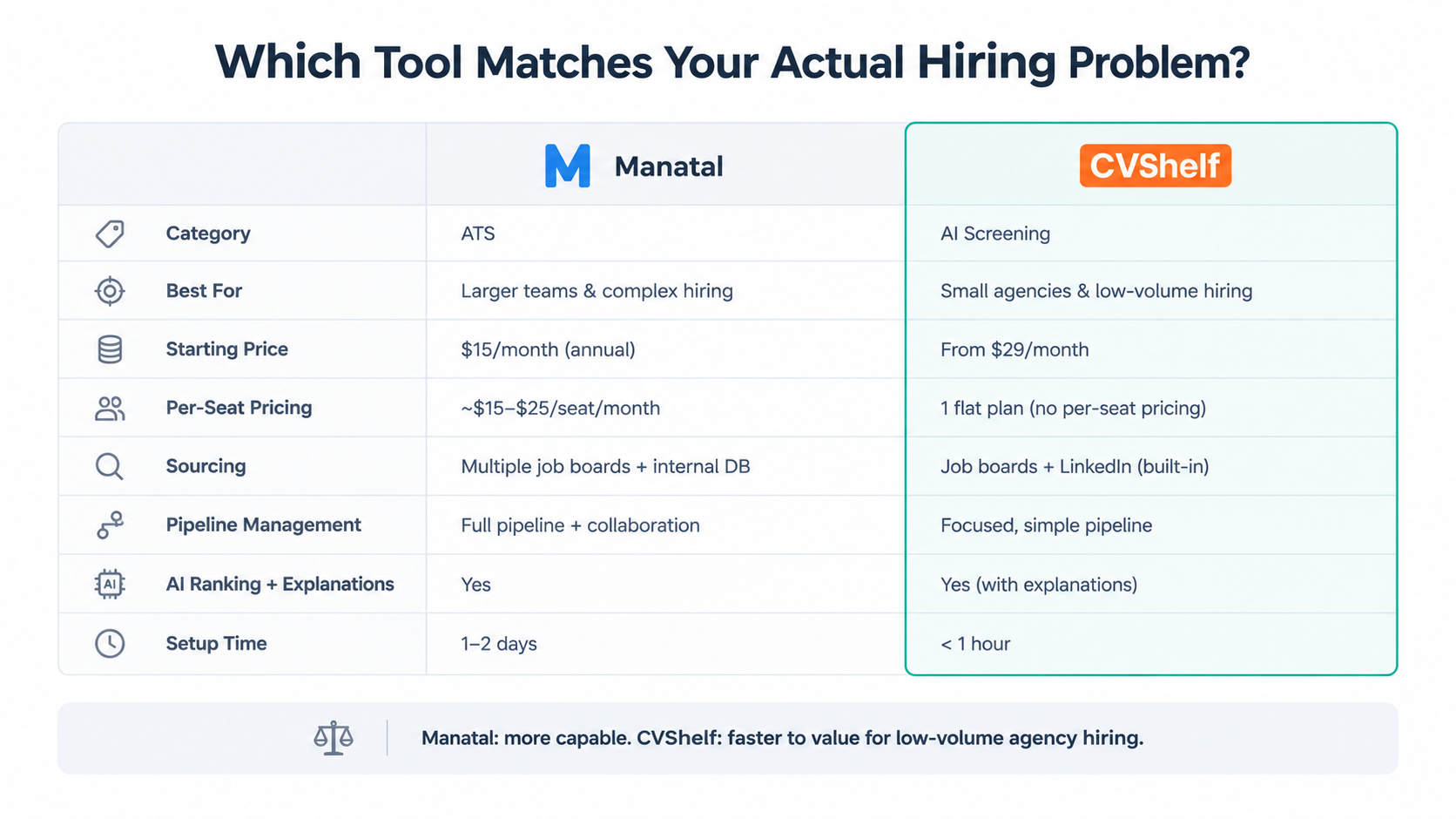
If you run a 10 to 100-person agency and you're searching for a Manatal alternative, you're probably in one of two situations. Either you looked at Manatal's pricing, realised the per-user cost adds up faster than expected for a team where three or four people might need access, and you're wondering what else is out there. Or you tried Manatal, found it has more features than you'll use, and want something lighter.
Both are legitimate reasons to look for an alternative. Here's an honest take on what the options actually cover.
Where Manatal Is Still the Right Tool
Manatal earns its place for agencies that do more than just inbound screening.
Its sourcing capabilities are the standout feature at this price point. Manatal aggregates candidates from LinkedIn and over 2,500 job board sources into a single pipeline, with AI-powered candidate recommendations on top. If you're actively sourcing candidates, not just waiting for inbound applications, and you want that sourcing and pipeline management in one tool, Manatal is one of the better-priced options that includes both.
It also handles the full pipeline: job posting, candidate tracking across stages, team collaboration, automated emails, and reporting. For an agency doing more than 15 to 20 hires per year, or one where two or three people need visibility into a shared candidate pipeline at the same time, Manatal's structure is genuinely useful.
The Professional plan starts at $15 per user per month on annual billing. For a solo recruiter or a two-person hiring team, that's manageable. For a five-person team all needing access, you're at $75 to $175 per month before you've added any extra features. Worth doing the actual per-seat calculation for your setup before comparing it against flat-rate tools.
Manatal makes sense if sourcing is a real constraint, if you coordinate hiring across more than two people, or if you're doing enough hires per year to justify a standing pipeline infrastructure.
Where CVShelf Is the Better Fit
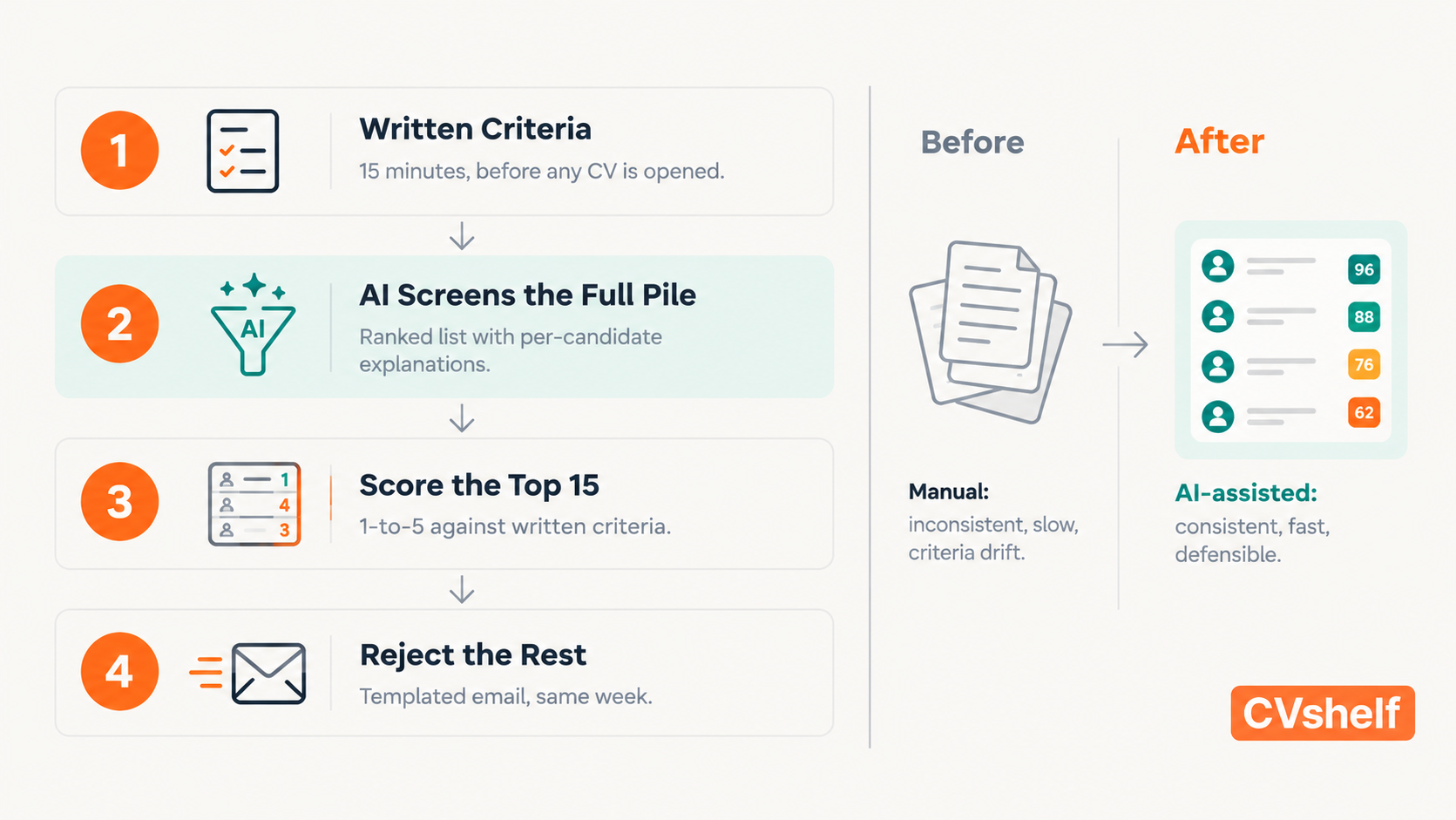
CVShelf doesn't do sourcing, pipeline management, or candidate communications. It does one thing: takes a job description and a bulk upload of resumes, reads every application against the criteria, and returns a ranked list with a per-candidate explanation.
That scope is deliberate. For a 30-person agency doing six to ten hires per year, the bottleneck is almost never sourcing, LinkedIn generates enough inbound volume for most roles. The bottleneck is processing the pile that arrives. A 200-application batch landing on an ops manager who already has a full week is where time gets lost and good candidates get missed.
CVShelf collapses that stage from a week of fragmented reading to one focused morning. The per-candidate explanation is what makes it usable without a recruitment background: you're reviewing a reasoned recommendation, not interpreting a score or reading everything from scratch.
Pricing is $29 per month flat, regardless of how many people at your agency need to use it. No per-seat calculation, no scaling cost as the team grows. Setup takes under ten minutes for a first role. There's no implementation process, no ATS to connect, no training required.
The right use case: an agency doing four to twelve hires per year with no dedicated recruiter, where the main problem is that the inbound screening takes too long and produces inconsistent shortlists. For a broader look at how this fits into an agency hiring process, the guide to candidate screening tools built for agencies covers the full setup.
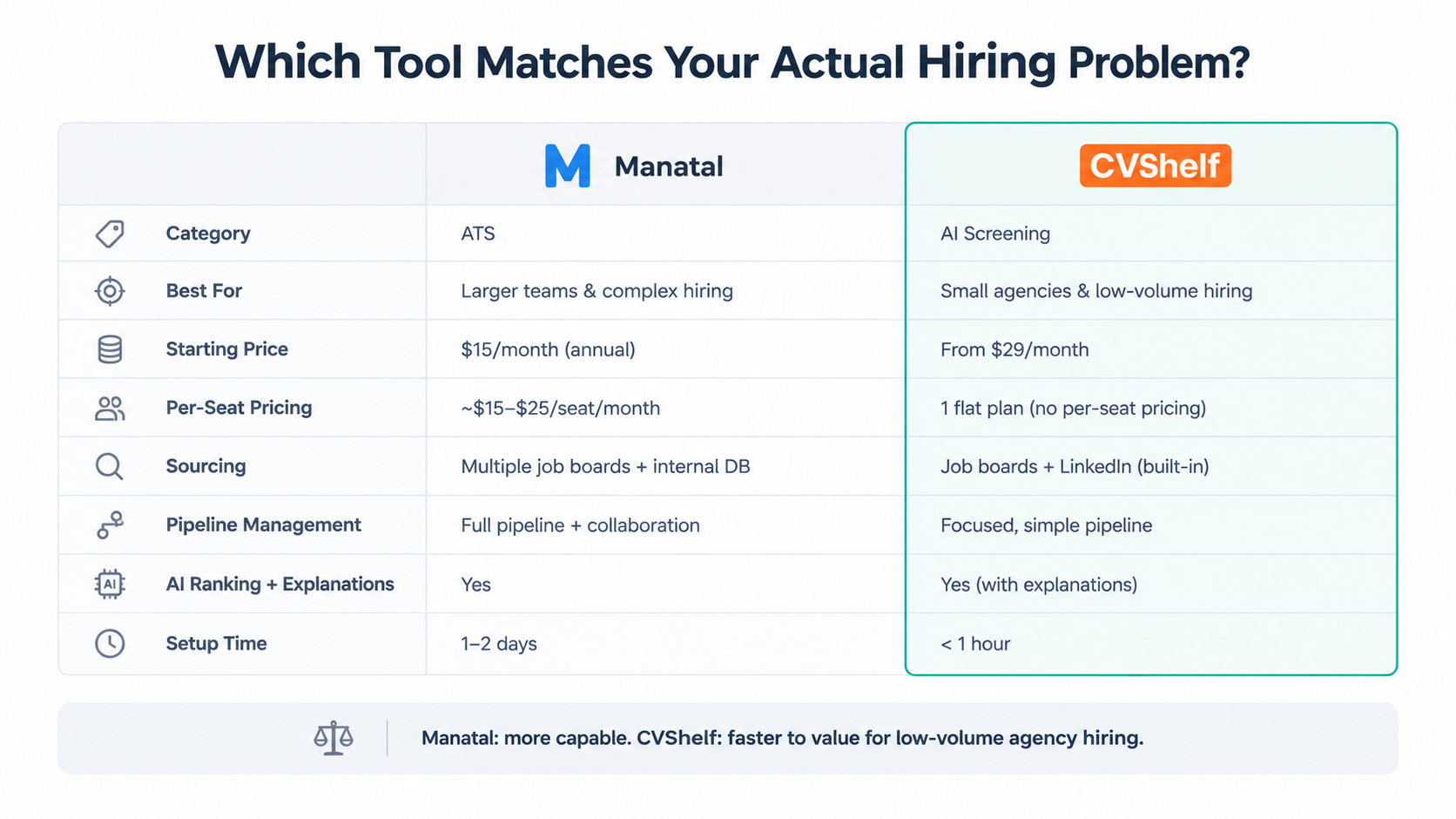
The honest read: Manatal is more capable. CVShelf is faster to value and cheaper for low-volume hiring without a recruiter. They solve different problems.
FAQ
Q1. Is Manatal worth it for a small agency doing fewer than 10 hires a year?
Probably not. Manatal's value comes from sourcing, pipeline management, and team collaboration, features that justify the per-seat cost at higher hiring volumes. For fewer than ten hires annually with one or two people involved in decisions, the overhead of a full ATS (setup, adoption, per-seat billing) tends to outweigh what it saves. An AI screening tool at a flat monthly rate is a better fit for the actual problem.
Q2. What does Manatal charge per user and how does it add up?
Manatal Professional starts at $15 per user per month on annual billing ($19 monthly). For a solo recruiter that's $15 to $19 per month. For a three-person hiring team it's $45 to $57. For five people it's $75 to $95. The per-seat model scales costs with team access rather than hiring volume, which can make it more expensive than expected for agencies where several people occasionally need to view candidates but hiring itself is infrequent.
Q3. Does CVShelf integrate with Manatal?
Not natively. CVShelf produces a ranked shortlist with explanations that you export and work from directly. If you already use Manatal for pipeline management and want to use CVShelf for the initial screening step, you'd move shortlisted candidates from CVShelf into Manatal manually. Some agencies run that combination, CVShelf for screening, Manatal or another ATS for tracking, when the existing pipeline tool doesn't have a strong screening layer.
Pick the tool that matches the problem you actually have. If sourcing and pipeline coordination are the bottlenecks, Manatal is worth evaluating properly. If the bottleneck is processing a large inbound pile without a recruiter, CVShelf is the faster, cheaper answer.
Try CVShelf complimentary at cvshelf.com.
Keep Reading
More from AI Resume Screening.
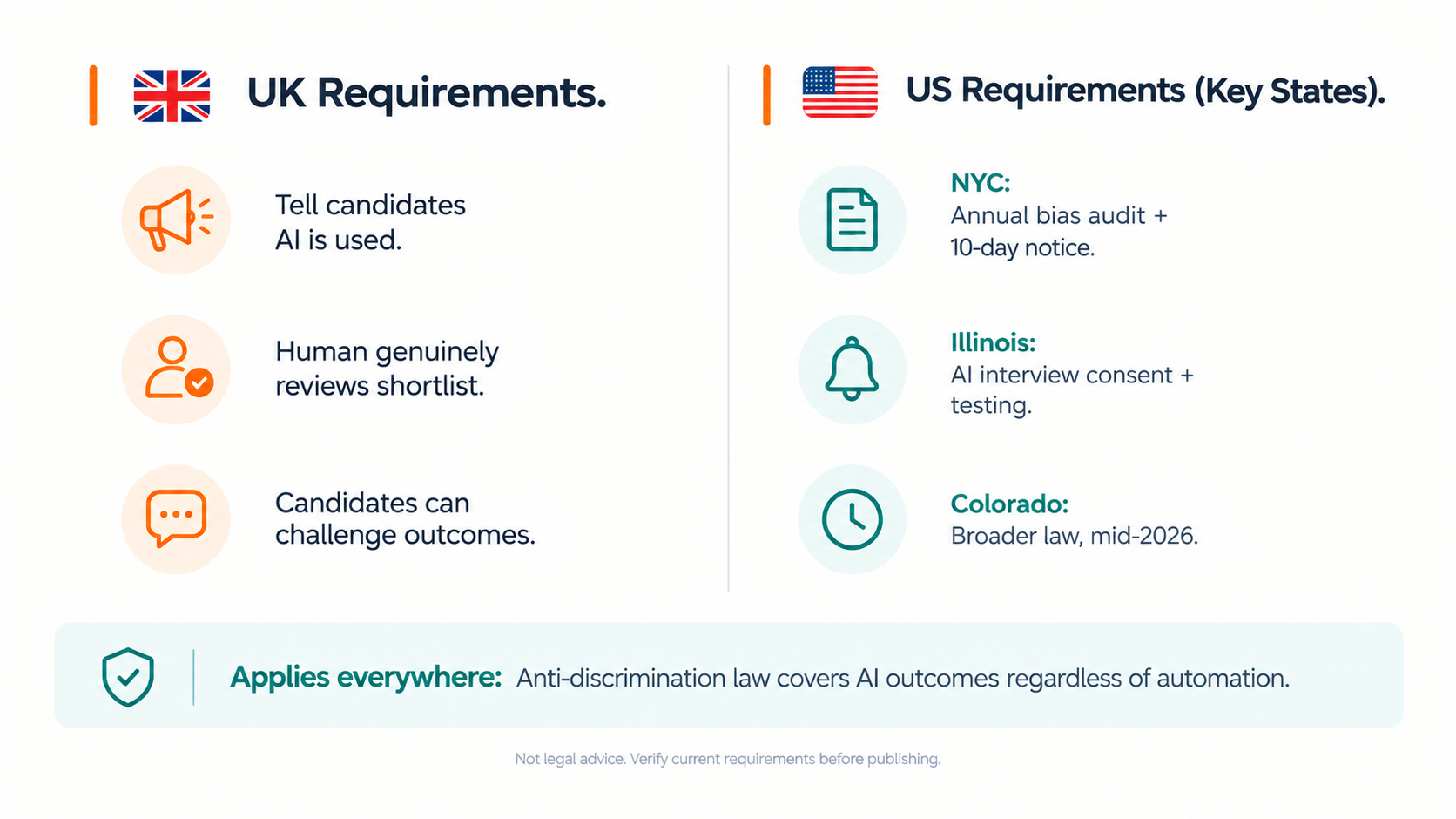
AI Hiring Compliance For Agencies
AI hiring compliance for agencies in 2026 means different things depending on where you're based and where your candidates are.
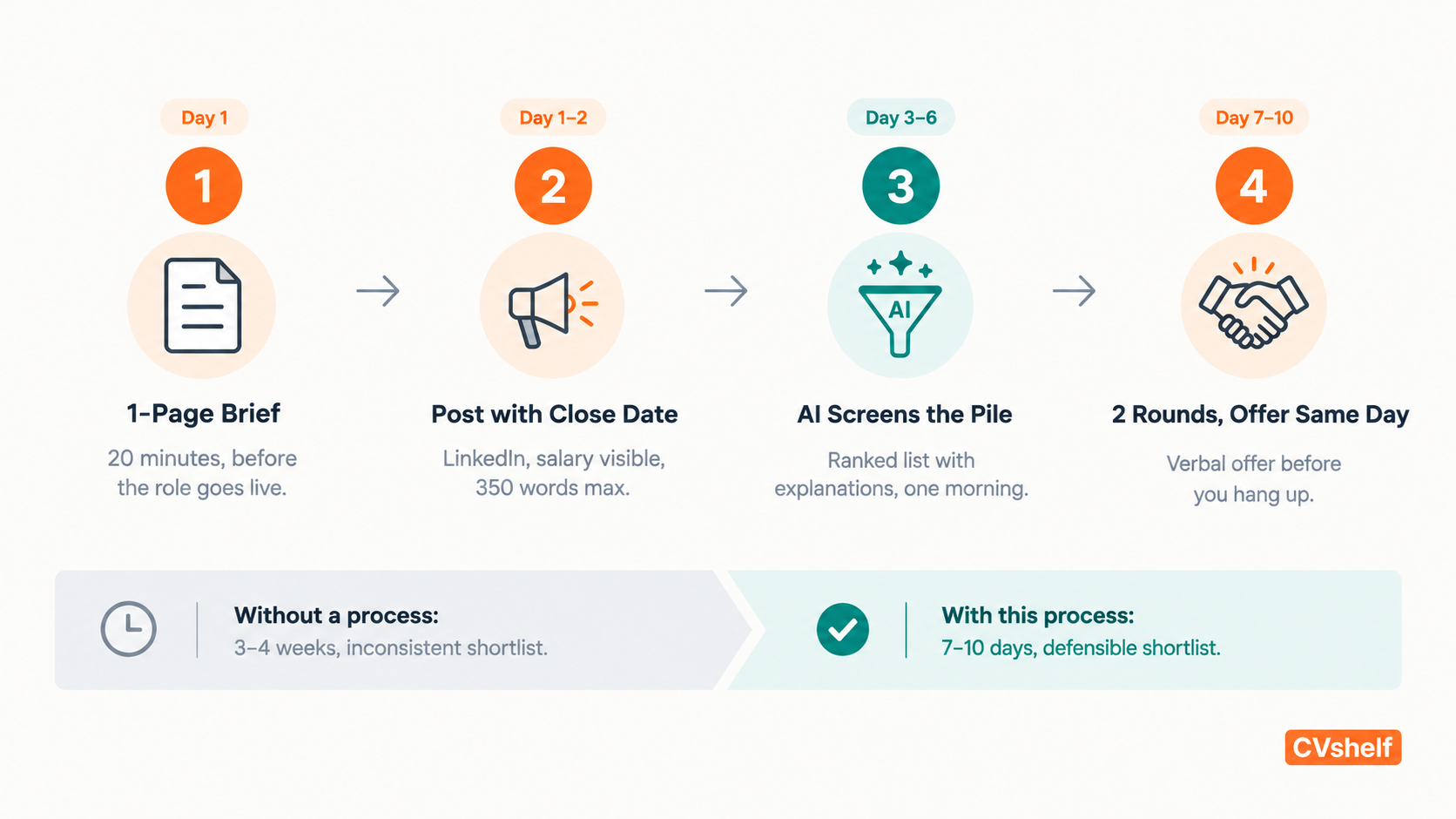
Hiring Without an HR Team: How Agencies Actually Do It
Most agencies under 100 people have no HR team.
Candidate Screening Tool For Agencies
Most candidate screening tools were built for companies with dedicated recruiters and established hiring pipelines.